- Animals
- ›Chordates
- ›Vertebrates
- ›Mammals
- ›Therians
- ›Placental Mammals
- ›Ungulates, Carnivorans, and Allies
- ›Bats
- ›Yangochiroptera
- ›Noctilionoid Bats
- ›Ghost-faced and Moustached Bats
- ›Pteronotus
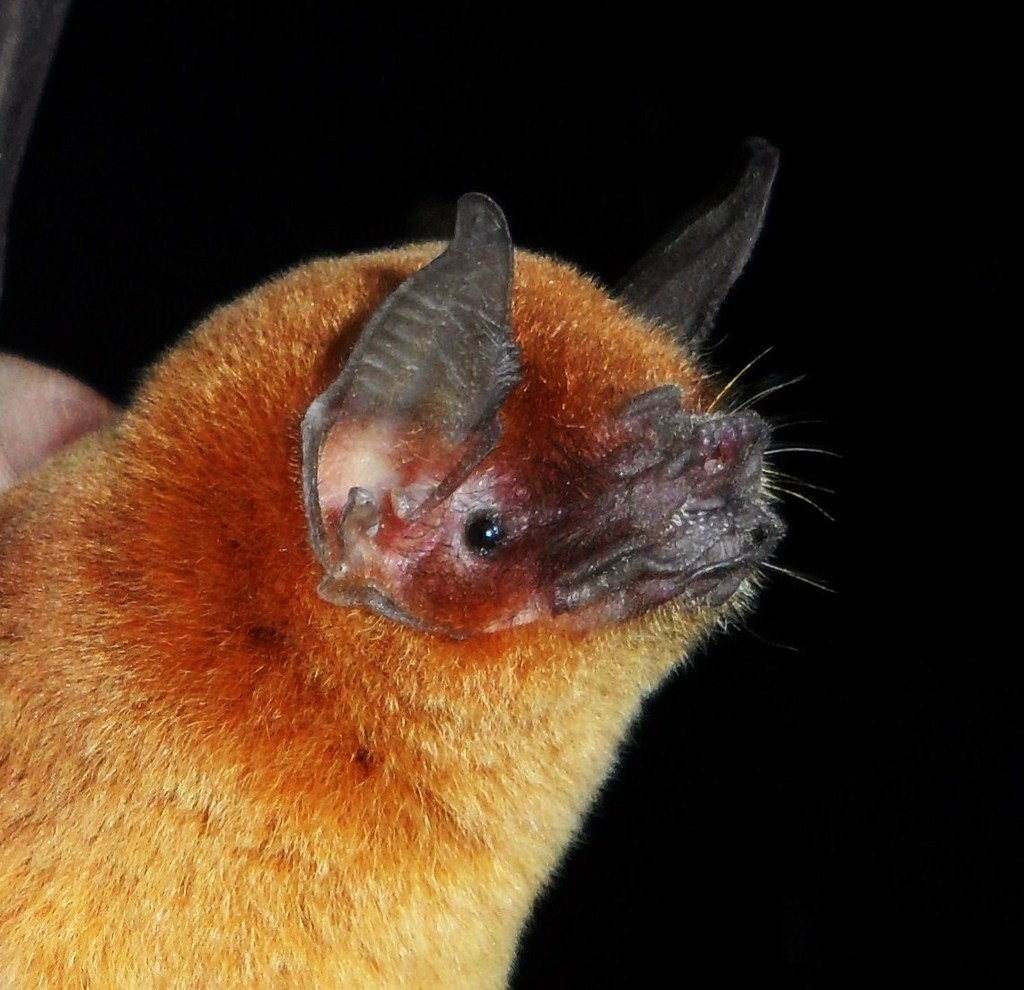
Wagner's Lesser Mustached Bat
Pteronotus personatus
Wagner's mustached bat (Pteronotus personatus) is a bat species from South and Central America. It is one of the few New World bats species known to perform Doppler-shift compensation behavior.
From the article Wagner's mustached bat on Wikipedia (CC BY-SA), quoted section by section
Description
Wagner's mustached bat is a relatively small bat, with a head-body length of 6 to 6.7 centimetres (2.4 to 2.6 in) and a tail 1.5 to 1.8 centimetres (0.59 to 0.71 in) long. There are two color phases, with some individuals having blackish-brown fur over the back and head with drab grey underparts, and others being clay-brown to reddish yellow with buff or cinnamon underparts. Individuals of both color phases can be found together in the same cave. The ears are long and pointed, with sharp serrations along the medial edges and a spatulate tragus including a shelf-like fold. The upper lip has a number of heavy bristles and surrounds the nose, with numerous folds and small projections along its edge. The snout is raised upwards, while the remainder of the skull is relatively flattened. The incisor teeth are reduced in size, but have a complex shape with two or three lobes. The wing membranes reach the ankles of the bat, which are also attached to a large uropatagium, with the short tail emerging near the middle of the upper surface. The wings are long and narrow, normally a feature that enables rapid flight. …
Range & habitat
Wagner's mustached bat is found in tropical Mexico are far north as Sonora and Tamaulipas, and through the central and western parts of Central America. In South America, it is found along the southern coast of the Gulf of Mexico as far east as Suriname, and in a band running from the Pacific coast of Colombia though eastern Ecuador, central Peru, northern Bolivia and across central Brazil from Mato Grosso to the Atlantic coast. The bat inhabits forested environments, ranging from tropical rainforest to dry deciduous forest, at elevations of up to 1,000 metres (3,300 ft). They commonly hunt for insects along rivers, streams, or arroyos, often travelling along local canyons. There are two recognised subspecies:
Pteronotus personatus personatus – South America, Panama, Costa Rica, Nicaragua, eastern Honduras Pteronotus personatus psilotis – western Honduras, El Salvador, Guatemala, Belize, Mexico Fossils of Wagner's mustached bat have been found on Tobago, indicating that it may once have had a wider range than it has today. The fossils date from the late Pleistocene.
Wikipedia: “Distribution and habitat”
What it does
Wagner's Mustached Bat roosts in hot, humid, caves during the day, with colonies that commonly range from 100 to 10,000 individuals, although a few larger colonies are known. They prefer caves that maintain a steady temperature of between 30 and 36 °C (86 and 97 °F), and begins to suffer from hypothermia at ambient temperatures below 20 °C (68 °F). The roosts are commonly shared with numerous other species of bat, and the Wagner's mustached bats may account for only a small minority of the bats in any given cave. The bat echolocates using a rapid series of constant frequency pulses followed by longer frequency modulated sweeps, although contradictory estimates of ultrasonic frequency and range have been reported in different studies. It was one of only a few bat species to use Doppler-shift compensatory behavior. As the bat flies through the air, the frequency of returning echoes changes due to Doppler shifting; Wagner's mustached bat is capable of changing the frequency of its emitted ultrasonic pulses to compensate for this effect. This helps it navigate easily while flying at relatively high speed through dense forest foliage.
Wikipedia: “Behavior”
Listen
Looking for field recordings…
Where it lives
Recorded sightings
—
geo-referenced records in GBIF, from museums, herbaria and field observers.
Drag the globe to turn it. Dots are where records exist, not a range map; darker means more records.
In the stacks
Searching the stacks…
Every page naming Pteronotus personatus in the Biodiversity Heritage Library →
This page is assembled live from iNaturalist, GBIF, Wikipedia, the Source Library and the Internet Archive. It is not yet part of the hand-edited codex. iNaturalist taxon 41220.