- Animals
- ›Chordates
- ›Vertebrates
- ›Amphibians
- ›Frogs and Toads
- ›African Reed Frogs
- ›Typical Reed Frogs
- ›Hyperolius
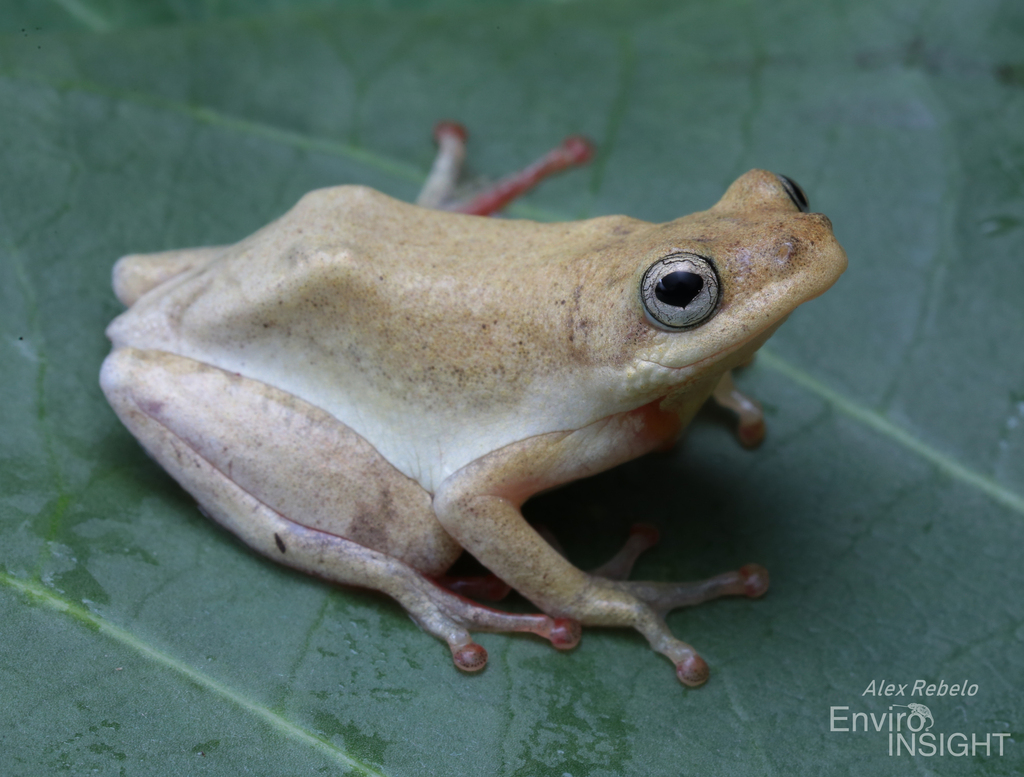
Chalky Reed Frog
Hyperolius nitidulus
Hyperolius nitidulus is a species of frog from the family Hyperoliidae. It is found on the West African savannas between Guinea and Mali in the west and Nigeria and Cameroon in the east. Common name plain reed frog has been coined for it.
From the article Hyperolius nitidulus on Wikipedia (CC BY-SA), quoted section by section
Description
Hyperolius nitidulus are medium-sized reed frogs with a rather blunt snout. Males vary in size between 23 and 29 mm (0.91 and 1.14 in) and on average weight about one gram. Females are larger and heavier than males, their body size can vary between 24 and 32 mm (0.94 and 1.26 in) with an average weight of about two grams before laying eggs. This species has a large choana, which is not hidden beneath edge of mandible like in most Hyperolius species. They have a relatively large tongue which is broad and shaped like a heart. Their dorsal view is roundish and sometimes a bit pointy. From a lateral view their body is flattened but some have a round truncate. The position of the naris is slightly close to snout tip than to the eye. Skin is laterally smooth and with small warts. Body is slender and half cylindrical with thin limbs. They have extra skin folds that are used to hide their feet while aestivating during dry conditions. Fingers and toes have circummarginal discs. Males have a median subgular vocal sac which is used for calling. During their juvenile stage their color is beige with a darker lightly flanked stripe at the side from snout to vent. As an adult they exhibit metachrosis (change in color), this color change is based on many factors such temperature, humidity. …
Range & habitat
Hyperolius nitidulus inhabit margins of swamps, rivers and lakes in savanna, grassland and bushland habitats. It is a very adaptable species that also occurs in many human-modified areas, such as cultivated land, towns, and gardens.
Wikipedia: “Habitat”
What it does
Adults are insectivores, usually consuming taxa such as Drosophila, Musca, Phormia, Lucilia, and Calliphora.
Wikipedia: “Diet”
Listen
Looking for field recordings…
Where it lives
Recorded sightings
—
geo-referenced records in GBIF, from museums, herbaria and field observers.
Drag the globe to turn it. Dots are where records exist, not a range map; darker means more records.
In the stacks
Searching the stacks…
Every page naming Hyperolius nitidulus in the Biodiversity Heritage Library →
This page is assembled live from iNaturalist, GBIF, Wikipedia, the Source Library and the Internet Archive. It is not yet part of the hand-edited codex. iNaturalist taxon 23329.