- Animals
- ›Chordates
- ›Vertebrates
- ›Amphibians
- ›Frogs and Toads
- ›African Reed Frogs
- ›Typical Reed Frogs
- ›Hyperolius
- ›Hyperolius nasutus
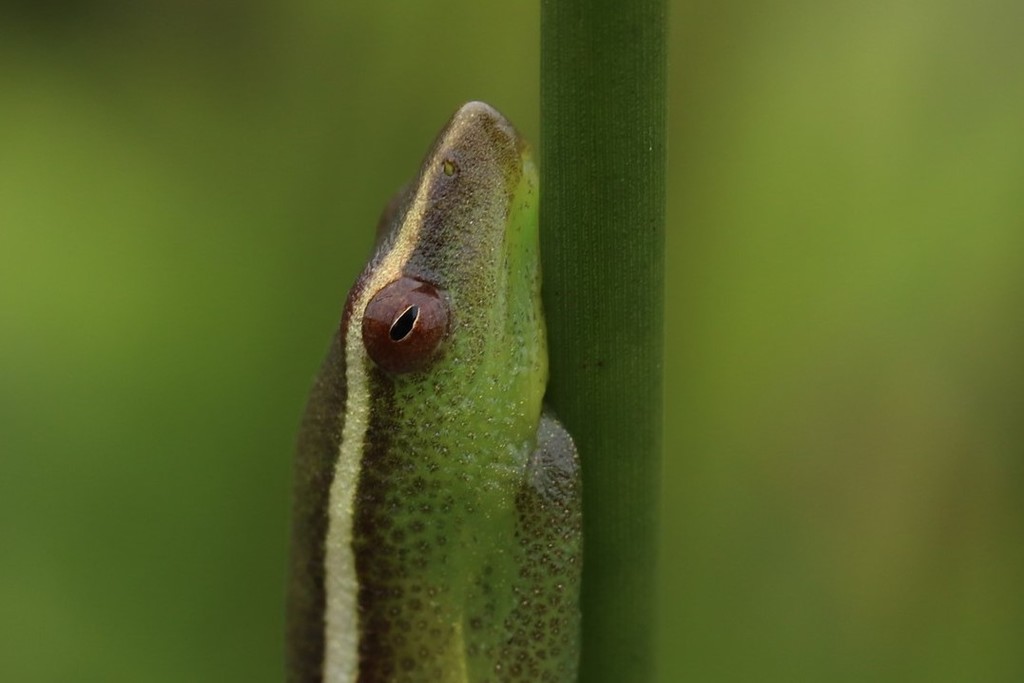
Power's reed frog
Hyperolius poweri
Hyperolius acuticeps is a species of frogs found in Burundi, the Democratic Republic of the Congo, Ethiopia, Kenya, Malawi, Mozambique, Rwanda, Somalia, South Africa, Sudan, Tanzania, Uganda, Zambia, and Zimbabwe, and possibly Botswana, the Central African Republic, Chad, Namibia, and Swaziland. Its natural habitats are dry savanna, moist savanna, temperate shrubland, subtropical or tropical moist shrubland, temperate grasslands, subtropical or tropical dry lowland grasslands, subtropical or tropical seasonally wet or flooded lowland grasslands, subtropical or tropical...
From the article Hyperolius poweri on Wikipedia (CC BY-SA), quoted section by section
Description
Males grow to 20 mm (0.8 in) and females to 25 mm (1.0 in) in snout–vent length. The snout is bluntly rounded in lateral view and sharply rounded from above. The toes are extensively webbed. The fingers and toes bear yellowish-green discs that are larger in the former. The dorsum is green with white lateral bands that run from over the eyes to the vent (sometimes these bands are not visible). There is a dark line running from the tip of the snout to the eyes. Males have white throat.
Range & habitat
Hyperolius poweri occurs in association with emergent vegetation at the margins of swamps, rivers and lakes in savanna and grassland habitats. Males call from sedges and other emergent vegetation. Although threatened by habitat loss and degradation, Hyperolius poweri has a relatively wide distribution and plenty of suitable habitat remaining, and it has been assessed as of "least concern" (2016). It is present in many protected areas. Nevertheless, the overall population appears to have declined.
== References ==
Wikipedia: “Habitat and conservation”
Listen
Looking for field recordings…
Where it lives
Recorded sightings
—
geo-referenced records in GBIF, from museums, herbaria and field observers.
Drag the globe to turn it. Dots are where records exist, not a range map; darker means more records.
In the stacks
Searching the stacks…
Every page naming Hyperolius poweri in the Biodiversity Heritage Library →
This page is assembled live from iNaturalist, GBIF, Wikipedia, the Source Library and the Internet Archive. It is not yet part of the hand-edited codex. iNaturalist taxon 65730.