- Animals
- ›Chordates
- ›Vertebrates
- ›Cartilaginous Fishes
- ›Sharks and Rays
- ›Sharks
- ›Squalean Sharks
- ›Squaliform Sharks
- ›Dogfish Sharks
- ›Squalus
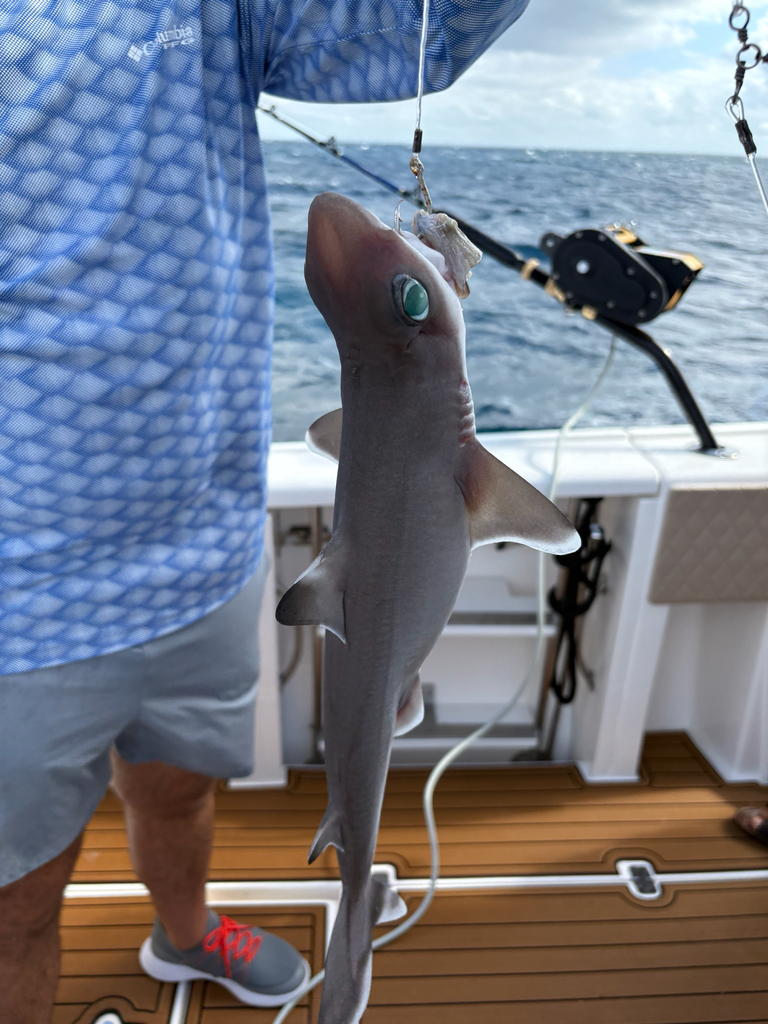
Cuban Dogfish
Squalus cubensis
The Cuban dogfish (Squalus cubensis) is a dogfish, a member of the family Squalidae in the order Squaliformes. It is found in the Western Atlantic from North Carolina to Florida, in the Gulf of Mexico, around Cuba, Hispaniola, southern Brazil, and Argentina. It inhabits continental shelves and uppermost slopes at depths from 60 to 380 m. Its length may reach 110 cm.
From the article Cuban dogfish on Wikipedia (CC BY-SA), quoted section by section
Description
The Cuban Dogfish was first discovered by Howell Rivero in 1936 in his publication of Some new, rare and little-known fishes from Cuba.
This dogfish has a slim grey fusiform body with a short round snout. The pectoral fins are sickle shaped with angular pointed tips. Their two dorsal fins have black tips and have venomous spines protruding out before the fin. Unlike their dorsal fins, their caudal and pelvic fins are white lined. The caudal is the fin attached to their tail. A pelvic fin is located underneath the fish before the anal fin and normally after the pectoral fins. This species exhibits countershading in its coloring. The grey topside side is juxtaposed with a lighter bottom. When viewed from below the lighter scales blend into the surface water. This blending hints at their preferred method of hunting. This species' ancestral heterocercal caudal tail has a longer upper lobe with shortened lower lobe. A quality exhibited in the Galeas, sharks, are dermal denticles. They are a type of scale commonly found on sharks, rays, and skates. These types of scales are like teeth and feel like sandpaper. This shark has a slim and elongated body that cuts through water. It's often described as fusiform. The head is conical and depressed but not laterally expanded. This distinct head shape resembles a slightly flattened cone without wide flattened edges. …
Range & habitat
This species can range from the subtropical Atlantic Ocean to the greater Caribbean and Mexican gulf. Within this range S. cubensis sitings are reported from North Carolina to Florida. Even further south, sitings are reported in Cuba, Hispaniola, southern Brazil and Argentina historically. Recent research has reported a change in historical ranges. Since 2016, S. cubensis has been recorded in Colombian waters.
Wikipedia: “Range of Species”
What it does
Long gestation periods and asynchronous breeding are Squalidae family characteristics. The gestation periods are species specific development from embryo to juvenile. This period of time comprises the process of embryo to birth or egg hatching. This species is ovoviviparous, specifically they are lecithotrophic where the embryo carries an individual yolk for nutrition. The embryo will develop inside the female until ready to hatch. This 'hatching' will occur inside the female, and the female will give live birth. In addition to live births, site association is common among the subclass elasmobranchii. Female S. cubensis will return to their original birth sites for parturition.
Wikipedia: “Reproduction”
Toxicity
An identifying characteristic of the S. cubensis is its venomous spines. The venomous spines originate anteriorly on both dorsal fins. Anteriorly placed means the spines are located before the dorsal fin. These spines are triangular with convex sides and ducts to make them nearly hollow. They secrete a whiteish venom at the sting site.The venom causes erythema and edema for up to two weeks. Erythema is the reddening of skin due to increased blood flow to the site of injury. This redness is paired with swelling of the skin, or edema. The sting's pain can spread to axilla or groin and cause muscle weakness. The intense pain can last up to six hours without treatment. Research suggests these stings can be fatal at a high enough dose.
Wikipedia: “Venom”
In human culture
The word Squalus is derived from the Latin Squalus which means dirty or filthy. This name was given to marine fishes, considered unfit for human consumption, this includes sharks. Cubensis was used as a description of its location, with the addition of the Latin suffix denoting place, -ensis . This fish was originally found in Cuba.
Wikipedia: “Etymology”
Where it lives
Recorded sightings
—
geo-referenced records in GBIF, from museums, herbaria and field observers.
Drag the globe to turn it. Dots are where records exist, not a range map; darker means more records.
In the stacks
Searching the stacks…
Every page naming Squalus cubensis in the Biodiversity Heritage Library →
This page is assembled live from iNaturalist, GBIF, Wikipedia, the Source Library and the Internet Archive. It is not yet part of the hand-edited codex. iNaturalist taxon 113033.