- Animals
- ›Chordates
- ›Vertebrates
- ›Mammals
- ›Therians
- ›Placental Mammals
- ›Primates, Rodents, and Allies
- ›Primates
- ›Monkeys, Apes, and Tarsiers
- ›Monkeys and Apes
- ›Apes and Old World Monkeys
- ›Old World Monkeys
- ›Cercopithecines
- ›Baboons, Macaques, and Mangabeys
- ›Macaca
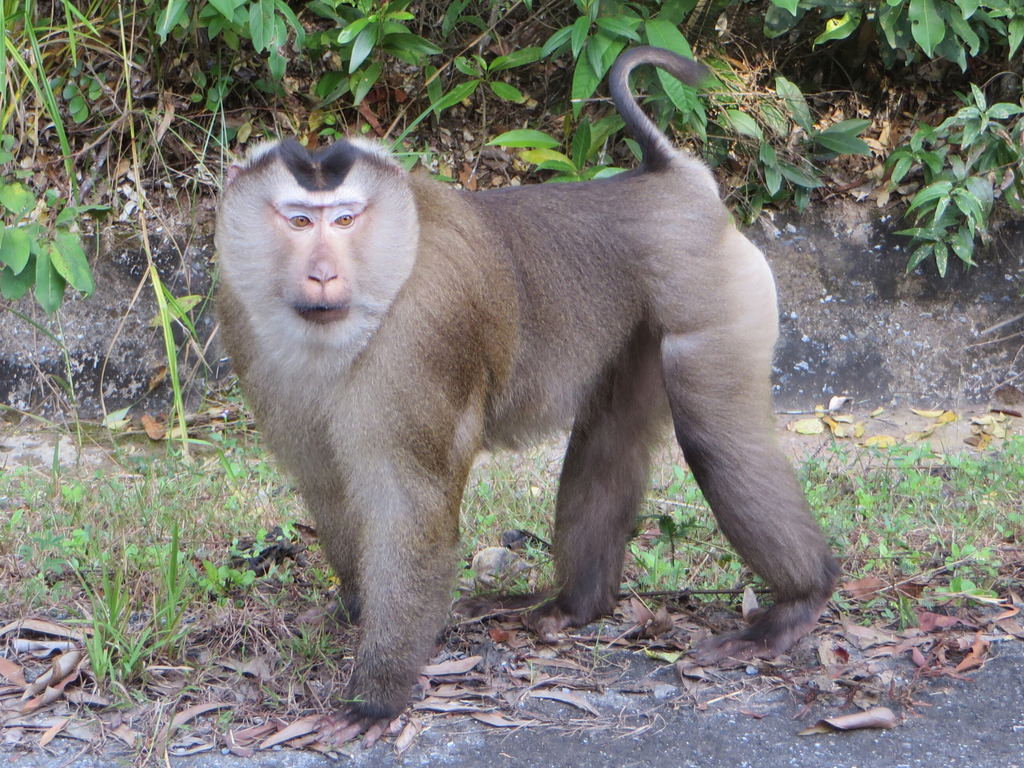
Northern Pig-tailed Macaque
Macaca leonina
The northern pig-tailed macaque (Macaca leonina) is a vulnerable species of macaque in the subfamily Cercopithecidae. It is found in Bangladesh, Cambodia, China, India, Laos, Myanmar, Thailand, and Vietnam. Traditionally, M. leonina was considered a subspecies of the southern pig-tailed macaque (M. nemestrina), but is now classified as an individual species. In the 21st century, the pig-tailed macaque was split into the northern pig-tailed macaque species Macaca leonina and the Sundaland pig-tailed macaque species M. nemestrina. This reclassification was aided by the observation of sexual swellings and basic attributes that distinguish the two. The northern pig-tailed macaque is frugivorous and their social grouping is matriarchal, where sexual dimorphic traits can distinguish males and females. Their adaptation to omnivorous diets occur in periods of fruit scarcity, munching on wild vegetation and crops, human foods, and small insects and mammals. Despite their adaptability, northern-pig tailed macaques experience viral threats such as the human immunodeficiency virus type 1, pathogenic simian immunodeficiency, and coronavirus. Human impacts are also present, such as agricultural expansions, aquaculture, transportation infrastructure, hunting and logging for meat and trophies, and the illegal pet trade; that result in habitat loss, forest fragmentation, and a reduced well-being.
From the article Northern pig-tailed macaque on Wikipedia (CC BY-SA), quoted section by section
Description
Physical characteristics identifiers in distinguishing the northern and the southern pig-tailed macaques. Northern pig-tailed macaques have a round greyish pelage from the side of their cheeks all the way around to the top of their head and beneath their chin, which is called a crown. A brown pelage patch is found on the centre of their crowns followed by white triangular forms beneath this patch and along the top of their eyes. One red stripe is found at each exterior corner of their eyes which are angled upwards and diagonally meeting at the ending point of the white triangular eye extremities. Their elongated muzzle is still shorter when compared to southern pig-tailed macaques. On their backs, for mostly males, a black streak is found at the centre; and can sometimes have a red hue towards the top and black towards the bottom. Moving downwards, their tails are composed of a thin pelage in a dark blackish hue and are shorter and skinnier than southern pig-tailed macaques. Tail shapes vary, however, the most common is a 90 degree point to the back, followed by a 45 degree, a forward and parallel, a forward arch meeting its back, pointed downwards. Beneath their tail, on their backside, there are oval shaped thick sitting pads that cover their hip bones, known as ischial callosities.
Wikipedia: “Appearance”
What it does
Northern pig-tailed macaques are frugivorous as they tend to forage for hundreds of fruit species such as fleshy and dry; as well as flowers and buds, piths, leaves, and shoot species that makeup more than fifty percent of their diet. Due to limited fruit availability in colder seasons or with habitat degradation, the macaques are found to become more omnivorous due to reliance on human food resources such as "rice, bread, biscuits"; and can also be found munching on fungi, ants, termites, spiders, stickbuds, grasshoppers, caterpillars, beetles, mushrooms, barks, eggs, lizards, and squirrels.
Group strategies. Despite their limited and varied accessibility to their main food resources and habitat transformations, the northern pig-tailed macaques adapt to their environments by altering how their social groups are formed and composed. Group sizes are shown to increase as a response to low connectivity within feeding sites, and tend to become more sedentary when relying on human food resources for nutrition. The opposite is true for their group sizes and lifestyle within more wild environments, where smaller groups and nomadic patterns are more common. Groups are fairly large within this species which can exceed over one hundred fifty individuals. However, they split into smaller groups when feeding and rejoin for larger group travel. …
Wikipedia: “Diet”
At the table
Viruses are a common threat among northern pig-tailed macaques within degraded environments. For example, nonpathogenic human immunodeficiency virus type 1 (HIV-1NL4-3) and pathogenic simian immunodeficiency (SIVmac239) viruses present in northern pig-tailed macaques can determine their survival rates. These two viruses were evaluated by Wen-Quiag et al. (2022), to understand how interferon (IFN)-a had an impact on both viruses. The result of both infections were taken from tissue samples from either euthanized individuals with chronic infection or those who experienced natural death.
The researchers found that HIV-1 performed better, meaning that the infectious qualities and viral activity were less replicated within the immune system with (IFN)-a when compared to the pathogenic simian immunodeficiency virus. They hypothesized that HIV's lower impact on the immune system in northern pig-tailed macaques can explain how HIV-1 does not reproduce and evolve into AIDS within the species. The results show that naturally derived IFN-a is effective at preventing HIV-1 from further long term reproduction, yet SIVmac239 needs to be monitored to prevent further chronic illness. Northern pig-tailed macaques were also reported to be affected by coronavirus 2 (SARS-CoV-2) and was shown to be fatal and highly transmissible.
Wikipedia: “Viruses”
Listen
Looking for field recordings…
Where it lives
Recorded sightings
—
geo-referenced records in GBIF, from museums, herbaria and field observers.
Drag the globe to turn it. Dots are where records exist, not a range map; darker means more records.
In the stacks
Searching the stacks…
Every page naming Macaca leonina in the Biodiversity Heritage Library →
This page is assembled live from iNaturalist, GBIF, Wikipedia, the Source Library and the Internet Archive. It is not yet part of the hand-edited codex. iNaturalist taxon 74532.