- Animals
- ›Chordates
- ›Vertebrates
- ›Mammals
- ›Therians
- ›Placental Mammals
- ›Primates, Rodents, and Allies
- ›Primates
- ›Monkeys, Apes, and Tarsiers
- ›Monkeys and Apes
- ›Apes and Old World Monkeys
- ›Old World Monkeys
- ›Colobines
- ›Langurs, Surilis, and Lutungs
- ›Trachypithecus
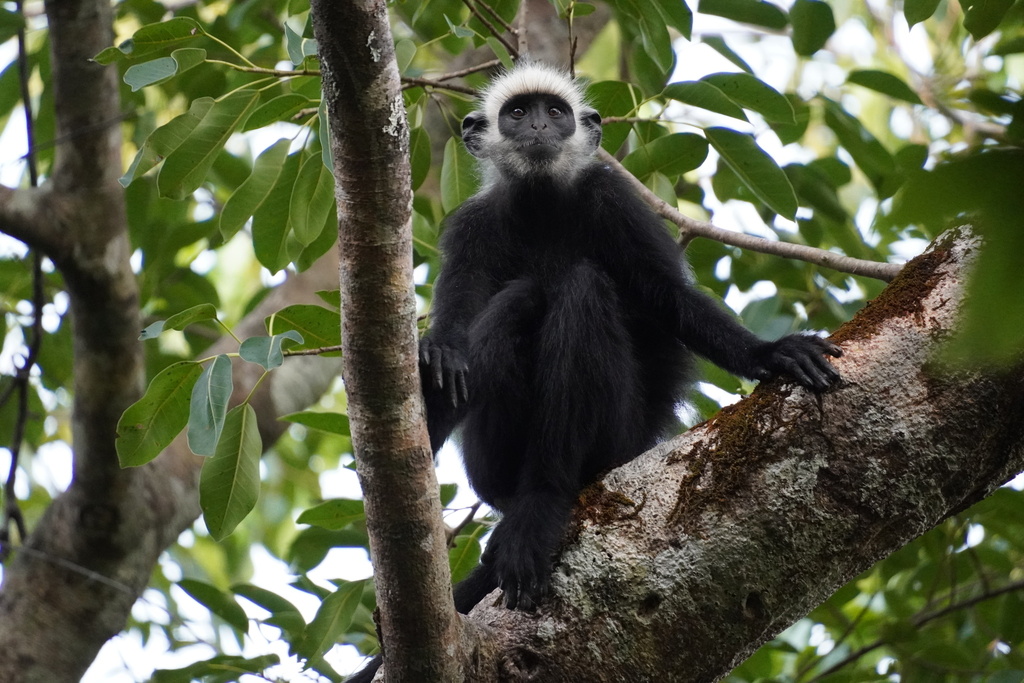
Laotian Lutung
Trachypithecus laotum
The Laotian langur or white-browed black langur (Trachypithecus laotum) is a species of primate in the family Cercopithecidae. It is endemic to Laos. Its natural habitat is subtropical or tropical dry forests. Genetically the Indochinese black and Hatinh langurs are very close to the Laotian langur, and consequently it has been suggested they should be considered subspecies of it.
From the article Laotian langur on Wikipedia (CC BY-SA), quoted section by section
Description
The Laotian langur has a dark black fur covering most of the body. The face is black with white hair encircling it. It has small ruft of black hair on top of the head. New borns have a golden fur, which changes color while the monkeys grow. Juveniles have similar appearance to the adults though the fur color might be paler and are usually smaller in size. It has four fingers on the limbs with a short thumb, which is an adaptation for their arboreal lifestyle. The Laotian langur has a multi chambered stomach, which helps in the digestion of the plant matter.
Wikipedia: “Morphology”
Range & habitat
The species is endemic to Laos in Southeast Asia. Its natural habitat consists of subtropical or tropical dry forests. It is classified as endangered in the IUCN Red List. Studies in 2021 have indicated that the langur habitats have shrunk due to deforestation and hunting. Based on the sightings, the langur groups consisted of fewer members compared to earlier studies done in the 1990s. The langur habitats have been protected by the establishment of various protected areas such Nam Kading National Protected Area, Nam Ha National Protected Area, and Phou Hin Poun National Biodiversity Conservation Area.
Wikipedia: “Distribution and habitat”
What it does
Laotian Langurs are primarily herbivorous and the diet consists of leaves, fruits, seeds, and flowers. They share a sympatric relationship with the Assamese macaque in their range. They often feed on the same trees, though the langurs occupy higher positions compared to the macaques. The langurs occupy limestone caves in rocks and cliffs, which serves as a shelter from predation and weather. As they consume a vegetation heavy diet, they often spend long times resting, and socializing.
== References ==
Wikipedia: “Behaviour”
Listen
Looking for field recordings…
Where it lives
Recorded sightings
—
geo-referenced records in GBIF, from museums, herbaria and field observers.
Drag the globe to turn it. Dots are where records exist, not a range map; darker means more records.
In the stacks
Searching the stacks…
Every page naming Trachypithecus laotum in the Biodiversity Heritage Library →
This page is assembled live from iNaturalist, GBIF, Wikipedia, the Source Library and the Internet Archive. It is not yet part of the hand-edited codex. iNaturalist taxon 75188.