- Animals
- ›Chordates
- ›Vertebrates
- ›Mammals
- ›Therians
- ›Placental Mammals
- ›Primates, Rodents, and Allies
- ›Primates
- ›Monkeys, Apes, and Tarsiers
- ›Monkeys and Apes
- ›Apes and Old World Monkeys
- ›Old World Monkeys
- ›Colobines
- ›Langurs, Surilis, and Lutungs
- ›Trachypithecus
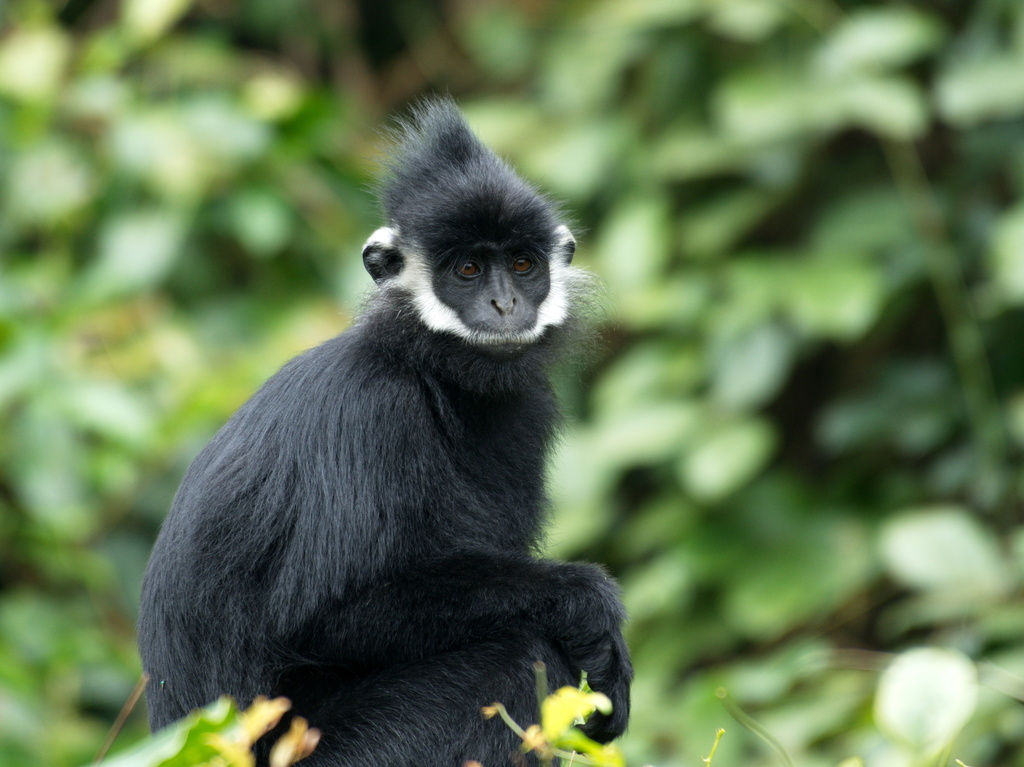
Hatinh Lutung
Trachypithecus hatinhensis
The Hatinh langur (Trachypithecus hatinhensis) is a highly threatened Old World monkey found in limestone forests in Vietnam, primarily in the Quảng Bình Province. A recent survey discovered a small population living in the Quảng Trị Province. Contrary to its name, it is not known from the Hà Tĩnh Province. The local Van Kieu minority refer to this lutung as the 'Con Cung', which roughly translates as "black, cliff-dwelling monkey with a long tail". It resembles...
From the article Hatinh langur on Wikipedia (CC BY-SA), quoted section by section
Range & habitat
Hatinh langurs inhabit the steep limestone cliffs of Central Vietnam and Southern Laos, prompting them to be referred to as the "Limestone Langur". A recent survey discovered a small population living in the Quảng Trị Province. Contrary to their name, they are not known from the Hà Tĩnh Province. The local Van Kieu minority refer to this monkey as the 'Con Cung', which roughly translates as "black, cliff-dwelling monkey with a long tail". They primarily occupy dense forests, but venture into open areas to forage on occasion. This species is known to sleep in caves and crevices in the limestone cliffs consistently for many years, unless disturbed by humans. The preferred height for sleeping locations is 20 meters from the cliff base, but they can be up to 50 meters off the ground. Their intense preference for these limestone cliffs may be an effect of widespread habitat loss.
Wikipedia: “Habitat”
What it does
While groups of up to 30 individuals have been recognized, the usual group size consists of two to 15 individuals. These groups consist of a single male, along with multiple females, and the offspring. The lifespan of the Hatinh langur is observed to be an average of 12 years. Although births peak in the warmer months when food is more abundant, females will give birth year round to a single offspring at a time. The gestation period is 180-190 days. Their diet was reported to consist of 81% leaves, 9% fruits, 9% vines, and 1% flowers based on a single study. The Hatinh langur is diurnal, leaving their caves at dawn and return early in the afternoon. As they move to and from their sleeping site, the group follows the dominant animal in a single file line down the rock face or aerial tree root. When they return to their sleeping site, they can be seen resting and playing before dusk until the dominant individual makes a "huut…huut" sound signaling the group to enter their caves. These animals will sleep alone, in pairs, or in groups of three, but as a whole, the group does not share a single cave. This "huut…huut" call will also be used by the dominant male when danger or unusual circumstances arise. Other types of calls include whoops and grunts; the former composed of a single exhalation, and the latter formed by a long inhalation-exhalation interval.
Wikipedia: “Behavior”
Listen
Looking for field recordings…
Where it lives
Recorded sightings
—
geo-referenced records in GBIF, from museums, herbaria and field observers.
Drag the globe to turn it. Dots are where records exist, not a range map; darker means more records.
In the stacks
Searching the stacks…
Every page naming Trachypithecus hatinhensis in the Biodiversity Heritage Library →
This page is assembled live from iNaturalist, GBIF, Wikipedia, the Source Library and the Internet Archive. It is not yet part of the hand-edited codex. iNaturalist taxon 75187.