- Animals
- ›Chordates
- ›Vertebrates
- ›Mammals
- ›Therians
- ›Placental Mammals
- ›Primates, Rodents, and Allies
- ›Rodents
- ›Mice, Rats, and Hamsters
- ›Muroids
- ›Old World Mice and Rats
- ›Gerbils
- ›Taterini
- ›Gerbilliscus
- ›Taterona
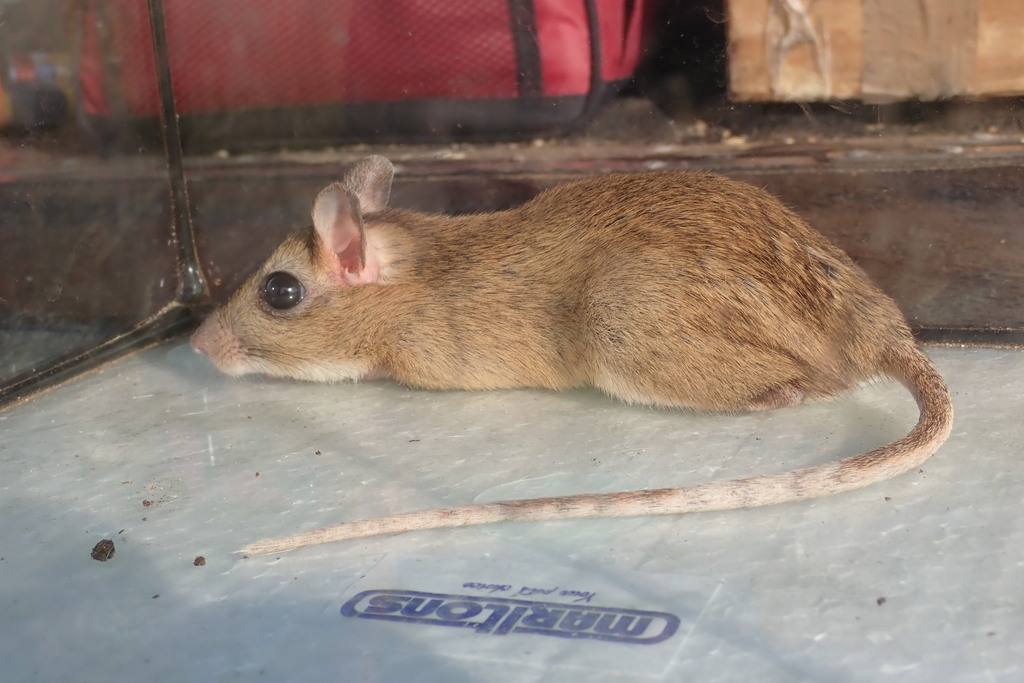
Highveld Gerbil
Gerbilliscus brantsii
The highveld gerbil (Gerbilliscus brantsii) is a species of rodent found in Angola, Botswana, Lesotho, Namibia, South Africa, Eswatini, Zambia, and Zimbabwe. Its natural habitats are dry savanna, temperate shrubland, subtropical or tropical dry shrubland, temperate grassland, and temperate desert. This is a common species with a wide range and the International Union for Conservation of Nature has rated it as being of "least concern" as of 2008.
From the article Highveld gerbil on Wikipedia (CC BY-SA), quoted section by section
Description
The highveld gerbil is a medium-sized species with soft, fluffy fur, the individual hairs having chevron patterns. It grows to a head-and-body length of about 135 mm (5.3 in). The head is narrow, with long whiskers and a pointed snout. The eyes are large, the chin white and the ears long, with rounded tips. The upper parts are pale rufous-brown, washed with brown. The underparts are whitish or pale buffy-grey. The hind legs are much longer than the forelegs. The tail is long, being about the same length as the head and body. The proximal half of the tail is the same colour as the animal's upper parts, and the distal half is white.
Range & habitat
The highveld gerbil is native to southern Africa. Its range includes Angola, Botswana, Lesotho, Mozambique, Namibia, South Africa, Eswatini, Zambia and Zimbabwe. Its typical habitat is grassy plains with scrub or open woodland on sandy soils, and it also occurs around marshes and pans on peaty soils.
Wikipedia: “Distribution and habitat”
What it does
The highveld gerbil is sociable, with several individuals living in close proximity to each other. It digs a complex burrow in loose, sandy soil which may extend for 6 m (20 ft). There are several entrances and a single nesting chamber. The animal is nocturnal, and chiefly active around dusk and dawn. Its diet consists of plant material, including the green parts and roots, and a small proportion of insects. Females may have five or six litters per year. The gestation period is about three weeks and the litter size averages three young.
Wikipedia: “Ecology”
Listen
Looking for field recordings…
Where it lives
Recorded sightings
—
geo-referenced records in GBIF, from museums, herbaria and field observers.
Drag the globe to turn it. Dots are where records exist, not a range map; darker means more records.
In the stacks
Searching the stacks…
Every page naming Gerbilliscus brantsii in the Biodiversity Heritage Library →
This page is assembled live from iNaturalist, GBIF, Wikipedia, the Source Library and the Internet Archive. It is not yet part of the hand-edited codex. iNaturalist taxon 74362.