- Plants
- ›Vascular Plants
- ›flowering plants
- ›Dicots
- ›beeches, oaks, walnuts, and allies
- ›beech family
- ›Quercus
- ›Cerris
- ›Cerris
- ›Suber
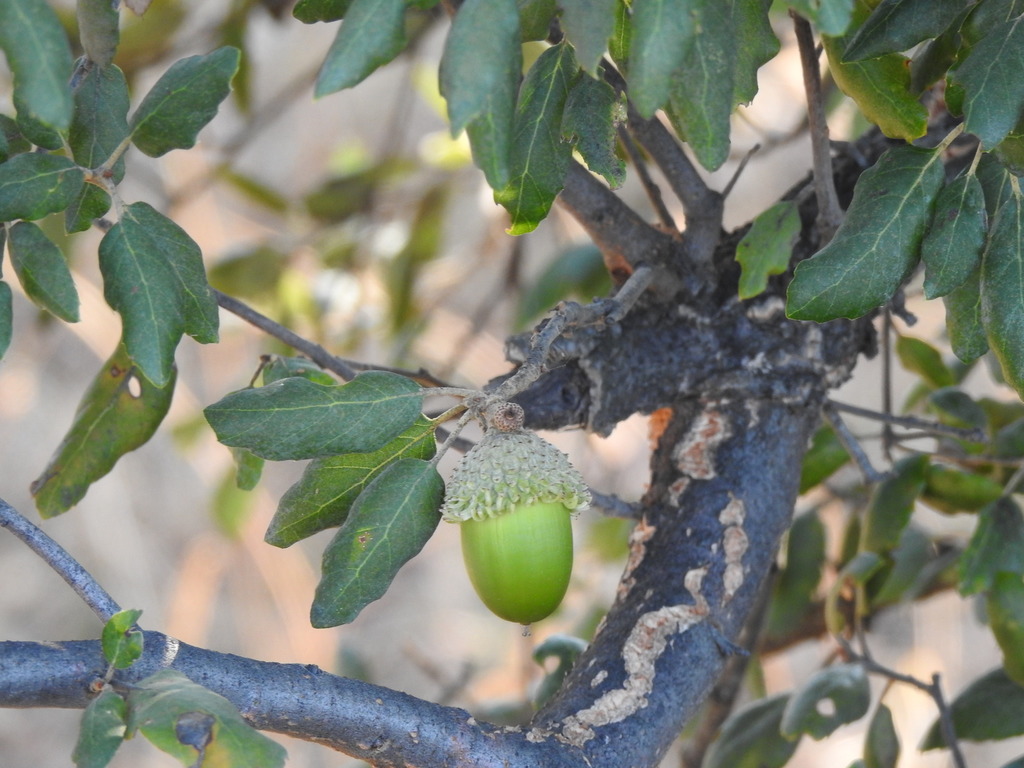
cork oak
Quercus suber
Quercus suber, commonly called the cork oak, is a medium-sized, evergreen oak tree in the section Quercus sect. Cerris. It is the primary source of cork for wine bottle stoppers and other uses, such as cork flooring and as the cores of cricket balls. It is native to southwest Europe and northwest Africa. In the Mediterranean basin the tree is an ancient species with fossil remnants dating back to the Tertiary period. It can survive for as long as two centuries. Typically, once it reaches 25 years old, its thick bark can be harvested for cork every 9 to 12 years without causing harm to the tree.
It endures drought and makes little demand on the soil quality and is regarded as a defence against desertification. Cork oak woodlands are home to a multitude of animal and plant species. Since cork for sealing bottles is increasingly being displaced by other materials, these forests are at risk as part of the cultural landscape and as a result animal species such as the Iberian lynx and imperial eagles are threatened with extinction.
From the article Quercus suber on Wikipedia (CC BY-SA), quoted section by section
Range & habitat
The cork oak occupies the area around the western Mediterranean basin. In Portugal, natural and cultivated stands cover an area of 750,000 ha (1,900,000 acres). There are natural populations of the nominate form at altitudes between 150 and 300 m (490 and 980 ft) above sea level, while the subspecies occidentalis is found along the Atlantic coast. In Spain the occurrences remain mostly below 600 m (2,000 ft), but rarely reach heights of 1,200 m (3,900 ft); cork oaks are common in the southern half of the country, as well as in the western and northeastern areas, but rare in central Spain. In Italy one finds natural occurrences along the Tyrrhenian Sea and in eastern Apulia on the Adriatic Sea, and across that sea the cork oak also grows on the Dalmatian coast. It is one of the most common forest trees in Sardinia. Natural and man-made occurrences exist in Africa on the Mediterranean coast of Tunisia, Algeria and the Al-Maamora Forest of Morocco and at altitudes up to 1,000 m (3,300 ft), on the High Atlas up to 2,000 m (6,600 ft). In its native range, cork oak forests cover approximately 22,000 square kilometres (8,500 square miles). Outside of its natural range, the cork oak is cultivated in the Crimea, the Caucasus, India and the Southwestern United States. …
Wikipedia: “Distribution and habitat”
What it does
The cork oak forest is one of the major plant communities of the Mediterranean woodlands and forests ecoregion. In natural populations, the cork oak grows together with the holm oaks (Quercus ilex, Quercus rotundifolia), the Portuguese oak (Quercus faginea), the Pyrenean oak (Quercus pyrenaica), Mirbeck's oak (Quercus canariensis), the maritime pine (Pinus pinaster), the stone pine (Pinus pinea), the strawberry tree (Arbutus unedo) and the olive tree (Olea europaea), in cooler locations also with the sweet chestnut (Castanea sativa). In addition to these tree species, the shrub-forming species include the Kermes oak (Quercus coccifera), the Lusitanian oak (Quercus lusitanica) the holly buckthorn (Rhamnus alaternus), species of the genus Phillyrea, the myrtle (Myrtus communis), the green heather (Erica scoparia), the common smilax (Smilax aspera) and the Montpellier cistus (Cistus monspeliensis) are often found together with the cork oak. As a pyrophyte, this tree has a thick, insulating bark that makes it well adapted to forest fires. After a fire, many tree species regenerate from seeds (as, for example, the maritime pine) or re-sprout from the base of the tree (as, for example, the holm oak). The bark of the cork oak allows it to survive fires and then simply regrow branches to fill out the canopy. …
Wikipedia: “Ecology”
At the table
The cork oak is grown for the production of cork in several Mediterranean countries. The centers of cork production are in southern Portugal (accounting for 50% of the total production) and southern Spain, where low trees with large crowns and strong branches are grown in large areas, which provide the highest yield of cork. These mostly extensively managed habitats are called montados in Portugal and dehesas in Spain. They are considered to be extremely valuable from the point of view of biodiversity and cultural heritage. The cork consists of dead, air-filled, thin-walled cells and contains cellulose and suberin. Cork is heat and sound insulating, the suberine gives it water-repellent properties. The cork layer is replicated by the cork-producing phellogen and can therefore be harvested repeatedly without damaging the tree too much. The first harvest usually takes place after about 25 years with a trunk diameter (DBH) of 70 cm (28 in), though new techniques (such as better irrigation systems) could shorten it to only 8 to 10 years. The first cork layer is called "male cork" or "virgin cork", is still not very elastic and cracked and is only used for insulating mats. The second harvested cork (known as secundeira), has a more regular structure and is softer, but is still only used for insulation and in decorative objects. …
Wikipedia: “Uses”
In human culture
The cork oak is featured in the city arms of several cities in Portugal, such as the city of Reguengos de Monsaraz, which shows a freshly harvested cork tree. In 2007, a 2 euro commemorative coin with the motif of a cork oak was issued in Portugal in memory of the Portuguese Presidency of the European Union.
Notable trees. In the Portuguese town of Águas de Moura lies the Sobreiro Monumental ('Monumental Cork Oak'), also known as 'The Whistler Tree', a tree 236 years old (planted in 1783/1784), over 14 metres (46 ft) tall and with a trunk that requires at least three people to embrace it. It has been considered a National Monument since 1988, and Guinness World Records lists it as the largest cork tree in the world.
Cork oaks of California. While native to the Mediterranean, cork oaks have been planted across several U.S. states with warm, mild climates, particularly in California. One of the oldest recorded cork oaks in the state, was planted in 1858, by Mexican miners, in the town of Campo Seco in the Central Valley. Another historic cork oak is in Napa and stands 89 feet tall with a 20 ft circumference. There are several streets or lanes in California with the name 'Cork Oak'. A street in Palo Alto, named 'Cork Oak Way' was established in 1960, in an area densely populated with cork oaks. …
Wikipedia: “Culture”
Where it lives
Recorded sightings
—
geo-referenced records in GBIF, from museums, herbaria and field observers.
Drag the globe to turn it. Dots are where records exist, not a range map; darker means more records.
In the old herbals & bestiaries

Commentaries on the Six Books of Dioscorides
Pietro Andrea Mattioli · 1560 · p.240

Commentaries on the Six Books of Dioscorides on Medical Matter
Pietro Andrea Mattioli · 1563 · p.240

Commentaries on the Six Books of Pedanius Dioscorides on Medical Matter
Pietro Andrea Mattioli · 1565 · p.384

Commentaries on the Six Books of Pedanius Dioscorides on Medical Matter
Pietro Andrea Mattioli · 1565 · p.383

Six Groups of the History of Plants
Rembert Dodoens · 1583 · p.839

History of Rare Plants
Carolus Clusius · 1601 · p.34

Rariorum Plantarum Historia (with Fungorum Historia)
Carolus Clusius · 1601 · p.40

Herbarium Portatile, Oder Behendes Kräuter- und Gewächs-Buch: Darinn nicht allein 1363. so wol Einheimische als Außländndische Kräuter mit Lateinisch und Deutscher Benennung abgebildet, sondern auch die meisten, so in der Medicin gebräuchlich, kürtzlich erkläret werden
Panckow, Thomas · 1656 · p.362
In the stacks
Searching the stacks…
Every page naming Quercus suber in the Biodiversity Heritage Library →
This page is assembled live from iNaturalist, GBIF, Wikipedia, the Source Library and the Internet Archive. It is not yet part of the hand-edited codex. iNaturalist taxon 50868.