- Plants
- ›Vascular Plants
- ›flowering plants
- ›monocots
- ›grasses, sedges, cattails, and allies
- ›grasses
- ›Pooideae
- ›Poeae
- ›oats, junegrasses, and relatives
- ›Avena
- ›Avena
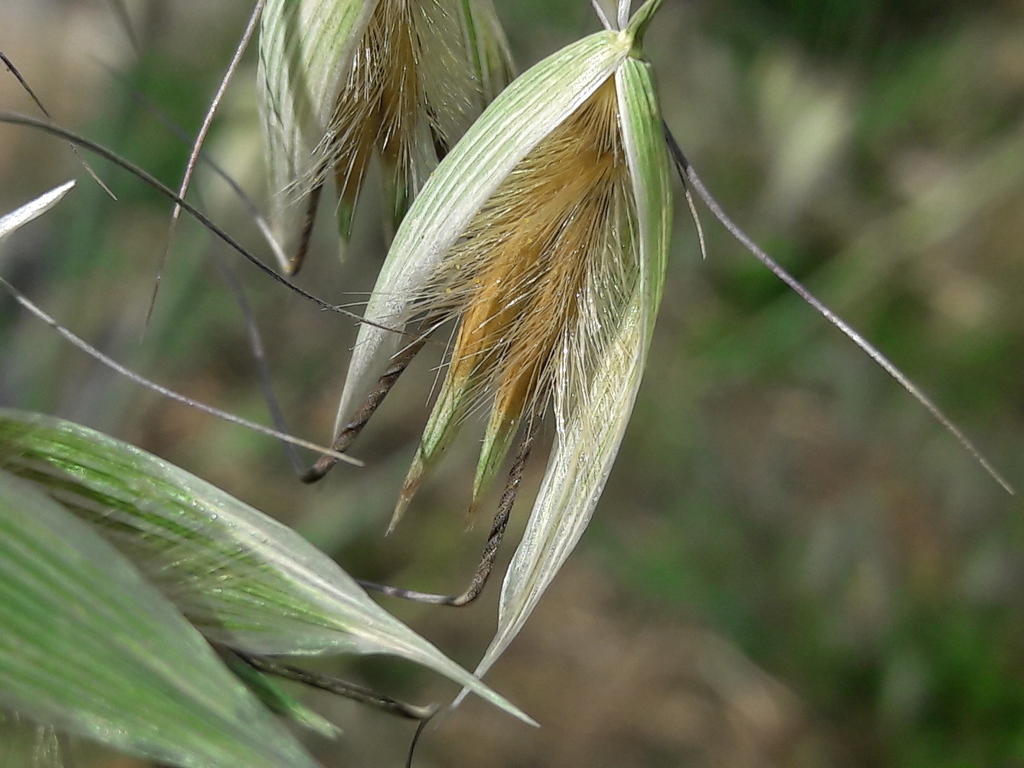
animated oat
Avena sterilis
Avena sterilis (animated oat, sterile oat, wild oat, wild red oat, winter wild oat; syn. Avena ludoviciana Durieu; Avena macrocarpa Moench; Avena sterilis ssp. sterilis; Avena sterilis ssp. ludoviciana) is a species of grass weed whose seeds are edible. Many common names of this plant refer to the movement of its panicle in the wind.
From the article Avena sterilis on Wikipedia (CC BY-SA), quoted section by section
Description
Avena sterilis is a stout, broad-leaved grass that grows up to 1.5 m (4 ft 11 in) tall. At maturity, it has leaf blades that are up to 60 cm (24 in) long, and 6–14 mm (0.24–0.55 in) wide.
It has an inflorescence that is either an equilateral or a slightly one-sided panicle. The spikelets usually have 3 florets, but can have anywhere from 2 to 5. The spikelets (without awns) are 1.7–4.5 cm (0.67–1.77 in) long; the glumes are 2.4–5 cm (0.94–1.97 in) long. The florets can either be a straw yellow or slightly reddish in colour. Occasionally, there can be reddish hairs at the base of the floret. The lemma is usually 1.5–4 cm (0.59–1.57 in) long. The florets are elongate and taper at the top. The two florets closest to the glumes have a twisted dorsal awn that is 3–9 cm (1.2–3.5 in) long.
Wikipedia: “Appearance”
Range & habitat
A. sterilis is native to the Mediterranean Basin and West, Central and South Asia, but is widely naturalized elsewhere. The species grows on all continents except Antarctica. In North America, it grows as an introduced species in the U.S. states of California, Oregon, New Jersey, Ohio, Pennsylvania, and the Canadian provinces of Ontario and Quebec.
Wikipedia: “Distribution”
What it does
A. sterilis is hexaploid. It is an annual plant, with a life cycle that mirrors many cereal crops. While an individual plant is capable of producing as many as 200 seeds, the average seed production of a single plant is 13-21 seeds. Seeds regularly live in the soil for upwards of two years, and can survive for as many as 5 years prior to germination.
Wikipedia: “Reproduction”
How it is grown
A. sterilis produces seeds that are difficult to separate from grain. Because of this, its seeds have spread around the world as a contaminant in wool, cereal grain, and seed. Because it thrives in the same conditions as many agricultural crops and has similar lifecycles, the grass directly competes with and reduces yield in arable crops. Castillejo-González et al., 2014 locate A. sterilis infested fields with almost perfect accuracy using QuickBird (satellite imagery) and various image classifiers.
Wikipedia: “Modern agricultural weed”
Where it lives
Recorded sightings
—
geo-referenced records in GBIF, from museums, herbaria and field observers.
Drag the globe to turn it. Dots are where records exist, not a range map; darker means more records.
In the stacks
Searching the stacks…
Every page naming Avena sterilis in the Biodiversity Heritage Library →
This page is assembled live from iNaturalist, GBIF, Wikipedia, the Source Library and the Internet Archive. It is not yet part of the hand-edited codex. iNaturalist taxon 75722.