- Animals
- ›Chordates
- ›Vertebrates
- ›Mammals
- ›Therians
- ›Placental Mammals
- ›Ungulates, Carnivorans, and Allies
- ›Odd-toed Ungulates
- ›Equines
- ›Equus
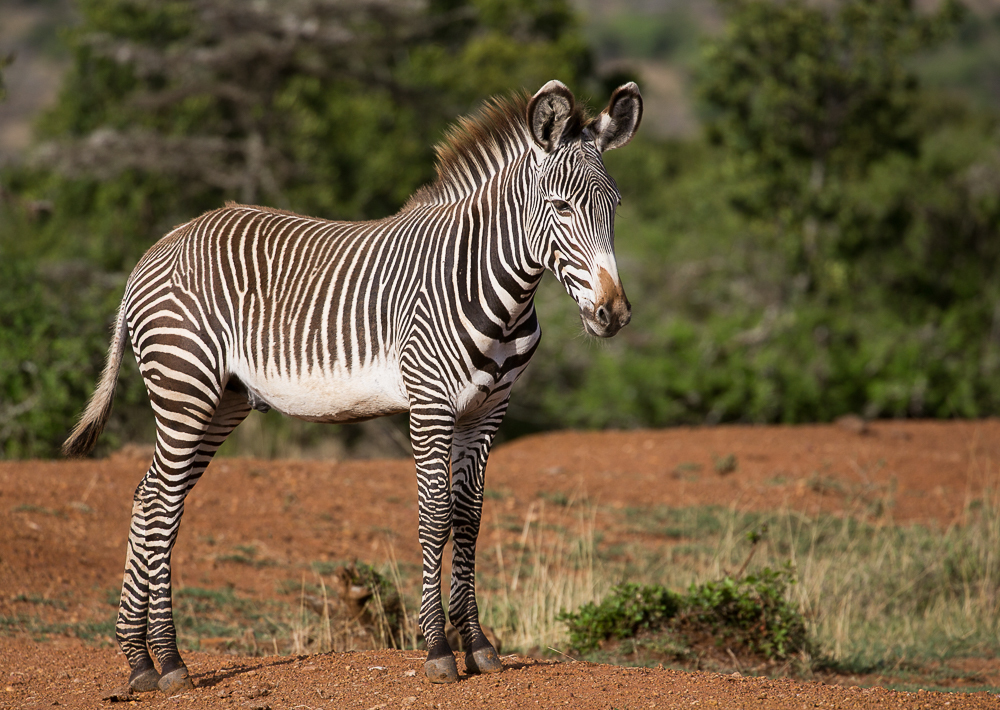
Grévy's Zebra
Equus grevyi
Grévy's zebra (Equus grevyi), also known commonly as the imperial zebra, is the largest living species of wild equid and the most threatened of the three species of zebras, the other two being the plains zebra and the mountain zebra. Named after French president Jules Grévy, it is found in parts of Kenya and Ethiopia. Superficially, Grévy's zebra's physical features can help to identify it from the other zebra species; its overall appearance is slightly closer to that of a mule and donkey, compared to the more "equine" (horse) appearance of the plains and mountain zebras. Compared to other zebra species, Grévy's zebra is the tallest; it has mule-like, larger ears, and has the narrowest stripes of all zebras. It has a distinctively erect mane, and a more slender snout.
Grévy's zebra lives in semi-arid savanna, where it feeds on grasses, legumes, and browse, such as acacia; it can survive up to five days without water. It differs from the other zebra species in that it does not live in a harem, and it maintains few long-lasting social bonds. Stallion territoriality and mother–foal relationships form the basis of the social system of the Grévy's zebra. Despite a handful of zoos and animal parks around the world having had successful captive-breeding programs, in its native home this zebra is listed by the IUCN as endangered. Its population has declined from 15,000 to 2,000 since the 1970s.
From the article Grévy's zebra on Wikipedia (CC BY-SA), quoted section by section
Description
Grévy's zebra is the largest of all wild equines. It is 2.5–2.75 m (8.2–9.0 ft) in head-body length, with a tail 55–75 cm (1.80–2.46 ft) long, stands 1.45–1.6 m (4.8–5.2 ft) high at the withers, and weighs 350–450 kg (770–990 lb). Grévy's zebra differs from the other two zebras in its more primitive characteristics. It is particularly mule-like in appearance; the head is large, long, and narrow with elongated nostril openings; the ears are very large, rounded, and conical, and the neck is short but thick. The muzzle is ash-grey to black in colour, and the lips are whiskered. The mane is tall and erect; juveniles have a mane that extends to the length of the back and shortens as they reach adulthood. As with all zebra species, Grévy's zebra's pelage has a black and white striping pattern. The stripes are narrow and close-set, broader on the neck, and extending to the hooves. The belly and the area around the base of the tail lack stripes and are just white in color, which is unique to the Grévy's zebra. Foals are born with brown and white striping, with the brown stripes darkening as they grow older.
Range & habitat
Grévy's zebra largely inhabits northern Kenya, with some isolated populations in Ethiopia. It was extirpated from Somalia and Djibouti and its status in South Sudan is uncertain. It lives in Acacia-Commiphora bushlands and barren plains. Ecologically, this species is intermediate between the arid-living African wild ass and the water-dependent plains zebra. Lactating mares and non-territorial stallions use areas with green, short grass and medium, dense bush more often than non-lactating mares and territorial stallions. Grévy's zebras rely on grasses, forbs (such as legumes), and browse for nutrition. They commonly browse when grasses are not plentiful. Their hindgut fermentation digestive system allows them to subsist on diets of lower nutritional quality than that necessary for ruminant herbivores. Grevy's zebras can survive up to a week without water, but will drink daily when it is plentiful. They often migrate to better watered highlands during the dry season. Mares require significantly more water when they are lactating. During droughts, the zebras will dig water holes and defend them. The main predators of Grévy's zebras are lions, but spotted hyenas also hunt them. African hunting dogs, cheetahs, and leopards almost never attack adults, even in desperate times, but they sometimes prey on young animals, although mares are fiercely protective of their young. …
Wikipedia: “Range and ecology”
What it does
Adult stallions mostly live in territories during the wet seasons but some may stay in them year round if there's enough water left. Stallions that are unable to establish territories are free-ranging and are known as bachelors. Mares, young and non-territorial stallions wander through large home ranges. The mares will wander from territory to territory preferring the ones with the highest-quality food and water sources. Up to nine stallions may compete for a mare outside of a territory. Territorial stallions will tolerate other stallions who wander in their territory. However, when an oestrous mare is present the territorial stallion keeps other stallions at bay. Non-territorial stallions might avoid territorial ones because of harassment. When mares are not around, a territorial stallion will seek the company of other stallions. The stallion shows his dominance with an arched neck and a high-stepping gait and the least dominant stallions submit by extending their tail, lowering their heads and nuzzling their superior's chest or groin. Zebras produce numerous sounds and vocalisations. When alarmed, they produce deep, hoarse grunts. Whistles and squeals are also made when alarmed, during fights, when scared or in pain. Snorts may be produced when scared or as a warning. A stallion will bray in defense of his territory, when driving mares, or keeping other stallions at bay. …
Wikipedia: “Behaviour and life history”
Listen
Looking for field recordings…
Where it lives
Recorded sightings
—
geo-referenced records in GBIF, from museums, herbaria and field observers.
Drag the globe to turn it. Dots are where records exist, not a range map; darker means more records.
In the stacks
Searching the stacks…
Every page naming Equus grevyi in the Biodiversity Heritage Library →
This page is assembled live from iNaturalist, GBIF, Wikipedia, the Source Library and the Internet Archive. It is not yet part of the hand-edited codex. iNaturalist taxon 43339.