- Animals
- ›Chordates
- ›Vertebrates
- ›Mammals
- ›Therians
- ›Placental Mammals
- ›Ungulates, Carnivorans, and Allies
- ›Odd-toed Ungulates
- ›Equines
- ›Equus
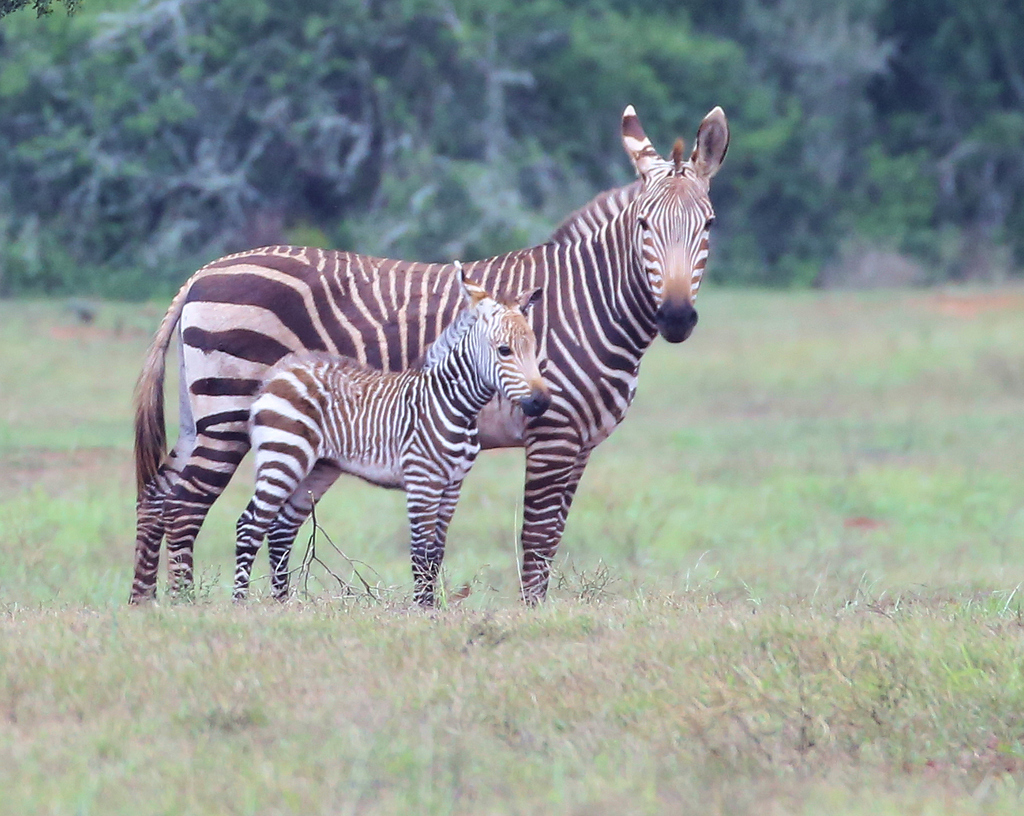
Mountain Zebra
Equus zebra
The mountain zebra (Equus zebra) is a zebra species in the family Equidae, native to southwestern Africa. There are two subspecies, the Cape mountain zebra (E. z. zebra) found in South Africa and Hartmann's mountain zebra (E. z. hartmannae) found in south-western Angola and Namibia.
From the article Mountain zebra on Wikipedia (CC BY-SA), quoted section by section
Description
The mountain zebra has a dewlap, which is more conspicuous in E. z. zebra than in E. z. hartmannae. Like all extant zebras, mountain zebras are boldly striped in black or dark brown, and no two individuals look exactly alike. The whole body is striped except for the belly. In the Cape mountain zebra, the ground colour is effectively white, but the ground colour in Hartmann's zebra is slightly buff. Adult mountain zebras have a head-and-body length of 2.1 to 2.6 m (6 ft 11 in to 8 ft 6 in) and a tail of 40 to 55 cm (16 to 22 in) long. Wither height ranges from 1.16 to 1.5 m (3 ft 10 in to 4 ft 11 in). They weigh from 204 to 372 kg (450 to 820 lb). Groves and Bell found that Cape mountain zebras exhibit sexual dimorphism, females being larger than males, whereas Hartmann's mountain zebras do not. Hartmann's zebra is on average slightly larger than the Cape mountain zebra.
Wikipedia: “Appearance”
Range & habitat
Mountain zebras are found on mountain slopes, open grasslands, woodlands, and areas with sufficient vegetation, but their preferred habitat is mountainous terrain, especially escarpment with a diversity of grass species.
Wikipedia: “Habitat”
What it does
Mountain zebras live in hot, dry, rocky, mountainous and hilly habitats. They prefer slopes and plateaus as high as 2,000 m (6,600 ft) above sea level, although they do migrate lower during winter. Their preferred diet is tufted grass, primarily Themeda triandra, but in times of shortage, they browse, eating bark, twigs, leaves, buds, fruit, and roots. Other grasses consumed include Cymbopogon pospischilii, Heteropogon contortus, Setaria sphacelata, and Enneapogon scoparius. They drink every day. When no surface water is available due to drought, they commonly dig for ground water in dry river beds. The Cape mountain zebra and Hartmann's mountain zebra are now allopatric, meaning that their present ranges do not overlap, which prevents them from crossbreeding. This was not always so, and the current situation is a result of their populations being fragmented when hunters exterminated them throughout the Northern Cape Province of South Africa. Historically, mountain zebras could be found across the entire length of the escarpments along the west coast of southern Africa and in the fold mountain region in the south. However, they generally inhabited poorly productive land and were nowhere really numerous in comparison to those species of zebras or antelope that inhabited the plains, for example.
Wikipedia: “Ecology”
Listen
Looking for field recordings…
Where it lives
Recorded sightings
—
geo-referenced records in GBIF, from museums, herbaria and field observers.
Drag the globe to turn it. Dots are where records exist, not a range map; darker means more records.
In the stacks
Searching the stacks…
Every page naming Equus zebra in the Biodiversity Heritage Library →
This page is assembled live from iNaturalist, GBIF, Wikipedia, the Source Library and the Internet Archive. It is not yet part of the hand-edited codex. iNaturalist taxon 43330.