- Animals
- ›Chordates
- ›Vertebrates
- ›Mammals
- ›Therians
- ›Placental Mammals
- ›Primates, Rodents, and Allies
- ›Rodents
- ›Squirrels, Dormice, and Mountain Beavers
- ›Squirrels
- ›Ground and African Tree Squirrels
- ›Holarctic Ground Squirrels
- ›Marmota
- ›Petromarmota
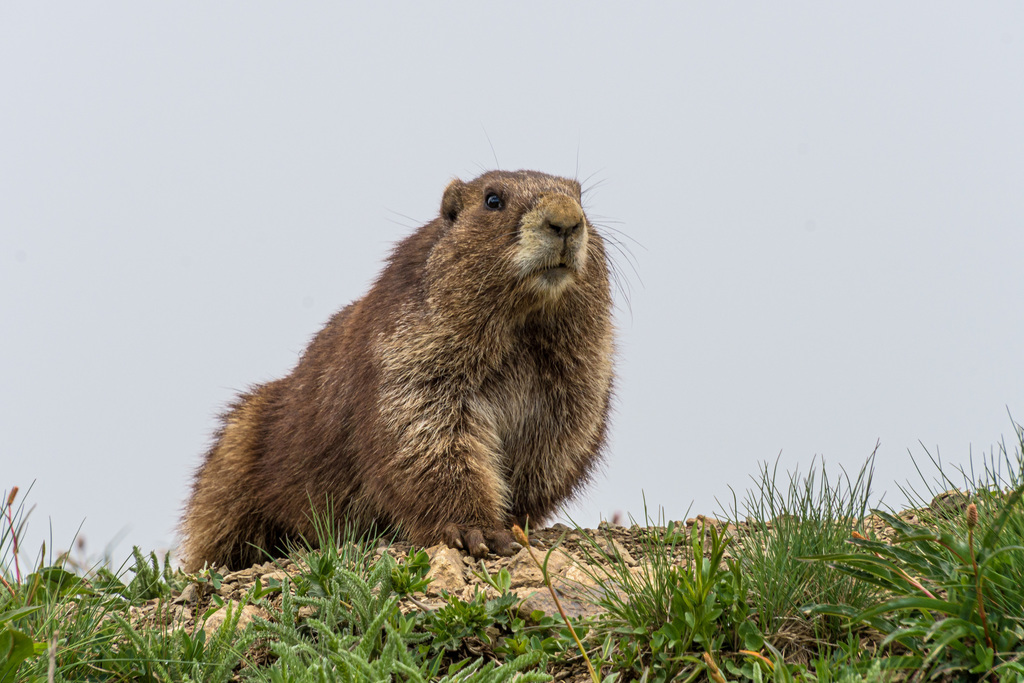
Olympic Marmot
Marmota olympus
The Olympic marmot (Marmota olympus) is a rodent in the squirrel family, Sciuridae. It occurs only in the U.S. state of Washington, at the middle elevations of the Olympic Peninsula. The closest relatives of this species are the hoary marmot and the Vancouver Island marmot. In 2009, it was declared the official endemic mammal of Washington state.
This marmot is about the size of a domestic cat, typically weighing about 8 kg (18 lb) in summer. The species shows the greatest sexual dimorphism found in marmots, with adult males weighing on average 23% more than females. It can be identified by a wide head, small eyes and ears, stubby legs, and a long, bushy tail. Its sharp, rounded claws aid in digging burrows. The coat color changes with the season and with age, but an adult marmot's coat is brown all over with small white areas for most of the year.
From the article Olympic marmot on Wikipedia (CC BY-SA), quoted section by section
Description
The Olympic marmot's head is wide with small eyes and ears; the body is stocky with stubby legs and sharp, rounded claws that facilitate digging; the tail is bushy and ranges from 18 to 24 cm (7.1 to 9.4 in) long. The Olympic marmot is about the size of a domestic cat; adults typically weigh from 2.7 to 11 kg (6.0 to 24.3 lb) and are from 67 to 75 cm (26 to 30 in) in length, with the average being 71 cm (28 in). This species may have the most pronounced sexual dimorphism found in marmots, with adult males weighing on average 4.1 to 9.3 kg (9.0 to 20.5 lb), post emergence in spring and at peak weights in autumn, respectively, and adult females weighing 3.1 to 7.1 kg (6.8 to 15.7 lb) at the same times. The Olympic marmot is the largest of the six marmot species found in North America, averaging slight heavier in mean body mass than hoary marmot and Vancouver marmot. Mean linear dimensions suggest the Olympic species is about 7% larger on average than these other two large North American species. The species rivals some lesser-studied Asian species as the largest marmots and largest members of the squirrel family, with similar body masses attained by some species such as the Tarbagan marmot and the Himalayan marmot. The coat is double-layered, consisting of soft, thick underfur, for warmth, and coarser outer hairs. …
Range & habitat
Olympic marmots are native to the Olympic Mountains in the Olympic Peninsula of Washington state. About 90% of Olympic marmots' total habitat is located in Olympic National Park, where they are often sighted, especially on Hurricane Hill. Marmots are in decline in some areas of the park due to encroachment by trees into meadows as well as predation by coyotes, and they are seldom seen in the wetter southwestern part. Within the park, Olympic marmots inhabit lush sub-alpine and alpine meadows, fields, and montane scree slopes. They live in colonies spread out in various locations in the mountains and containing the burrows of varied numbers of marmot families. Some meadows can contain as few as one marmot family, while some can have multiple families, amounting to as many as 40 marmots. There is a higher risk of inbreeding and death from random events in meadows with fewer marmots, making migration essential to the survival of the species. Burrows can be found at elevations ranging from 920 m (3,020 ft) to 1,990 m (6,530 ft); they are most often found in the range of 1,500 m (4,900 ft) to 1,750 m (5,740 ft). Burrows are more frequently located on south-facing slopes, which generally receive more precipitation, 75 cm (30 in) per year (mostly snow), and thus have more available flora. …
Wikipedia: “Distribution and habitat”
What it does
Olympic marmots eat meadow flora such as avalanche and glacier lilies, heather blossoms, subalpine lupine, mountain buckwheat, harebells, sedges, and mosses. They prefer green, tender, flowering plants over other sources of food, but roots are a large part of their diets in the early spring when other plants have not yet appeared. During May and June, they may resort to gnawing on trees for food. They also occasionally eat fruits and insects. Their water requirements are met by the juice in the vegetation they eat and dew on the plants' surfaces. When snowfall covers vegetation, marmots have a more omnivorous diet, consuming carrion encountered while digging for roots and possibly killing late hibernating chipmunks (Neotamias townsendii). At this time, they also obtain water from melted snow. Hibernating Olympic marmots do not keep food in their burrows; instead, they put on fat before hibernating and can double their body weight to survive eight months without eating.
Wikipedia: “Feeding”
Listen
Looking for field recordings…
Where it lives
Recorded sightings
—
geo-referenced records in GBIF, from museums, herbaria and field observers.
Drag the globe to turn it. Dots are where records exist, not a range map; darker means more records.
In the stacks
Searching the stacks…
Every page naming Marmota olympus in the Biodiversity Heritage Library →
This page is assembled live from iNaturalist, GBIF, Wikipedia, the Source Library and the Internet Archive. It is not yet part of the hand-edited codex. iNaturalist taxon 46093.