- Animals
- ›Chordates
- ›Vertebrates
- ›Mammals
- ›Therians
- ›Placental Mammals
- ›Primates, Rodents, and Allies
- ›Rodents
- ›Squirrels, Dormice, and Mountain Beavers
- ›Squirrels
- ›Ground and African Tree Squirrels
- ›Holarctic Ground Squirrels
- ›Spermophilus
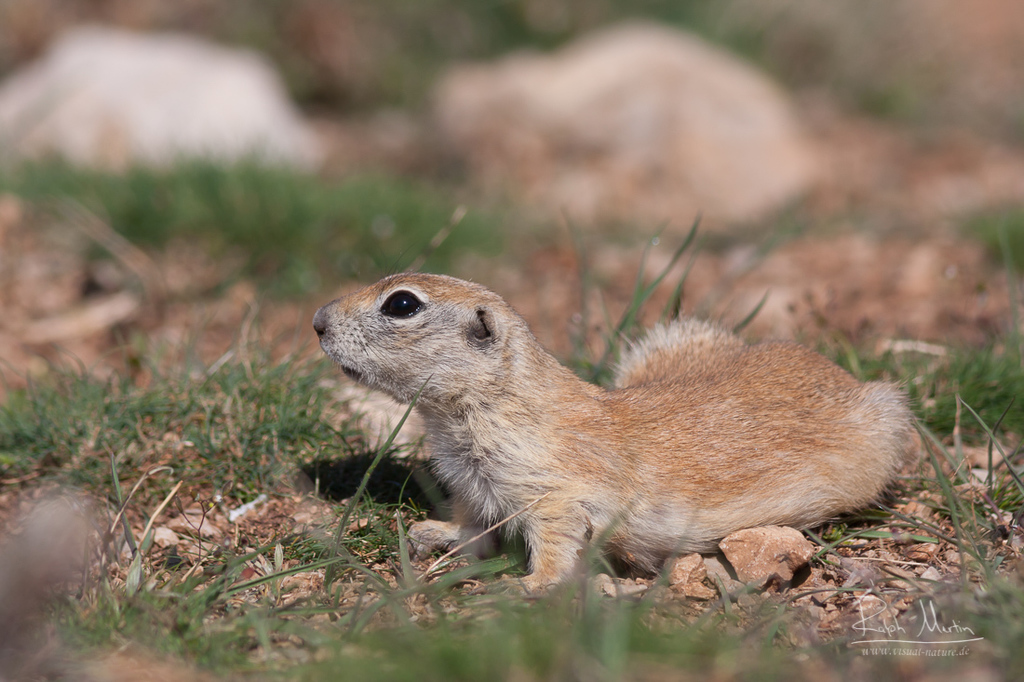
Asia Minor Ground Squirrel
Spermophilus xanthoprymnus
The Asia Minor ground squirrel (Spermophilus xanthoprymnus), also known as Anatolian souslik, Anatolian ground squirrel, is a species of rodent in the family Sciuridae. It is found in Armenia, Iran, and Turkey. The scientific name roughly translates as "seed-lover with yellow underparts".
From the article Asia Minor ground squirrel on Wikipedia (CC BY-SA), quoted section by section
Description
Like many other ground squirrels, the Asia Minor species has a rounded body and head, with short limbs and tail. Males, at 25 to 29 centimetres (9.8 to 11.4 in) in total length and 235 to 490 grams (8.3 to 17.3 oz) in weight, are noticeably larger than females at 23 to 28 centimetres (9.1 to 11.0 in) and 170 to 410 grams (6.0 to 14.5 oz). The tail is 3 to 6 centimetres (1.2 to 2.4 in) long. The fur is uniform in colour over most of the body, and does not have the darker markings found in neighbouring species such as the European souslik. Asia Minor ground squirrels are typically buff in colour, but may vary from greyish to dark brown. The underside and limbs are somewhat paler than the rest of the body, often being yellowish in colour. The only clear markings are narrow white rings around the eyes, and a white patch on the chin and throat. Females have eight or ten teats, and both sexes possess scent-producing anal glands.
Range & habitat
Asia Minor ground squirrels are found throughout central and eastern Anatolia in Turkey, extending into Iran and Armenia at the very eastern edge of their range. Small, isolated populations have also been identified in the Antalya and Çukurova plain regions of southern Anatolia, but the species is otherwise absent from near-coastal regions and from European Turkey. They inhabit steppe country and alpine meadows, between 800 and 2,900 metres (2,600 and 9,500 ft) elevation. Although two subspecies of Asia Minor ground squirrel were formerly recognised, inhabiting the northwest highlands and the central lowlands of Anatolia, respectively, there seems to be little scientific evidence to support their distinct identities. They feed primarily on seeds, leaves, and shoots of hardy plants such as cocklebur, star-thistle, shepherd's purse, mustard, wild onion, speedwell, and wild grains, in addition to domesticated crops. Although primarily herbivorous, they may also eat small invertebrates. Because of the relatively arid nature of the preferred habitat, they rarely, if ever, drink free-standing water, obtaining all they need from their diet. Natural predators include eagle owls, buzzards, falcons, and red foxes.
Wikipedia: “Distribution, habitat, and diet”
What it does
Asia Minor ground squirrels are diurnal, burrowing, animals, that hibernate through the winter. Their regular burrows are simple tunnels about 21 to 57 centimetres (8.3 to 22.4 in) deep. However, burrows used for nesting or hibernation may be as deep as 219 centimetres (86 in), and may have additional entrances and deep nesting and food storage chambers. They generally hibernate from September to March, although the exact timing depends on the local climate. Hibernation in the Asia Minor ground squirrel consists of bouts of torpor lasting up to a couple of weeks, during which the body temperature drops by 10 degrees Celsius or more, separated by brief periods of arousal.
Wikipedia: “Behaviour”
Listen
Looking for field recordings…
Where it lives
Recorded sightings
—
geo-referenced records in GBIF, from museums, herbaria and field observers.
Drag the globe to turn it. Dots are where records exist, not a range map; darker means more records.
In the stacks
Searching the stacks…
Every page naming Spermophilus xanthoprymnus in the Biodiversity Heritage Library →
This page is assembled live from iNaturalist, GBIF, Wikipedia, the Source Library and the Internet Archive. It is not yet part of the hand-edited codex. iNaturalist taxon 46041.