- Animals
- ›Chordates
- ›Vertebrates
- ›Mammals
- ›Therians
- ›Placental Mammals
- ›Primates, Rodents, and Allies
- ›Primates
- ›Monkeys, Apes, and Tarsiers
- ›Monkeys and Apes
- ›New World Monkeys
- ›Spider, Howler, and Woolly Monkeys
- ›Howler Monkeys
- ›Alouatta
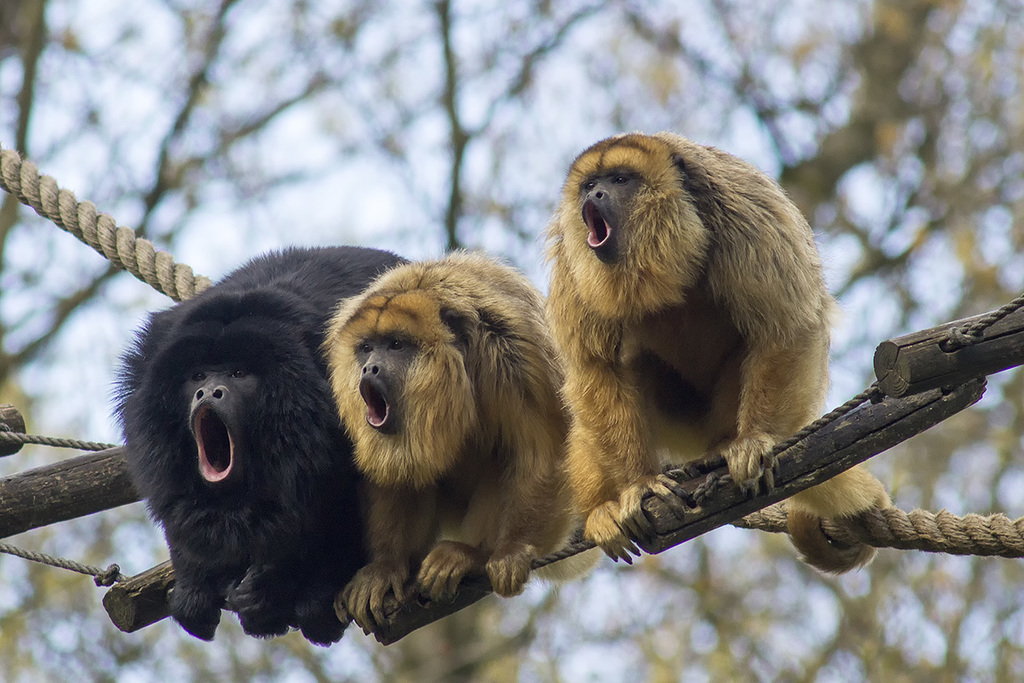
Black-and-gold Howler Monkey
Alouatta caraya
The black howler (Alouatta caraya) or black-and-gold howler, is among the largest New World monkeys and a member of the Alouatta genus. The black howler is distributed in areas of South America such as Paraguay, southern Brazil, eastern Bolivia, northern Argentina, and Uruguay. This species is sexually dimorphic, with adult males having entirely black fur and adult females and babies of both sexes having an overall golden colouring; which emphasizes black-and-gold in the name. The IUCN Red List has classed the black howler as Near Threatened as a result of a recent population reduction due to a variety of human-caused factors.
From the article Black howler on Wikipedia (CC BY-SA), quoted section by section
Range & habitat
The black howler is distributed in areas of Central and South America such as Paraguay, southern Brazil, eastern Bolivia, northern Argentina, and occasionally, Uruguay. Howler monkeys are adaptable to numerous forest environments in Central and South America. They have been spotted in tropical and subtropical forests such as evergreen, seasonally dry deciduous, semideciduous, gallery, montane, woodland, and flooded forests. They may survive in a variety of settings, including disturbed ecosystems and forest remnants in agricultural regions and human populations.
Wikipedia: “Distribution and habitat”
What it does
Black howlers share many behaviors with other howler monkeys. They are recognized for their 'howl', a powerful vocalization. A howler's 'howl' is one of the primates' strongest vocalizations, and it may be heard up to two kilometers away. The vocalizations of black howlers have been studied in Brazil, where they mostly vocalize around dawn. Howling is used as a behavioural strategy for displaying territory and regulating inter-group distance. This species is mostly arboreal, rarely coming down to the ground. They are also one of the least active groups of primates, as they are diurnal and spend up to 60-70% of the day resting or sleeping. Although the diet of the black howler is largely folivorous, it does not prevents the digestion of fruits, figs, mosses, bark, seeds, and flowers. Eating leaves may appear to be unfeasible for other primates, as it lacks nourishment and energy; however, howlers have developed a complicated digestive system that allows them to digest leaves quickly and have strong molar teeth to help chew mature leaves. Black howlers' activity levels vary depending on their diet. During the winter months, when fruit is scarce, most of their diet consists of leaves and they are less active compared to the summer months when fruit is more available. Activity ranges between feeding, socialization, locomotion, and sexual activity. …
Wikipedia: “Behaviour and diet”
Listen
Looking for field recordings…
Where it lives
Recorded sightings
—
geo-referenced records in GBIF, from museums, herbaria and field observers.
Drag the globe to turn it. Dots are where records exist, not a range map; darker means more records.
In the stacks
Searching the stacks…
Every page naming Alouatta caraya in the Biodiversity Heritage Library →
This page is assembled live from iNaturalist, GBIF, Wikipedia, the Source Library and the Internet Archive. It is not yet part of the hand-edited codex. iNaturalist taxon 43435.