- Animals
- ›Chordates
- ›Vertebrates
- ›Mammals
- ›Therians
- ›Placental Mammals
- ›Primates, Rodents, and Allies
- ›Primates
- ›Monkeys, Apes, and Tarsiers
- ›Monkeys and Apes
- ›Apes and Old World Monkeys
- ›Old World Monkeys
- ›Cercopithecines
- ›Guenons, Vervet Monkeys, and Talapoins
- ›Allenopithecus
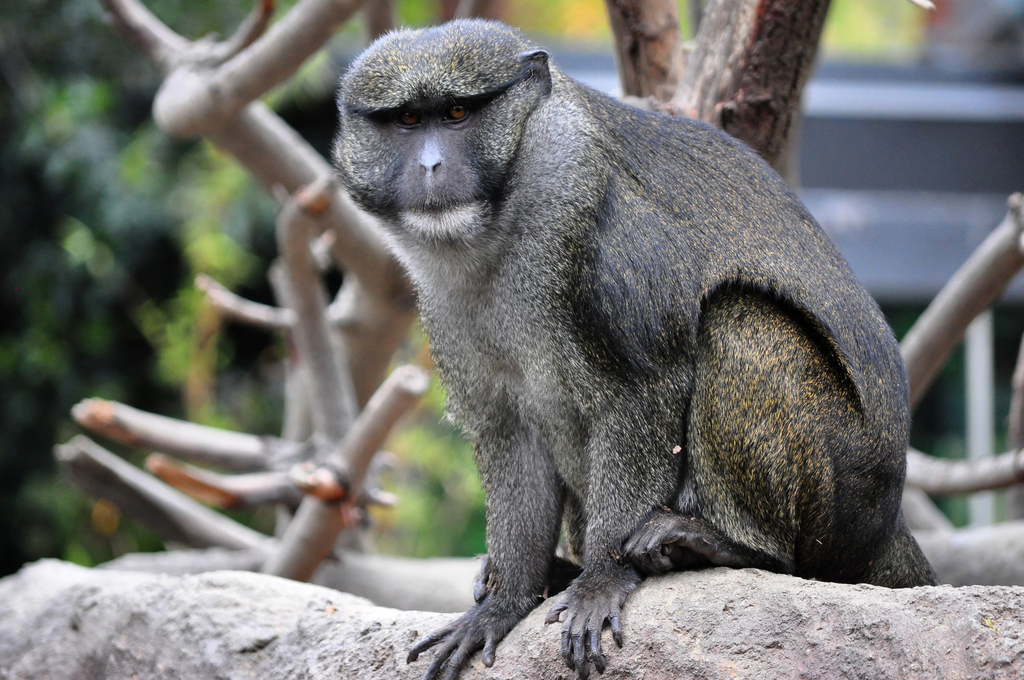
Allen's Swamp Monkey
Allenopithecus nigroviridis
Allen's swamp monkey (Allenopithecus nigroviridis) is a species of Old World monkey endemic to swamps and riparian forests in the central Congo Basin. As a medium-sized primate, adult individuals can have head-body lengths of up to 18 in (46 cm), with tails being slightly longer. It is identifiable by its coarse coat of green, brown, gray, and white fur. An arboreal omnivore, Allen's swamp monkey is typically found in trees adjacent to bodies of water, periodically descending to the ground to forage for a variety of invertebrates and plant matter in its riverine habitat. It is a diurnal, social animal that lives in groups of over 40 individuals. Although it was once considered to be a guenon, Allen's swamp monkey has been taxonomized as the only member of the genus Allenopithecus since the 1920s, which is now regarded as a sister clade of the guenons. Despite being a cercopithecin, Allen's swamp monkey exhibits a pastiche of traits typical of papionins, as it has many primitive features of the Cercopithecinae subfamily.
Allen's swamp monkey is classified as a least-concern species by the International Union for Conservation of Nature, and is projected to become threatened by poaching as road infrastructure expands near its habitats in relation to the logging industry in the Congo Basin.
From the article Allen's swamp monkey on Wikipedia (CC BY-SA), quoted section by section
Description
Allen's swamp monkey has an overall guenon-like appearance, but also possesses traits reminiscent of papionins. It has a stocky, robust build, differing from the typically gracile bodies of other cercopithecins. The adult head-body length can be as long as 18 in (46 cm). The tail is only slightly longer than the head-body length, which is derived from a longer, ancestral form that is still exhibited by extant guenons. Males, weighing up to 6.0 kg (13.2 lb), are substantially larger than the females, which only weigh up to 3.7 kg (8.2 lb). The intermembral index is 84. The skeleton is generalized so as to facilitate both arboreal and terrestrial locomotion. With the exception of the free thumb, the fingers are webbed between the proximal phalanges, which may be an adaptation to a semiaquatic lifestyle. The quadrupedal standing posture resembles that of a baboon, with the thumb and index finger articulated independently from the other three digits. Except for the pale cheeks, the facial skin is darkly pigmented. The ears are pointed, resembling those of a macaque rather than a cercopithecin. Adult females retain sparse black cilia as remnants of the long silky eyelashes of the fetal form, whereas in adult males such features are absent. The top of the braincase is flat, with the exception of an enlarged sagittal crest in males. The adult brain weighs 1⁄51 the body weight. …
Range & habitat
Allen's swamp monkey lives in the Congo Basin between 16°E and 24°E, and between 4°N and possibly 6° S. Its range includes the Republic of the Congo, the Democratic Republic of the Congo, and possibly Cameroon and Angola, with one documented observation in the Central African Republic. Prior to the 1990s, its range was believed to be limited to the swamps and riparian forests adjacent to the lower Likouala-aux-Herbes, Oubangui, and Sangha rivers. A discontinuous population was confirmed in the upper Sangha in 2006, about 100 km (62 mi) northwest of its previously recognized range. It was recorded north of Bayanga in the Central African Republic in 2016. Because of its riparian habit, rivers are less likely to be geographic barriers that affect the species' range than they are for sympatric primates.
Wikipedia: “Distribution”
What it does
Allen's swamp monkey is a diurnal primate that lives in multimale-multifemale groups of over 40 individuals. Allogrooming is practiced to reinforce social bonds between individuals. Gestures and vocalizations facilitate communication, with chirps being used as warning calls. The number of males in a group depends on the number of females, such that smaller groups are likely to contain only one adult male. Despite this demographic pattern, males are not known to live solitarily, indicating that external factors may influence the relationship between group size and adult male presence. The sizes and sexual compositions of groups imitate those of papionins; however, the rarity with which members of opposite sexes interact is a guenon trait. This idiosyncratic social organization could be a result of Allen's swamp monkey's basal position within Cercopithecini. Allen's swamp monkey is typically arboreal, although it descends to the ground to forage for food. Its diet is unusual among primates, as it not only consumes fruits, seeds, leaves, nectar, and flowers, but also small invertebrates such as shrimp, fish, snails, and worms. The digestive retention time is approximately 23–24 hours, which follows the cercopithecine pattern of having longer retention times than what would be expected for the animal's body size. …
Wikipedia: “Behavior”
Listen
Looking for field recordings…
Where it lives
Recorded sightings
—
geo-referenced records in GBIF, from museums, herbaria and field observers.
Drag the globe to turn it. Dots are where records exist, not a range map; darker means more records.
In the stacks
Searching the stacks…
Every page naming Allenopithecus nigroviridis in the Biodiversity Heritage Library →
This page is assembled live from iNaturalist, GBIF, Wikipedia, the Source Library and the Internet Archive. It is not yet part of the hand-edited codex. iNaturalist taxon 43464.