- Animals
- ›Chordates
- ›Vertebrates
- ›Mammals
- ›Therians
- ›Placental Mammals
- ›Primates, Rodents, and Allies
- ›Primates
- ›Monkeys, Apes, and Tarsiers
- ›Monkeys and Apes
- ›Apes and Old World Monkeys
- ›Old World Monkeys
- ›Colobines
- ›Langurs, Surilis, and Lutungs
- ›Trachypithecus
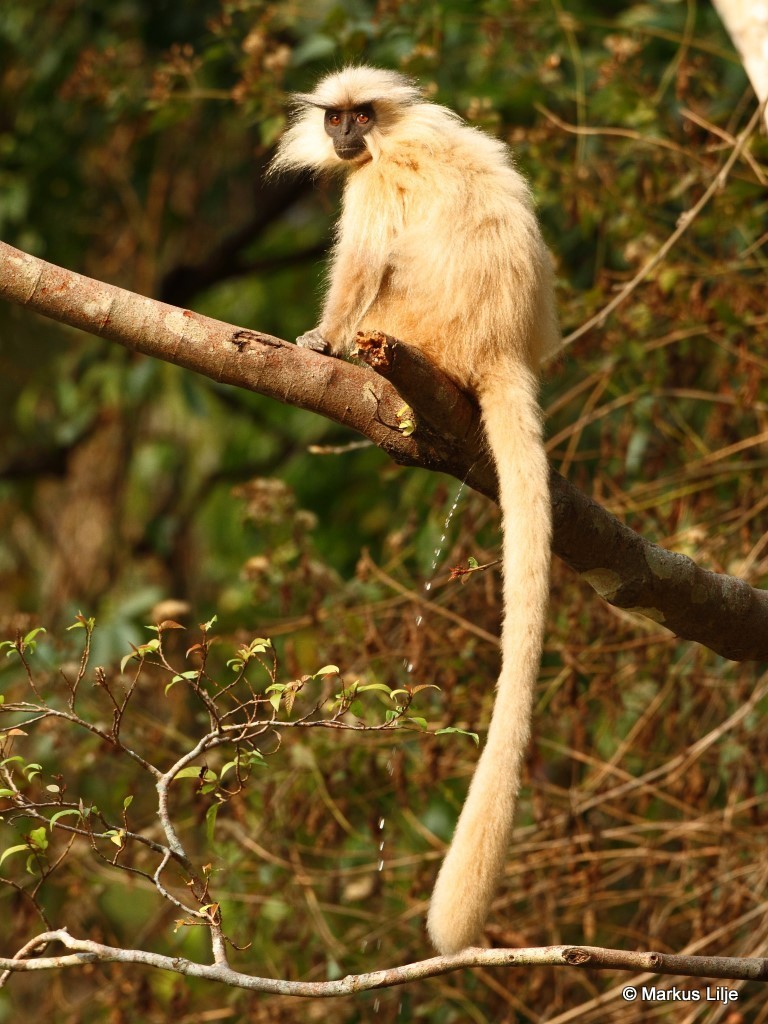
Gee's Golden Lutung
Trachypithecus geei
Gee's golden langur (Trachypithecus geei), also known as simply the golden langur, is an Old World monkey found in a small region of Western Assam, India and the neighboring foothills of the Black Mountains of Bhutan. Long considered sacred by many Himalayan people, the golden langur was first brought to the attention of the Western world by the naturalist Edward Pritchard Gee in the 1950s. Adult males have a cream to golden coat with darker flanks while the females and juveniles are lighter. The golden langur has a black face and a long tail up to 100 cm (39 in) in length. It lives in high trees and has a herbivorous diet of fruits, leaves, seeds, buds, and flowers. The average group size is eight individuals, with a ratio of several females to each adult male. It is one of the most endangered primate species of India and Bhutan.
In 2008–09, there were 6,000 golden langurs in India, which has grown to 7,396 by 2020–21.
From the article Gee's golden langur on Wikipedia (CC BY-SA), quoted section by section
Range & habitat
Gee's golden langur is found in an area of approximately 30,000 square kilometres (12,000 sq mi), much of which is unsuitable habitat, bounded on the south by the Brahmaputra River, on the east by the Manas River, on the west by the Sankosh River, in Assam, India, and on the north by the Black Mountains of Bhutan. These biogeographical barriers are believed to have led to the radiation of species from the closely related capped langur (Trachypithecus pileatus). There are two primary sub-populations fragmented by the National Highway 27. The northern sub-population occupies the western portion of the Manas National Park, extending from the Sankosh River to the Manas River along the northern side of National Highway 27 and State Highway 2, reaching the India-Bhutan border. Conversely, the southern sub-population is situated along the southern side of NH27, extending to the Brahmaputra River. Population estimates of the 2020–21 survey, indicate a larger northern population, totaling 5,566 individuals distributed across 534 groups and 23 lone males. In contrast, the southern fragmented population consists of approximately 1,830 langurs organized into 173 groups and eight lone males. …
Wikipedia: “Distribution”
What it does
For the most part, the langur is confined to high trees where its long tail serves as a balancer when it leaps across branches. During the rainy season it obtains water from dew and rain-drenched leaves. Its diet is herbivorous, consisting of ripe and unripe fruits, mature and young leaves, seeds, buds and flowers. It generally lives in troops of about 8, with a ratio of several females to each adult male. The smallest golden langur troop was composed of four individuals, while the largest had 22, giving an average value of 8.2 individuals per troop. The adult sex ratio was 2.3 females to every male, although the majority of groups had only one adult male.
Wikipedia: “Behavior and ecology”
In human culture
The earliest record of the golden langur is in an 1838 paper by Robert Boileau Pemberton which states that "Griffith observed these monkeys near Tongso in Central Bhutan." However, since Pemberton's work was lost and not rediscovered until the 1970s, the scientific discovery of the golden langur unfolded differently. In 1907, Edward Oswald Shebbeare—who was out with some hunters and forest rangers—reported seeing a "cream coloured langur" in the vicinity of the Jamduar. However, neither a photograph nor a live or dead specimen was presented at that time. The first reference to the golden langur in print, as an animal of unidentified taxonomic status, was in a 1919 publication that stated: "Pithecus sp? – A pale yellow coloured langur is common in the adjoining district of Goalpara (Assam). Jerdon reported one from Terai, the adjacent district on the (west) side, which Blanford suggested might be P. entellus." In February 1947, in the Forest Rest House visitors' book in Raimona, a few miles south of Jamduar, C. G. Baron reported seeing some langurs whose "whole body and tail is one colour – a light silvery-gold, somewhat like the hair of a blonde." A year later, back in Jamduar, H. E. …
Wikipedia: “Discovery and etymology”
Listen
Looking for field recordings…
Where it lives
Recorded sightings
—
geo-referenced records in GBIF, from museums, herbaria and field observers.
Drag the globe to turn it. Dots are where records exist, not a range map; darker means more records.
In the stacks
Searching the stacks…
Every page naming Trachypithecus geei in the Biodiversity Heritage Library →
This page is assembled live from iNaturalist, GBIF, Wikipedia, the Source Library and the Internet Archive. It is not yet part of the hand-edited codex. iNaturalist taxon 43495.