- Animals
- ›Chordates
- ›Vertebrates
- ›Mammals
- ›Therians
- ›Placental Mammals
- ›Ungulates, Carnivorans, and Allies
- ›Bats
- ›Yangochiroptera
- ›Noctilionoid Bats
- ›New World Leaf-nosed Bats
- ›Stenodermatine Bats
- ›Stenodermatini
- ›Artibeus
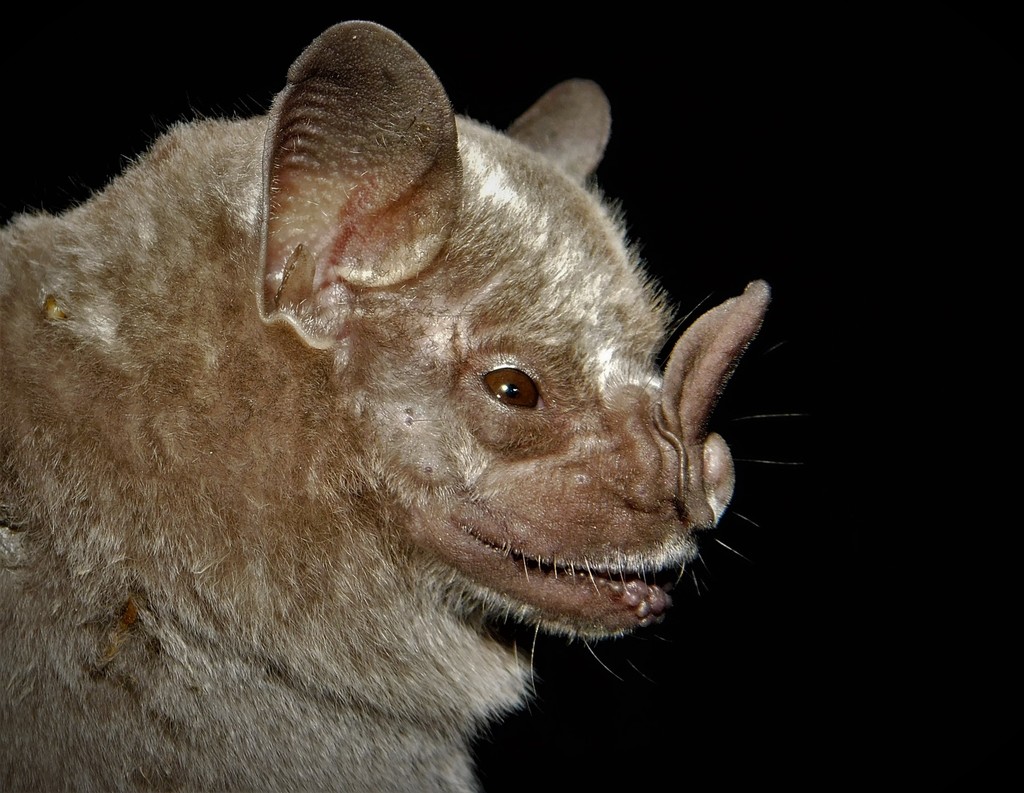
Jamaican Fruit-eating Bat
Artibeus jamaicensis
The Jamaican, common or Mexican fruit bat (Artibeus jamaicensis) is a fruit eating bat native to Mexico, through Central America to northwestern South America, as well as the Greater and many of the Lesser Antilles. It is also an uncommon resident of the Southern Bahamas. Populations east of the Andes in South America are now usually regarded a separate species, the flat-faced fruit-eating bat (A. planirostris). The distinctive features of the Jamaican fruit bat (which however...
From the article Jamaican fruit bat on Wikipedia (CC BY-SA), quoted section by section
Description
The Jamaican fruit bat is a medium-sized bat, having a total length of 78–89 mm (3.1–3.5 in) with a 96–150 mm (3.8–5.9 in) wingspan and weighing 40 to 60 g (1.4 to 2.1 oz). It has broad but pointed and ridged ears with a serrated tragus. Its prominent noseleaf has an array of sebaceous glands. The lower lip is littered with warts with a relatively large one in the center. Sebaceous holocrine glands can be found in both lips. On the back the fur is an ashy-shade of gray or brown with visible white hair bases and variable fur patterning on the face. The wings of the fruit bat are broad and dark gray in color. The underfur is paler in color. The fruit bat has no external tail. It has broad dark grey wings and a narrow hairless interfemoral membrane with a short calcar. The distinctive features of the Jamaican fruit bat (which however are shared by some of its relatives) include the absence of an external tail and a minimal, U-shaped interfemoral membrane. A transcriptome dataset is available with more than 25,000 annotated transcripts that are directly searchable by BLAST. A genome assembly has also been generated.
Range & habitat
The Jamaican fruit bat ranges from southern Mexico through Central America southward to northwestern South America (in Colombia). It also lives throughout the Caribbean islands of the Greater and Lesser Antilles, as well as the southern Bahamas. The Jamaican fruit bat can be found in elevations from sea level to 2,135 m (7,005 ft). This species is found in a variety of habitats. It prefers habitats that are humid and tropical but has also adapted to cloud forests and drier tropical habitats. Fruit bats roost in caves, hollow trees, dense foliage, buildings and leaf tents. The fruit bat may create its own "tent" to roost in by altering broad leaves. These "tents" are only temporarily used.
Wikipedia: “Distribution and habitat”
What it does
The Jamaican fruit bat is a frugivore. They eat a number of kinds of fruit but focus mostly on figs; at Barro Colorado Island, Panama, figs make up more than 78% of the fruits eaten. Bats will also supplement leaves of plants with high amounts of protein. Overall, the fruit bat consumes a diverse amount of plants but locally only eats certain types. A Jamaican fruit-eating bat plucks its food and carries it away with its mouth before eating it in its roosts. As such it can disperse seeds fairly far. Fruit bats have been recorded carrying fruits weighing 3–14 g (0.11–0.49 oz) or even as much as 50 g (1.8 oz). Jamaican fruit bats rely on sight and smell to find fruit of certain colors and odors. They mainly feed on Ficus figs and also on other fruits like avocados, mangoes, guava, papaya and bananas. In the dry season, their diet can consist of leaves of plants whose foliage has large amounts of protein, nectar, pollen, flower pieces and a few insects.
Wikipedia: “Diet”
Listen
Looking for field recordings…
Where it lives
Recorded sightings
—
geo-referenced records in GBIF, from museums, herbaria and field observers.
Drag the globe to turn it. Dots are where records exist, not a range map; darker means more records.
In the stacks
Searching the stacks…
Every page naming Artibeus jamaicensis in the Biodiversity Heritage Library →
This page is assembled live from iNaturalist, GBIF, Wikipedia, the Source Library and the Internet Archive. It is not yet part of the hand-edited codex. iNaturalist taxon 41005.