- Animals
- ›Chordates
- ›Vertebrates
- ›Amphibians
- ›Frogs and Toads
- ›African Reed Frogs
- ›Typical Reed Frogs
- ›Afrixalus
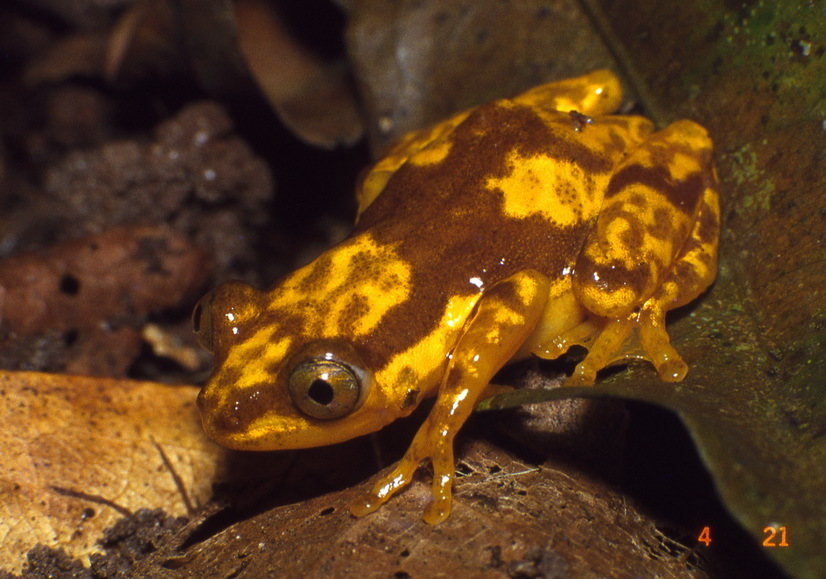
Nimba banana frog
Afrixalus vibekensis
Afrixalus vibekensis, sometimes known as the Nimba banana frog, is a species of frogs in the family Hyperoliidae. It is confirmed to exist in two locations in Côte d'Ivoire and one in Ghana, and it possibly occurs in Guinea and Liberia. It was originally described as subspecies of Afrixalus laevis and the type locality is in Côte d'Ivoire near Mount Nimba.
From the article Afrixalus vibekensis on Wikipedia (CC BY-SA), quoted section by section
Description
Adult males measure 19–23 mm (0.7–0.9 in) and adult females 23–27 mm (0.9–1.1 in) in snout–vent length. The dorsum is yellowish white with a darker or lighter brown pattern; the pattern does not vary between individuals (as in Afrixalus laevis). Males lack asperities. The male advertisement call consists of an inconspicuous buzzing with low intensity, which is then followed by a creaking sound.
Range & habitat
Afrixalus vibekensis occurs in forest edge habitats such as forest road margins and tree-fall gaps. Breeding takes place in small temporary ponds and puddles. The eggs are laid either on leaves above water or directly in the water. This species is difficult to find and might be under-recorded. It is threatened by habitat loss caused by agricultural encroachment, expanding human settlements, and logging. It occurs in the Taï National Park and Haute Dodo Classified Forest in Côte d'Ivoire and in the Bobiri Forest Reserve and Butterfly Sanctuary in Ghana.
== References ==
Wikipedia: “Habitat and conservation”
Listen
Looking for field recordings…
Where it lives
Recorded sightings
—
geo-referenced records in GBIF, from museums, herbaria and field observers.
Drag the globe to turn it. Dots are where records exist, not a range map; darker means more records.
In the stacks
Searching the stacks…
Every page naming Afrixalus vibekensis in the Biodiversity Heritage Library →
This page is assembled live from iNaturalist, GBIF, Wikipedia, the Source Library and the Internet Archive. It is not yet part of the hand-edited codex. iNaturalist taxon 23471.