- Animals
- ›Chordates
- ›Vertebrates
- ›Amphibians
- ›Frogs and Toads
- ›Terraranas
- ›Rain Frogs
- ›Eleutherodactylinae
- ›Eleutherodactylus
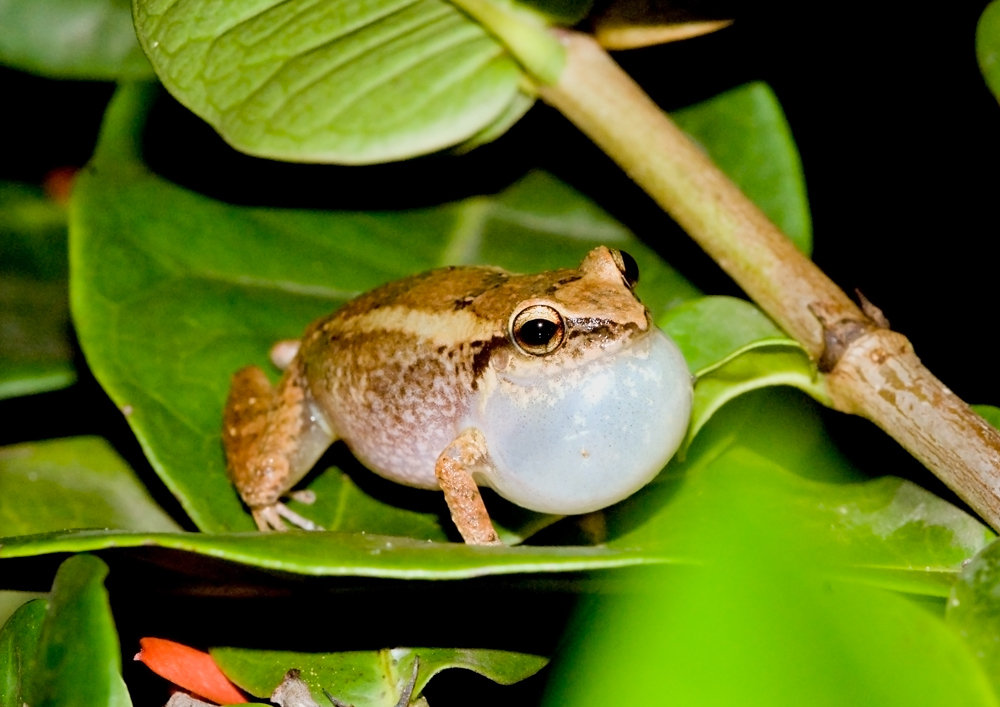
Lesser Antillean whistling frog
Eleutherodactylus johnstonei
The Antilles coqui (also known as the Montserrat whistling frog or the Lesser Antillean whistling frog, Spanish: coquí antillano, scientific name Eleutherodactylus johnstonei), is a species of frog in the Eleutherodactylidae family found in Anguilla, Antigua and Barbuda, Barbados, Bermuda, Colombia, Dominica, French Guiana, Grenada, Guadeloupe, Guyana, Jamaica, Martinique, Montserrat, the Netherlands Antilles, Panama, Saint Kitts and Nevis, Saint Lucia, Saint Vincent and the Grenadines, Trinidad and Tobago, and Venezuela. Its natural habitats are subtropical or...
From the article Antilles coquí on Wikipedia (CC BY-SA), quoted section by section
Description
The snout-to-vent length of the species is around 35 mm (1.4 in) for females 25 mm (0.98 in) for males, but variation is high, especially so between different populations of the frog. Individuals have colourations ranging from brown to a greyish-tan, usually with colourful patterns, almost always including one chevron on their heads and often with another on their backs.
Range & habitat
The frog is native to the Lesser Antilles, but its range has expanded to the entire Caribbean, up to Bermuda, down into South America and across the Pacific into greenhouses and botanical gardens in Europe. The frogs proficiency at establishing itself in places it has been introduced to has led to it being considered an invasive species. The frog is capable of surviving in a wide variety of habitats, including urban ones, living at elevations ranging from sea level to over 1,700 metres (5,600 ft). Zoologist Albert Schwartz said of them that they dwell in "almost any terrestrial situation which offer concealment and some moisture"..
Wikipedia: “Distribution and habitat”
What it does
The frog's call consists of a lower pitch note lasting 0.07–0.09 seconds followed by a higher pitch note lasting 0.18–0.27 seconds. Males tend to be about a meter off the ground, perched on leaves, when they make their calls. Individuals make up to 60 calls in a minute, but the average time between the end of one call and the beginning of the next is 1.2 seconds.
Wikipedia: “Behaviour”
Listen
Looking for field recordings…
Where it lives
Recorded sightings
—
geo-referenced records in GBIF, from museums, herbaria and field observers.
Drag the globe to turn it. Dots are where records exist, not a range map; darker means more records.
In the stacks
This page is assembled live from iNaturalist, GBIF, Wikipedia, the Source Library and the Internet Archive. It is not yet part of the hand-edited codex. iNaturalist taxon 22333.