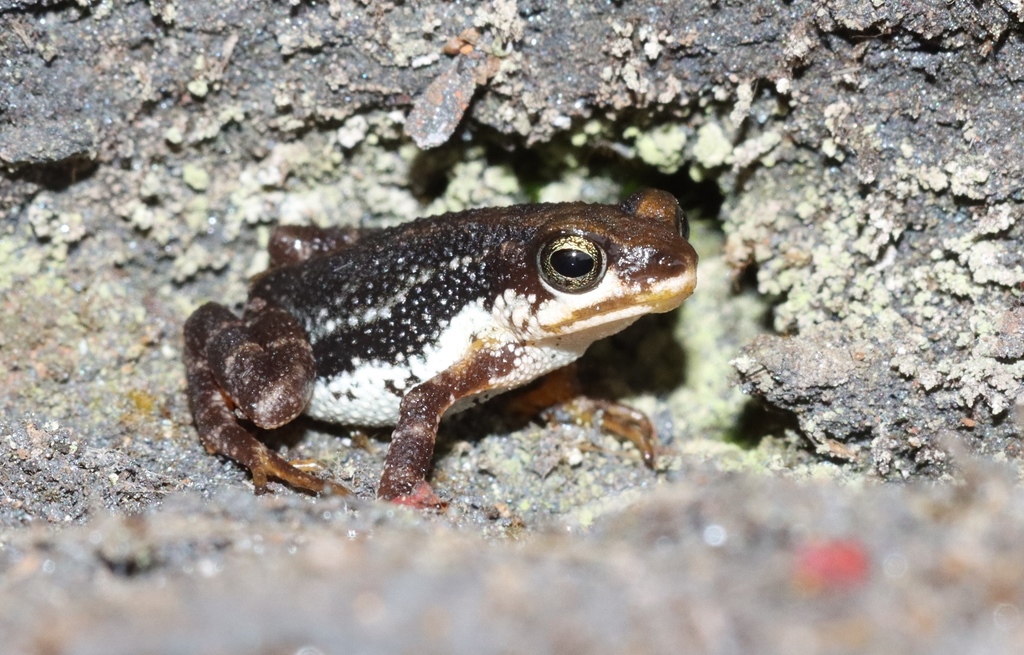
Western Nimba Toad
Nimbaphrynoides occidentalis
Nimbaphrynoides is a monotypic genus of true toads from highlands in the Mount Nimba region of the West African countries of Guinea, Liberia, and Côte d'Ivoire. The sole species is Nimbaphrynoides occidentalis. Along with Nectophrynoides, Eleutherodactylus jasperi, and Limnonectes larvaepartus, Nimbaphrynoides is one of the only anurans that combine internal fertilization with ovoviviparity.
From the article Nimbaphrynoides on Wikipedia (CC BY-SA), quoted section by section
Description
Adult males of Nimbaphrynoides occidentalis occidentalis measure on average 18 mm (0.7 in) and adult females on average 20.5 mm (0.8 in) in snout–vent length. Nimbaphrynoides occidentalis liberiensis are larger at respectively 22.4 and 28.7 mm (0.9 and 1.1 in). Adult colouration is variable. The dorsum in most individuals is brown to black backs, without a distinct border between the two colours. It may also be uniform in colouration, or have lighter and darker browns irregularly mixed. There are some lighter areas in the head, at least on the snout and the eye-lids. The legs are light brown with irregularly bordered darker stripes or dots. The venter is typically white, but some Nimbaphrynoides occidentalis liberiensis have small to large light brown dots on their venter. Juveniles had brighter coloured backs than adults.
Range & habitat
Nimbaphrynoides occur in montane grasslands at elevations of 1,200–1,680 m (3,940–5,510 ft) above sea level. It is not tolerant to disturbance, and recent observations are from less impacted areas where soil was not compacted or little compacted. It can be locally very common, but the population is severely fragmented. The area has been affected by mining, and the type locality of Nimbaphrynoides occidentalis liberiensis is now an open cast mining pit. Future threats include a proposed iron ore mining concession and the arrival of a large contingent of refugees. Part of the population is protected by the Mount Nimba Strict Nature Reserve, although improved management of the site is required.
Wikipedia: “Habitat and conservation”
What it does
The male advertisement call is very faint, short, and resembles a metallic "bing". Nimbaphrynoides are viviparous—they have internal fertilisation and the female gives birth to fully developed, tiny toadlets. Eggs are small, ranging from 0.5–0.6 mm in diameter.
Wikipedia: “Reproduction”
Listen
Looking for field recordings…
Where it lives
Recorded sightings
—
geo-referenced records in GBIF, from museums, herbaria and field observers.
Drag the globe to turn it. Dots are where records exist, not a range map; darker means more records.
In the stacks
This page is assembled live from iNaturalist, GBIF, Wikipedia, the Source Library and the Internet Archive. It is not yet part of the hand-edited codex. iNaturalist taxon 134953.