- Animals
- ›Chordates
- ›Vertebrates
- ›Cartilaginous Fishes
- ›Sharks and Rays
- ›Sharks
- ›Squalean Sharks
- ›Squaliform Sharks
- ›Kitefin Sharks
- ›Dalatias
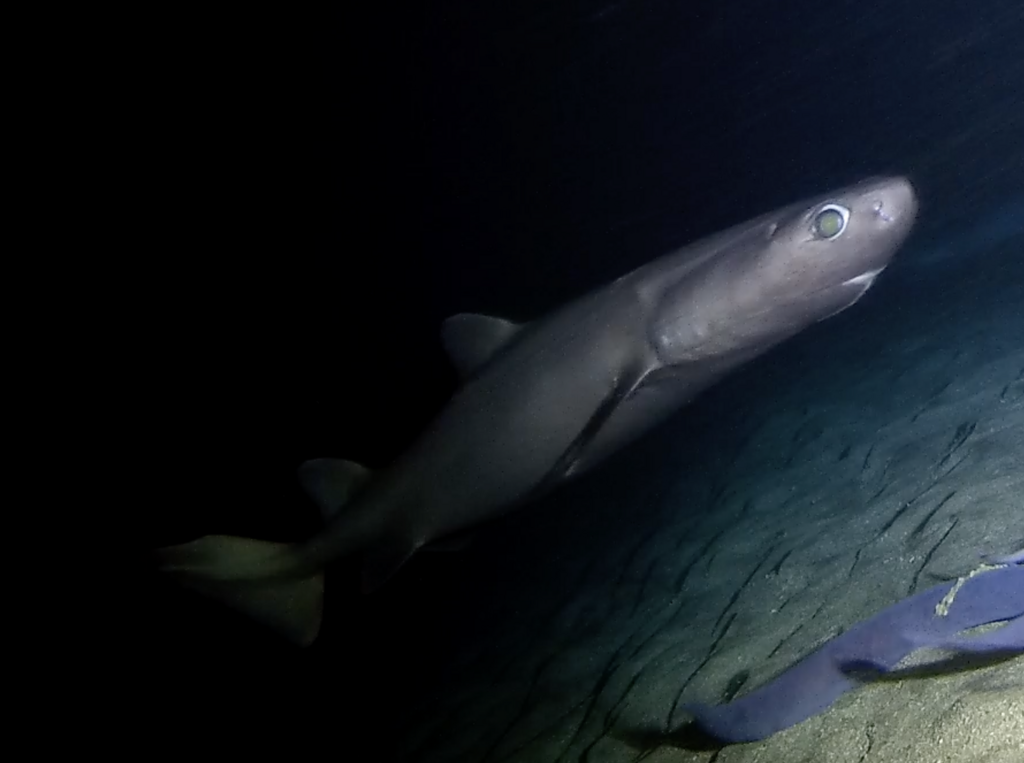
Kitefin Shark
Dalatias licha
The kitefin shark or seal shark (Dalatias licha) is a species of squaliform shark in the family Dalatiidae, and the type species in its genus. It is found sporadically around the world, usually close to the sea floor at depths of 200–600 m (660–1,970 ft). With a sizable oil-filled liver to maintain neutral buoyancy, this shark is able to cruise slowly through the water while expending little energy. The kitefin shark, the largest luminous vertebrate on record, has a slender body with a very short, blunt snout, large eyes, and thick lips. Its teeth are highly differentiated between the upper and lower jaws, with the upper teeth small and narrow and the lower teeth large, triangular, and serrated. Its typical length is 1.0–1.4 m (3.3–4.6 ft), though examples as long as 5.9 ft (180 cm) have been encountered.
Armed with large teeth and a strong bite, the kitefin shark is a powerful, solitary predator that takes many different types of prey, ranging from bony fishes, sharks and rays, to cephalopods, crustaceans, polychaete worms, siphonophores, and possibly carrion. It also takes bites out of animals larger than itself, similar to its smaller relative, the cookiecutter shark (Isistius brasiliensis). This shark is aplacental viviparous and gives birth to 10–14 young. The kitefin shark is fished commercially for its meat, skin, and liver oil, primarily by Portugal and Japan.
From the article Kitefin shark on Wikipedia (CC BY-SA), quoted section by section
Description
The kitefin shark has a moderately elongated body with a very short, rounded snout. The eyes and spiracles are large. The lips are thick with pleats or fringes, though are not modified to be suctorial. There are 16–21 tooth rows in the upper jaw and 17–20 tooth rows in the lower jaw. The upper teeth are small and spike-shaped, curving slightly towards the corners of the mouth. The lower teeth are very large, knife-shaped, and serrated, with their bases interlocking to form a continuous cutting surface. The first dorsal fin is slightly smaller and shorter-based than the second, and neither has spines. The first dorsal fin originates behind the free rear tip of the pectoral fins, while the second originates above the middle of the pelvic fin bases. The pectoral fins are short and rounded. The caudal fin has a prominent upper lobe with a well-developed notch near the tip, and a barely present lower lobe. The form and arrangement of the fins is similar to the Portuguese dogfish (Centroscymnus coelolepis), from which this species can be distinguished by the lack of fin spines. The dermal denticles are small and flat, with a single horizontal ridge ending in a point. The coloration is a uniform dark brown or gray, sometimes with faint black spots on the back. The fins have white or translucent trailing edges, and the tip of the caudal fin is black. …
Range & habitat
The kitefin shark has an almost circumglobal range in tropical and warm-temperature waters, consisting of a number of widely separated populations with likely little interchange between them. This shark has not been reported from the eastern Pacific and northern Indian Oceans. In the northern Atlantic, it occurs in the Georges Bank and the northern Gulf of Mexico, and from the North Sea to Cameroon, including around the British Isles, in the western and central Mediterranean Sea, and off Madeira and the Azores. In the Indian Ocean, it is found off South Africa and Mozambique. In the Pacific, it occurs off Japan, Java, Australia and New Zealand, and the Hawaiian Islands. There is a single record of this species in the southern Atlantic, from off southern Brazil. An offshore, deepwater species, the kitefin shark is most common at a depth of 200–600 m (660–1,970 ft), but has been captured from the surface to as deep as 1,800 m (5,900 ft). Off the Azores this shark segregates by sex, with females most common around a depth of 230 m (750 ft) and males most common around 412–448 m (1,352–1,470 ft). The kitefin shark inhabits the outer continental shelves and upper continental slopes, and is also found around oceanic islands and seamounts. …
Wikipedia: “Distribution and habitat”
What it does
Relatively common where it occurs, kitefin sharks are usually solitary in nature but may form small groups. It is a slow swimmer with a large liver filled with squalene, a lipid less dense than water, allowing it to maintain neutral buoyancy and hover above the bottom with little effort. Studies off the coast of North Africa and in the Gulf of Genoa have found males outnumbering females by 2:1 and 5:1 respectively; this imbalanced sex ratio has not been observed off South Africa and may reflect sampling bias. The kitefin shark is preyed upon by larger fishes and sharks, as well as by sperm whales (Physeter macrocephalus). Parasite data on this species is limited; an examination of two sharks caught off Ireland found three nematodes in the stomach lumen. One could be identified as Anisakis simplex L3, while another may have been a larval Raphidascaris. A powerful and versatile deepwater predator, the short, robust jaws of the kitefin shark give it an enormously strong bite. …
Wikipedia: “Biology and ecology”
Where it lives
Recorded sightings
—
geo-referenced records in GBIF, from museums, herbaria and field observers.
Drag the globe to turn it. Dots are where records exist, not a range map; darker means more records.
In the stacks
Searching the stacks…
Every page naming Dalatias licha in the Biodiversity Heritage Library →
This page is assembled live from iNaturalist, GBIF, Wikipedia, the Source Library and the Internet Archive. It is not yet part of the hand-edited codex. iNaturalist taxon 51322.