- Animals
- ›Chordates
- ›Vertebrates
- ›Cartilaginous Fishes
- ›Sharks and Rays
- ›Sharks
- ›Squalean Sharks
- ›Squaliform Sharks
- ›Kitefin Sharks
- ›Isistius
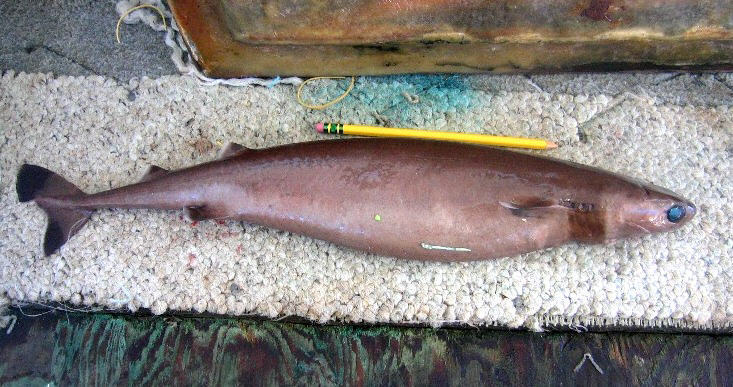
Smalltooth Cookiecutter Shark
Isistius brasiliensis
The cookiecutter shark (Isistius brasiliensis), also called the cigar shark, is a species of small squaliform shark in the family Dalatiidae. This shark lives in warm, oceanic waters worldwide, particularly near islands, and has been recorded as deep as 3.7 km (2.3 mi). It migrates vertically up to 3 km (1.9 mi) every day, approaching the surface at dusk and descending with the dawn. Reaching only 42–56 cm (16.5–22 in) in length, the cookiecutter shark has a long, cylindrical body with a short, blunt snout, large eyes, two tiny spineless dorsal fins, and a large caudal fin. It is dark brown, with light-emitting photophores covering its underside except for a dark "collar" around its throat and gill slits.
The name "cookiecutter shark" refers to its feeding method of gouging round plugs, as if cut out with a cookie cutter, out of larger animals. Marks made by cookiecutter sharks have been found on a wide variety of marine mammals and fishes, and on submarines, undersea cables, and human bodies. It also consumes whole smaller prey, such as squid. Cookiecutter sharks have adaptations for hovering in the water column, and likely rely on stealth and subterfuge to capture more active prey. Its dark collar seems to mimic the silhouette of a small fish, while the rest of its body blends into the downwelling light via its ventral photophores. When a would-be predator approaches the lure, the shark attaches itself using its suctorial lips and specialized pharynx and neatly excises a chunk of the flesh using its bandsaw-like set of lower teeth.
From the article Cookiecutter shark on Wikipedia (CC BY-SA), quoted section by section
Description
The cookiecutter shark has an elongated, cigar-shaped body with a short, bulbously rounded snout. The nostrils have a very short flap of skin in front. The large, oval, green eyes are placed forward on the head, though not so that binocular vision is extensive. Behind the eyes are large spiracles, positioned on the upper surface of the head. The mouth is short, forming a nearly transverse line, and is surrounded by enlarged, fleshy, suctorial lips. The upper jaw has 30–37 teeth, and the lower jaw has 25–31, increasing with body size. The upper and lower teeth are extremely different; the upper teeth are small, narrow, and upright, tapering to a single, smooth-edged cusp. The lower teeth are also smooth-edged, but much larger, broader, and knife-like, with their bases interlocking to form a single saw-like cutting edge. The five pairs of gill slits are small. The pectoral fins are short and roughly trapezoidal in shape. Two spineless dorsal fins are placed far back on the body, the first originating just ahead of the pelvic fins and the second located just behind. The second dorsal fin is slightly larger than the first, and the pelvic fins are larger than either. The anal fin is absent. The caudal fin is broad, with the lower lobe almost as large as the upper, which has a prominent ventral notch. …
Range & habitat
Inhabiting all of the world's major tropical and warm-temperate oceanic basins, the cookiecutter shark is most common between the latitudes of 20°N and 20°S, where the surface water temperature is 18–26 °C (64–79 °F). In the Atlantic, it has been reported off the Bahamas and southern Brazil in the west, Cape Verde, Guinea to Sierra Leone, southern Angola, and South Africa in the east, and Ascension Island in the south. In the Indo-Pacific region, it has been caught from Mauritius to New Guinea, Australia, and New Zealand, including Tasmania and Lord Howe Island, as well as off Japan. In the central and eastern Pacific, it occurs from Fiji north to the Hawaiian Islands, and east to the Galápagos, Easter, and Guadalupe Islands. Fresh wounds observed on marine mammals suggest this shark may range as far as California in warm years. Based on catch records, the cookiecutter shark appears to conduct a diel vertical migration up to 3 km (1.9 mi) each way. It spends the day at a depth of 1–3.7 km (0.62–2.30 mi), and at night it rises into the upper water column, usually remaining below 85 m (279 ft), but on rare occasions venturing to the surface. This species may be more tolerant of low dissolved oxygen levels than sharks in the related genera Euprotomicrus and Squaliolus. …
Wikipedia: “Distribution and habitat”
What it does
Best known for biting neat round chunks of tissue from marine mammals and large fish, the cookiecutter shark is considered a facultative ectoparasite, as it also wholly ingests smaller prey. It has a wide gape and a very strong bite, by virtue of heavily calcified cranial and labial cartilages. With small fins and weak muscles, this ambush predator spends much of its time hovering in the water column. Its liver, which can comprise some 35% of its weight, is rich in low-density lipids, which enables it to maintain neutral buoyancy. This species has higher skeletal density than Euprotomicrus or Squaliolus, and its body cavity and liver are proportionately much larger, with much higher oil content. Its large caudal fin allows it to make a quick burst of speed to catch larger, faster prey that come in range. The cookiecutter shark regularly replaces its teeth like other sharks, but sheds its lower teeth in entire rows rather than one at a time. A cookiecutter shark has been calculated to have shed 15 sets of lower teeth, totaling 435–465 teeth, from when it was 14 cm (5.5 in) long to when it reached 50 cm (20 in), a significant investment of resources. …
Wikipedia: “Biology and ecology”
Where it lives
Recorded sightings
—
geo-referenced records in GBIF, from museums, herbaria and field observers.
Drag the globe to turn it. Dots are where records exist, not a range map; darker means more records.
In the stacks
Searching the stacks…
Every page naming Isistius brasiliensis in the Biodiversity Heritage Library →
This page is assembled live from iNaturalist, GBIF, Wikipedia, the Source Library and the Internet Archive. It is not yet part of the hand-edited codex. iNaturalist taxon 103503.