- Animals
- ›Chordates
- ›Vertebrates
- ›Cartilaginous Fishes
- ›Sharks and Rays
- ›Sharks
- ›Galean Sharks
- ›Ground Sharks
- ›Coloured Catsharks
- ›Atelomycterus
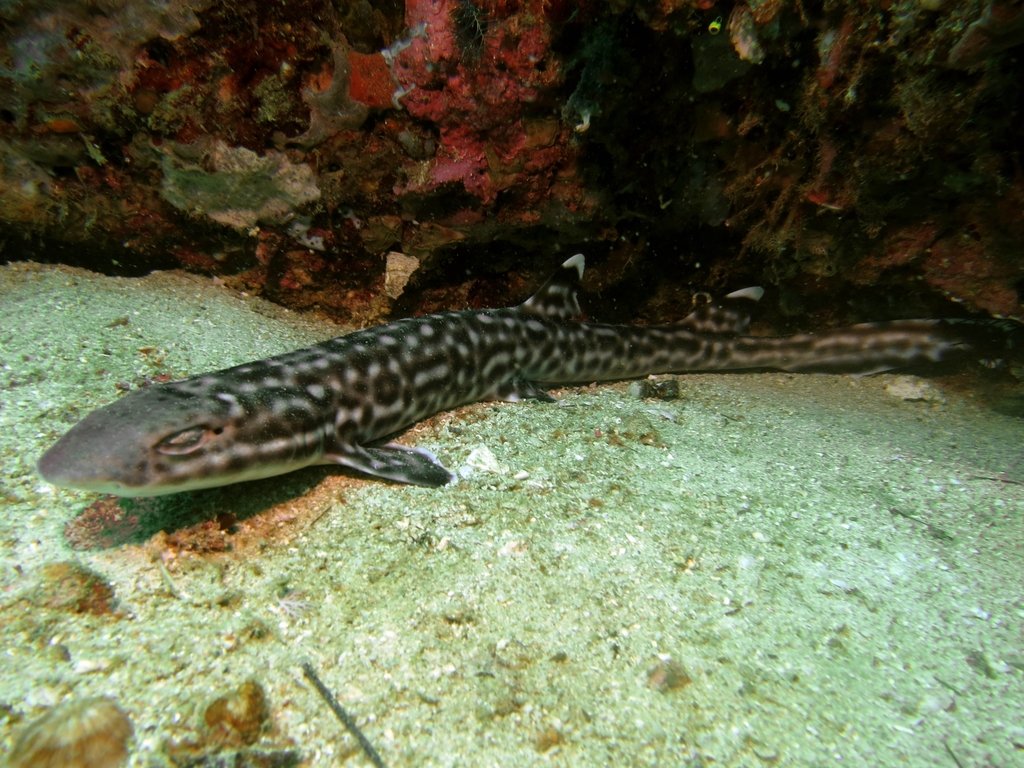
Coral catshark
Atelomycterus marmoratus
The coral catshark (Atelomycterus marmoratus) is a species of coloured catshark belonging to the family Atelomycteridae. It is common on shallow coral reefs across the Indo-West Pacific, from Pakistan to New Guinea. Reaching up to 70 cm (28 in) in length, the coral catshark has an extremely slender body, a short head and tail, and two dorsal fins that are angled backwards. It can be identified by the numerous black and white spots on its back, sides, and fins, which often merge to form horizontal bars. Furthermore, adult males have distinctively long and thin claspers.
Reclusive and inactive during the day, at dusk and at night, the coral catshark actively forages for small, bottom-living invertebrates and bony fishes. Its slender form allows it to access tight spaces on the reef. It is oviparous; females lay purse-shaped egg capsules two at a time on the bottom, and the young hatch after 4–6 months. This small, harmless shark adapts well to captivity and has reproduced in the aquarium; it is regarded as one of the most suitable shark species for private aquarists. The coral catshark is a minor bycatch of reef fisheries, with minimal commercial value. Increasing fishing activity and extensive habitat degradation occur within its range, leading to concern over its population and its assessment as near threatened by the International Union for Conservation of Nature.
From the article Coral catshark on Wikipedia (CC BY-SA), quoted section by section
Description
The coral catshark has a very slender, cylindrical, firm body and a short, narrow head. The snout is short and slightly flattened, with a blunt tip. The eyes are horizontally oval and protected by rudimentary nictitating membranes; behind are spiracles of moderate size. The large nostrils are mostly covered by broad, triangular flaps of skin on their anterior margins, leaving small incurrent and excurrent openings. The nasal flaps reach the mouth, obscuring a pair of broad grooves connecting the excurrent openings and the mouth. The long, angular mouth has very long furrows at the corners extending onto both the upper and lower jaws. The small teeth have a narrow central cusp flanked by 1–2 cusplets on both sides. There are five pairs of gill slits. The pectoral fins are fairly large. The first dorsal fin is angled backwards and originates over the rear of the pelvic fin bases; the second dorsal fin is similarly shaped and slightly smaller than the first, and originates over the front quarter of the anal fin base. Adult males have thin, tapering claspers that extend about two-thirds of the distance between the pelvic and anal fins. The anal fin is much smaller than the dorsal fins. The caudal fin is relatively short and broad, with an indistinct lower lobe and a ventral notch near the tip of the upper lobe. The skin is thick and covered by well-calcified dermal denticles. …
Range & habitat
The most widely distributed member of its genus, the coral catshark can be found from Pakistan and India to Southeast Asia and Taiwan, including the Philippines and New Guinea. Its range extends as far north as the Ryukyu Islands. Early records from Australian waters are in fact of the related Australian marbled catshark (A. macleayi) and banded sand catshark (A. fasciatus). Common and bottom-dwelling in nature, the coral catshark inhabits inshore coral reefs at depths not exceeding 15 m (49 ft).
Wikipedia: “Distribution and habitat”
What it does
The elongated body of the coral catshark allows it to move into and through small spaces in the reef environment, though it does not "crawl" using its pectoral and pelvic fins like the epaulette shark (Hemiscyllium ocellatum). It is primarily crepuscular and nocturnal, with active foraging activity beginning in the afternoon and ending before sunrise. During the day, it generally hides under shelter such as reef overhangs or sunken logs, either singly or in groups. Individual sharks may return to the same hiding place on successive days. This species feeds on small benthic invertebrates and bony fishes; captive specimens have been observed lying still and lunging at prey that comes into range. The coral catshark is oviparous, with the female producing eggs two at a time. Each egg is enclosed in a purse-shaped capsule roughly 6–8 cm (2.4–3.1 in) long and 2 cm (0.79 in) wide, with two constricted "waists"; one end of the capsule is squared off, while the other bears two short "horns" that may terminate in short tendrils. The female deposits the eggs on the bottom, rather than attaching them to vertical structures. The capsule is light brown when freshly laid and darkens over time. The eggs hatch in 4–6 months at 26 °C (79 °F). …
Wikipedia: “Biology and ecology”
Where it lives
Recorded sightings
—
geo-referenced records in GBIF, from museums, herbaria and field observers.
Drag the globe to turn it. Dots are where records exist, not a range map; darker means more records.
In the stacks
Searching the stacks…
Every page naming Atelomycterus marmoratus in the Biodiversity Heritage Library →
This page is assembled live from iNaturalist, GBIF, Wikipedia, the Source Library and the Internet Archive. It is not yet part of the hand-edited codex. iNaturalist taxon 94781.