- Animals
- ›Chordates
- ›Vertebrates
- ›Cartilaginous Fishes
- ›Sharks and Rays
- ›Sharks
- ›Galean Sharks
- ›Ground Sharks
- ›Coloured Catsharks
- ›Atelomycterus
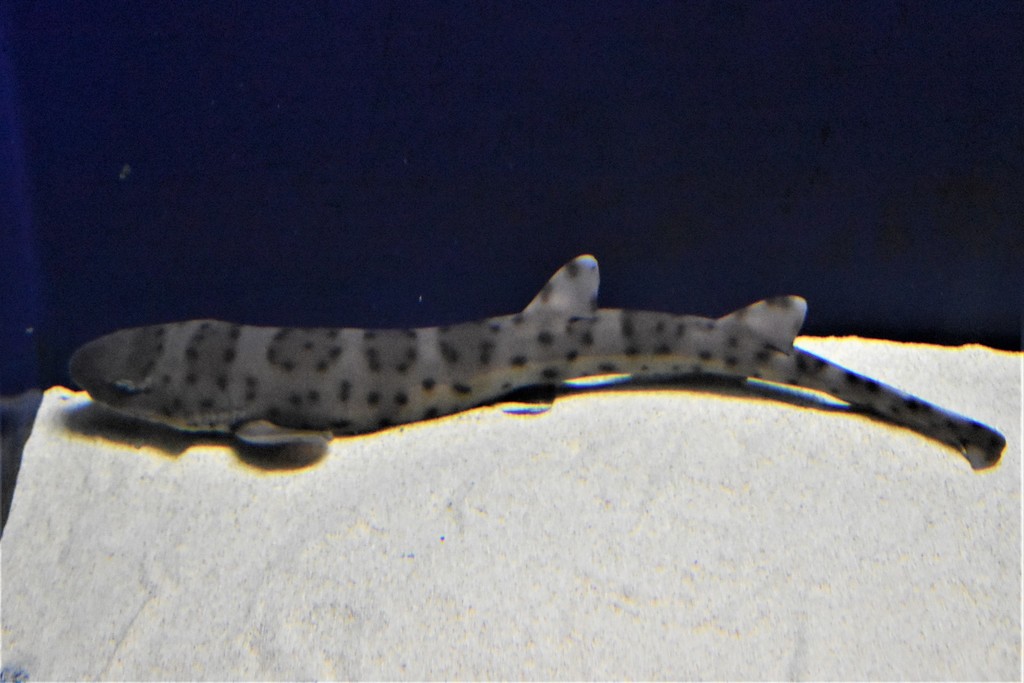
Bali catshark
Atelomycterus baliensis
The Bali catshark (Atelomycterus baliensis) is a species of coloured catshark, belonging to the family Atelomycteridae, found only off the Indonesian island of Bali. It can grow up to 47 cm (19 in). Atelomycterus baliensis inhabits the deep coastal waters of Bali, Indonesia, feeding on small fish and invertebrates. It is a small catshark in the family Scyliorhinidae, known from inshore waters around the island of Bali, Indonesia, in the eastern Indian Ocean. It inhabits shallow rocky and coral reef habitats to an inferred depth of 100 m and is taken as bycatch in a range of local fisheries. The species has been assessed as Least Concern on the IUCN Red List of Threatened Species following a global assessment completed in 2020 and published in 2021.
From the article Bali catshark on Wikipedia (CC BY-SA), quoted section by section
Description
The Bali catshark is a small shark reaching at least 47 cm total length. Males mature at around 43 cm total length. The species is oviparous, but no further details of its biology are currently known from the available information. The Bali catshark has unique coloring in comparison to other members of their species. Catsharks have noticeable and distinctive white spots along their body, Atelomycterus baliensis however, lacks these spots. The Bali catshark's back has four dark saddles, which manifest themselves as four brown patches, and no highlights on the tips of their dorsal fins. The greatest difference between Atelomycterus baliensis and other species of catshark is their higher pectoral-pelvic and pelvic-anal ratio.
Range & habitat
The Bali catshark is endemic to Indonesia. It is native to the island of Bali in the eastern Indian Ocean and may also occur off West Java, although records from that area require genetic confirmation. The species occurs in the marine neritic zone and is found inshore on coral and rocky reefs. A depth range of 0–100 m is inferred from information on the closely related species Atelomycterus marmoratus.
Wikipedia: “Distribution and habitat”
What it does
Not much is known about the Bali catshark's reproductive system, but they are most likely oviparous, like other species of catshark. This means that the majority of development occurs outside of the mother. In the case of Bali catsharks, this development happens in egg cases laid by the mother. Atelomycterus baliensis mothers show preference for laying their eggs in sandy substrate or on calcareous rock formations. The egg cases of the Bali catshark are similar to those of the rest of their genus, Atelomycterus, containing 6 species. Morphologically, the cases have elongated anterior and posterior waists, with a shortened anterior. This blunt anterior may have fibers for the purpose of attaching the egg casing to a substrate during development. The posterior end is often more tapered than the anterior and is adorned with two horns which may end in curled tendrils depending on the species. The Bali catshark lacks these tendrils, which is one way to distinguish it from other species. On each of the four corners of the egg casing, there is a single opening for respiration. Individual species can be further distinguished from one another by the widths of the sides of the egg casings. The Bali Catshark in particular, has a wider midsection which tapers out on both ends of the casing. …
Wikipedia: “Reproduction”
Where it lives
Recorded sightings
—
geo-referenced records in GBIF, from museums, herbaria and field observers.
Drag the globe to turn it. Dots are where records exist, not a range map; darker means more records.
In the stacks
Searching the stacks…
Every page naming Atelomycterus baliensis in the Biodiversity Heritage Library →
This page is assembled live from iNaturalist, GBIF, Wikipedia, the Source Library and the Internet Archive. It is not yet part of the hand-edited codex. iNaturalist taxon 94778.