 NL·0439
Herbarium of the Nature Library
- Name
- Euphausia superba
- Family
- Euphausiidae
- Native to
- Southern Ocean around Antarctica, densest in the Scotia Sea and Antarctic Peninsula
- Habitat
- Polar open ocean, Sea ice edge
Antarctic krill
Euphausia superba
Also calledKrill (Norwegian) · Okiami (Japanese) · Kril antártico (Spanish) · Nánjí línxiā (Chinese)
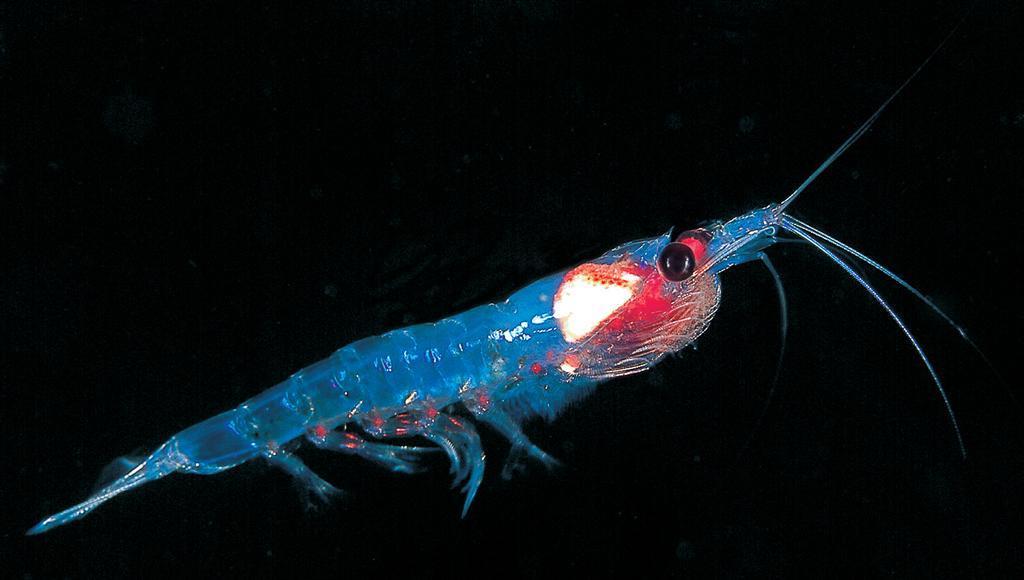
A shrimp-like crustacean only about 6 cm long whose total weight, hundreds of millions of tonnes, may be the largest of any wild animal species. Almost everything in the Southern Ocean depends on it, from penguins to blue whales.
Antarctic krill is a species of krill found in the Antarctic waters of the Southern Ocean. It is a small, swimming crustacean that lives in large schools, called swarms, sometimes reaching densities of 10,000–30,000 animals per cubic metre. It feeds directly on minute phytoplankton, thereby using the primary production energy that phytoplankton originally derive from the sun in order to sustain its pelagic life cycle. It grows to a length of 6 centimetres (2.4 in), weighs up to 2 grams (0.071 oz), and can live for up to six years. A key species in the Antarctic ecosystem and in terms of biomass, E. superba is one of the most abundant animal species on the planet, with a cumulative biomass of approximately 500 million metric tons ; however, the species is suffering from overfishing. Wikipedia
What it can do
- iForms swarms with tens of thousands of individuals per cubic metre
- iiGrazes algae from the underside of sea ice in winter
- iiiCan shrink by moulting when food is short
- ivHas light-producing organs (photophores)
- vMoves carbon to the deep sea in its faeces and moults
In the field
Field marks
- aTransparent to pinkish shrimp-like body
- bLarge, black, light-sensitive eyes
- cFeathery legs forming a 'feeding basket'
- dGreen-coloured gut when feeding on algae
- Not to be confused with
- Ice krill (Euphausia crystallorophias) is smaller and lives closer to the continent. Thysanoessa species are smaller and more slender.
- Where to see it
- Surface swarms seen from expedition ships around South Georgia and the Antarctic Peninsula, often signalled by feeding whales and seabirds.
- When
- Year-round; most visible near the surface in the austral summer (Nov–Mar)
Life & habits
- Diet
- Phytoplankton, especially diatoms, and ice algae; some small zooplankton
- Habitat
- Cold open ocean and the sea-ice zone of the Southern Ocean
- Size
- Up to about 6 cm and 2 g
- Lifespan
- About 5–6 years
Swarms rise towards the surface at night and sink by day, possibly to avoid visual predators.
Where it lives
Recorded sightings
—
geo-referenced records in GBIF, from museums, herbaria and field observers.
Native range
Southern Ocean around Antarctica, densest in the Scotia Sea and Antarctic Peninsula
Drag the globe to turn it. Dots are where records exist, not a range map; darker means more records.
In the stacks
Searching the stacks…
Every page naming Euphausia superba in the Biodiversity Heritage Library →
Marginalia
The word 'krill' comes from Norwegian whalers, meaning the small fry of fish. Britain's Discovery Investigations of the 1920s–30s first mapped its role in the whaling grounds.
Curiosity
Estimates of its global biomass are around 300–500 million tonnes, comparable to the total weight of all humans.
Kinship



Photographs: iNaturalist contributors under the licences shown. Records: GBIF.org. Historical plates: Source Library (CC BY-SA 4.0; originals public domain). Summary text: Nature Library editors and Wikipedia (CC BY-SA). Medicinal and edibility notes are historical and educational, not advice. iNaturalist taxon 344134.