- Animals
- ›Chordates
- ›Vertebrates
- ›Mammals
- ›Therians
- ›Placental Mammals
- ›Primates, Rodents, and Allies
- ›Primates
- ›Monkeys, Apes, and Tarsiers
- ›Monkeys and Apes
- ›Apes and Old World Monkeys
- ›Old World Monkeys
- ›Cercopithecines
- ›Guenons, Vervet Monkeys, and Talapoins
- ›Chlorocebus
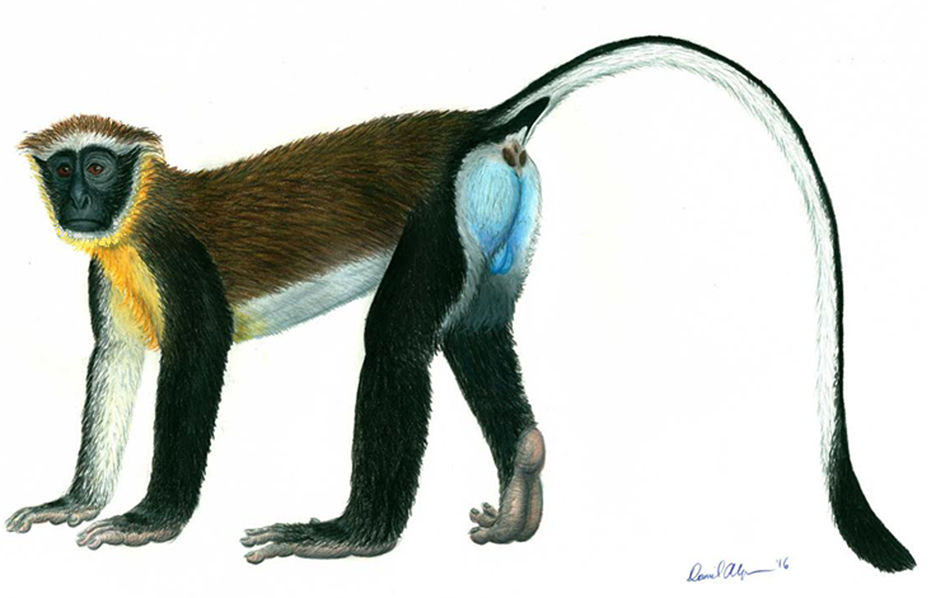
Dryas Monkey
Chlorocebus dryas
The Dryas monkey (Chlorocebus dryas), also known as Salonga monkey, ekele, or inoko, is a little-known species of Old World monkey found only in the Congo Basin, restricted to the left bank of the Congo River. It is now established that the animals that had been classified as Cercopithecus salongo (the common name being Zaire Diana monkey) were in fact Dryas monkeys. Some older sources treat the Dryas monkey as a subspecies of the Diana monkey and classify it as C. diana dryas, but it is geographically isolated from any known Diana monkey population.
While the Dryas monkey had been considered data deficient, evidence suggests it is very rare and its total population possibly numbers fewer than 200 individuals. Consequently, its status was changed to critically endangered in the 2008 IUCN Red List. Along with being listed by the IUCN, this species is also listed on Appendix II of CITES. However, in January 2019 the IUCN status was changed to endangered following the discovery of this species at eight locations in Lomami National Park.
From the article Dryas monkey on Wikipedia (CC BY-SA), quoted section by section
What it does
This species prefers secondary forest locations. Although secondary forests are said to be preferred, these monkeys may also inhabit lowlands, rivers, or swampy areas of the Congo. The diet of the Dryas is said to be made up of mostly plant foods, including fruits, young leaves, and flowers. Due to most of these foods being seasonal, this species also consumes small invertebrates, such as insects, as a supplement.
Wikipedia: “Ecology”
Listen
Looking for field recordings…
Where it lives
Recorded sightings
—
geo-referenced records in GBIF, from museums, herbaria and field observers.
Drag the globe to turn it. Dots are where records exist, not a range map; darker means more records.
In the stacks
Searching the stacks…
Every page naming Chlorocebus dryas in the Biodiversity Heritage Library →
This page is assembled live from iNaturalist, GBIF, Wikipedia, the Source Library and the Internet Archive. It is not yet part of the hand-edited codex. iNaturalist taxon 1368467.