- Animals
- ›Chordates
- ›Vertebrates
- ›Mammals
- ›Therians
- ›Placental Mammals
- ›Primates, Rodents, and Allies
- ›Rodents
- ›Mice, Rats, and Hamsters
- ›Muroids
- ›Old World Mice and Rats
- ›Murines
- ›Australasian Mice and Rats
- ›Pseudomys
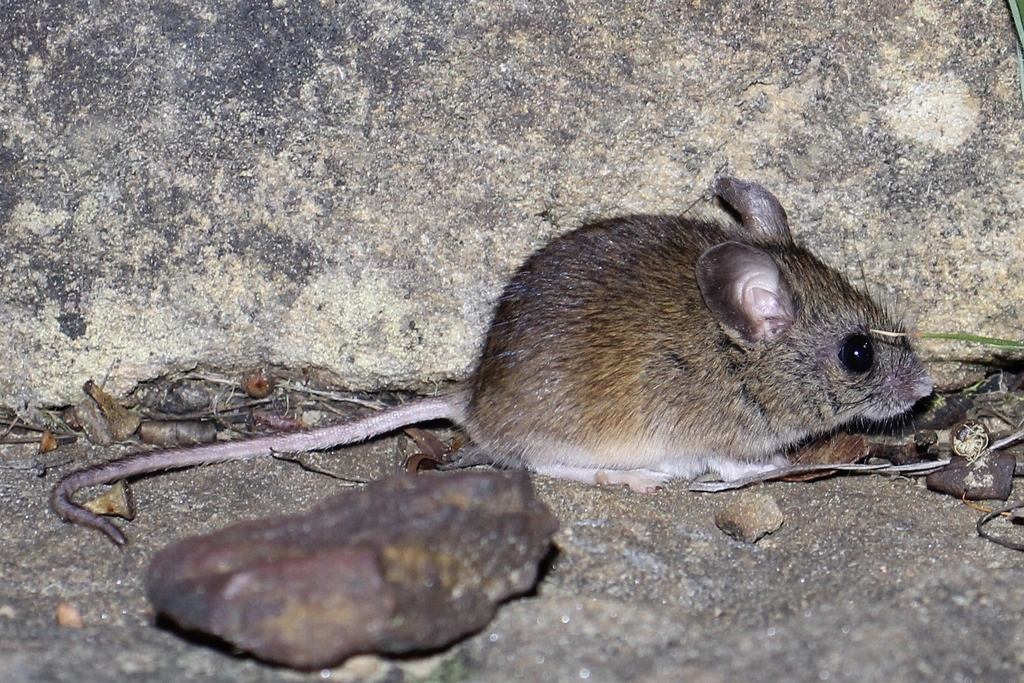
New Holland Mouse
Pseudomys novaehollandiae
The New Holland mouse (Pseudomys novaehollandiae) also known as a Pookila is a species of rodent in the family Muridae. It was first described by George Waterhouse in 1843. It vanished from view for over a century before its rediscovery in Ku-ring-gai Chase National Park north of Sydney in 1967. It is found only in south east Australia, within the states of New South Wales, Queensland, Victoria, and Tasmania.
From the article New Holland mouse on Wikipedia (CC BY-SA), quoted section by section
Description
The New Holland mouse has a grey-brown fur with a dusky-brown tail, which is darker on the dorsal side. Its body length is roughly 65–90mm, with a tail length of 80–105 mm (3.1–4.1 in), and a hind foot length of approximately 20–22 mm (0.79–0.87 in). The New Holland mouse's size has been shown to vary slightly depending on the environment. Populations of New Holland mice that live in Tasmania, have a slightly larger body weight than those that are from New South Wales and Victoria. Despite this, however, the head shape and length share the measurements as in Tasmania, New South Wales, and Victoria. It has also been noted that the New Holland mouse looks very similar to the common house mouse, which was introduced to the area by European settlers. It can be differentiated from the common house mouse however by its ears and eyes, which are slightly larger than the common house mouse. Also, the New Holland mouse lacks the presence of a notch on the upper incisors and a 'mousy' odor is absent.
Range & habitat
The New Holland mouse is a nocturnal species inhabiting environments such as woodlands, forests with a heathland understorey and vegetated sand dunes, and open heathlands. It is a social species. The mice live in burrows carved out by colonies in softer sands. The New Holland mouse has been shown to increase in prominence promptly after a wildfire or sand mining has occurred; usually two to three years afterwards. The species is most common during the early/mid portions of vegetation succession. In Tasmania however, they have been found in areas that contained vegetation as far as 16 years post fire.
Wikipedia: “Habitat and ecology”
What it does
The New Holland is omnivorous. While active at night, it spends a majority of its time foraging for seeds above ground. Although seeds are the most prominent component of the New Holland mouse's diet, it also consumes leaves, fungi and small invertebrates. Studies observed that overall they consumed 27% dicotyledon leaf, 29% fungi, 17% invertebrates, and 14% seeds. There can be dietary differences depending on the local vegetation.
Wikipedia: “Diet”
Listen
Looking for field recordings…
Where it lives
Recorded sightings
—
geo-referenced records in GBIF, from museums, herbaria and field observers.
Drag the globe to turn it. Dots are where records exist, not a range map; darker means more records.
In the stacks
Searching the stacks…
Every page naming Pseudomys novaehollandiae in the Biodiversity Heritage Library →
This page is assembled live from iNaturalist, GBIF, Wikipedia, the Source Library and the Internet Archive. It is not yet part of the hand-edited codex. iNaturalist taxon 45219.