- Animals
- ›Arthropods
- ›Crustaceans
- ›Typical Crustaceans
- ›Malacostracans
- ›Decapods, Isopods, and allies
- ›Amphipods, Isopods, and Allies
- ›Isopods
- ›Predaceous and Parasitic Isopods
- ›Fish-associated Isopods
- ›Cirolanidae
- ›Antrolana
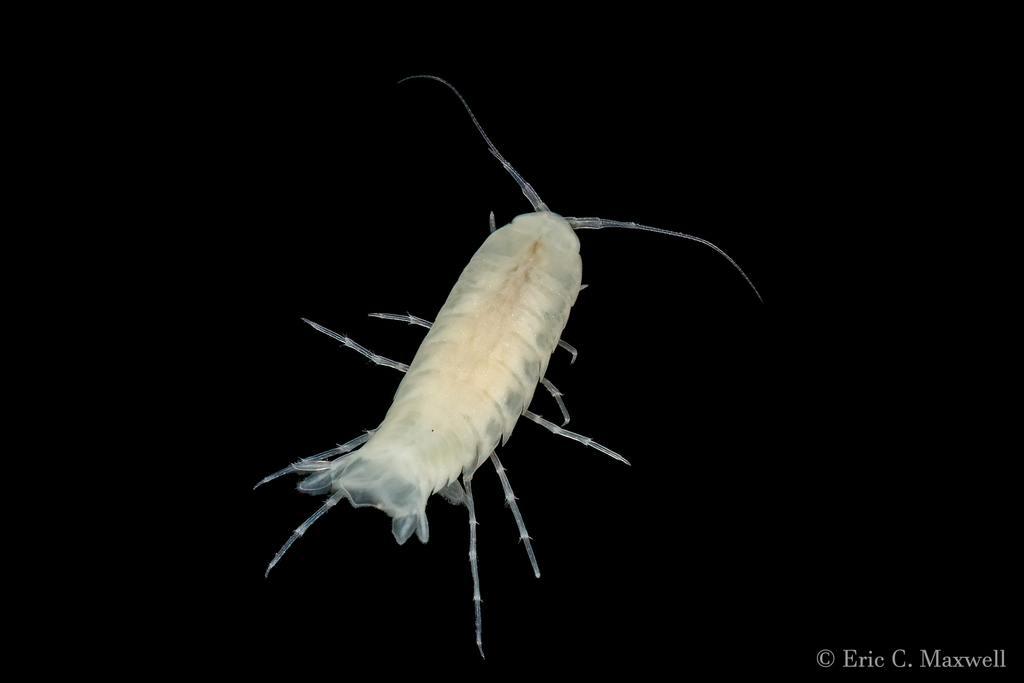
Madison Cave Isopod
Antrolana lira
Antrolana lira, also known as The Madison Cave isopod, is a freshwater, cave-dwelling crustacean species. It is in the family Cirolanidae and it is the only species of its genus Antrolana. This isopod can be found in flooded limestone caves and karst aquifers throughout the Great Appalachian Valley of Virginia and West Virginia. The Madison Cave isopod has been listed as a vulnerable species on the IUCN Red List since 1983 and as a threatened species under the United States Endangered Species Act since 1982. The species was named after the cave in which it was first discovered, Madison Saltpetre Cave. Very little is known about the life history and behavior of the Madison Cave isopod.
From the article Antrolana on Wikipedia (CC BY-SA), quoted section by section
Description
Madison Cave isopods are the largest subterranean isopods in the eastern United States. Adult males reach a length of 15 mm (0.59 in) and a width of 5 mm (0.20 in). Adult females reach a length of 18 mm (0.71 in) and a width of 6 mm (0.24 in). Their bodies are flat with 7 pairs of legs, the first pair being modified to grab objects. They have two pairs of antennae, one short and one long. They are completely unpigmented and have no eyes.
Range & habitat
The Madison Cave isopod lives in water that ranges in temperature from 11 to 14 °C (52 to 57 °F). Plates of calcite are often found floating on the surface of the aquifers it occupies, which indicates that the water is supersaturated with calcium carbonates. The levels of water in the karst aquifers it occupies can vary by tens of meters in certain areas.
Wikipedia: “Habitat”
What it does
The feeding habits of Madison Cave isopods are unknown, but they are believed to be carnivorous as they readily consume shrimp bait. Insect parts were found in the stomachs of several individuals from Steger's Fissure.
Wikipedia: “Diet”
In human culture
The Madison Cave isopod's reproduction mechanism is currently unknown. In related isopod species, females incubate fertilized eggs in a ventral marsupium after mating, though this has never been observed in any captured Madison Cave isopod. It is inferred that the species has a low reproductive potential, as the majority of samples consist of very few to no juveniles and no egg-bearing females. Based on sampling data, populations of Madison Cave isopods tend to skew towards a female-biased sex ratio, ranging from 2.2 to 3.7 females per male. However, it has been suggested that this sex ratio may be due to differential responses of females and males to shrimp bait.
Wikipedia: “Life History”
Where it lives
Recorded sightings
—
geo-referenced records in GBIF, from museums, herbaria and field observers.
Drag the globe to turn it. Dots are where records exist, not a range map; darker means more records.
In the stacks
Searching the stacks…
Every page naming Antrolana lira in the Biodiversity Heritage Library →
This page is assembled live from iNaturalist, GBIF, Wikipedia, the Source Library and the Internet Archive. It is not yet part of the hand-edited codex. iNaturalist taxon 94230.