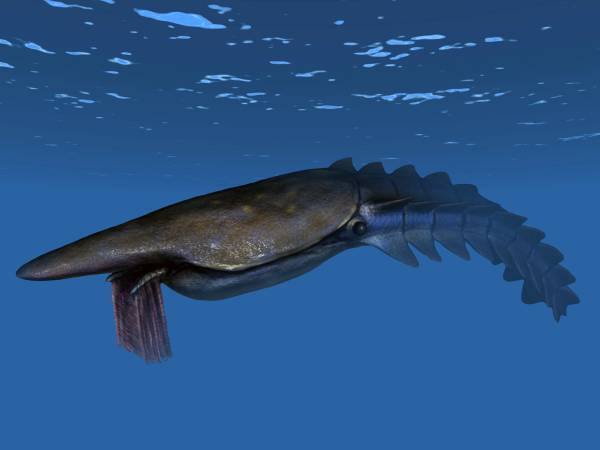
Aegirocassis
Aegirocassis (″Aegir's helmet″) is an extinct genus of giant radiodont arthropod belonging to the family Hurdiidae that lived 480 million years ago during the early Ordovician in the Fezouata Formation of Morocco. It is known by a single species, Aegirocassis benmoulai. Van Roy initiated scientific study of the fossil, the earliest known of a "giant" filter-feeder discovered to date. Aegirocassis is considered to have evolved from early predatory radiodonts. This animal is characterized by its long, forward facing head sclerite, and the endites on its frontal appendages that bore copious amounts of baleen-like auxiliary spines. This animal evolving filter-feeding traits was most likely a result of the Great Ordovician Biodiversification Event, when environmental changes caused a diversification of plankton, which in turn allowed for the evolution of new suspension feeding lifeforms. Alongside the closely related Pseudoangustidontus, an unnamed hurdiid from Wales, the middle Ordovician dinocaridid Mieridduryn, and the Devonian hurdiid Schinderhannes, this radiodont is one of the few dinocaridids known from post-Cambrian rocks.
1 branches of this genus, most-observed first
See this branch on the Wheel of Life →Where it lives
Recorded sightings
—
geo-referenced records in GBIF, from museums, herbaria and field observers.
Drag the globe to turn it. Dots are where records exist, not a range map; darker means more records.
In the stacks
Searching the stacks…
Every page naming Aegirocassis in the Biodiversity Heritage Library →
This page is assembled live from iNaturalist, GBIF, Wikipedia, the Source Library and the Internet Archive. It is not yet part of the hand-edited codex. iNaturalist taxon 918604.