- Animals
- ›Echinoderms
- ›Sea Stars and Brittle Stars
- ›Sea Stars
- ›Forcipulatacean Sea Stars
- ›Forcipulatidan Sea Stars
- ›Asteriid Sea Stars
- ›Asterias
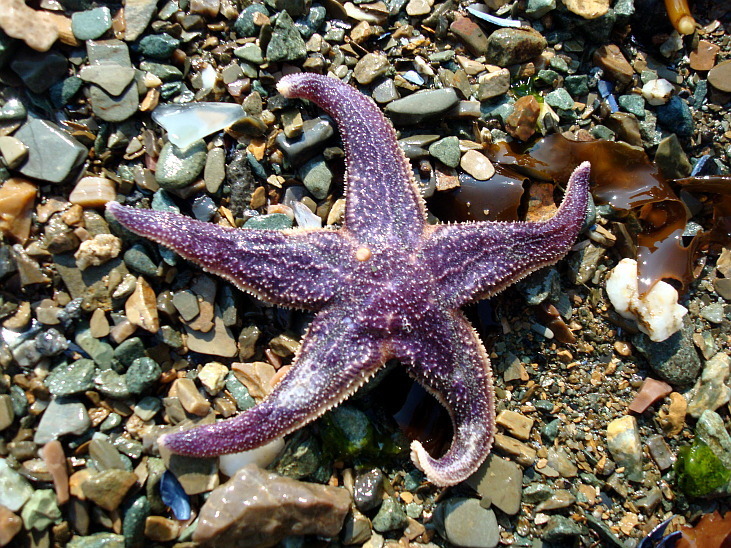
Asterias rathbuni
Asterias rathbuni is a starfish native to the Pacific coasts of Alaska in the United States and Far East Russia. There are two subspecies.
From the article Asterias rathbuni on Wikipedia (CC BY-SA), quoted section by section
Description
This starfish has five arms, broad at the base but tapering to acute tips, four times as long as broad. The central disc of specimens preserved by drying is rather broad. The dorsal skeleton is reticulated and rather weak, thus specimens preserved in alcohol are soft and flaccid. There are numerous small pedicellariae on both the dorsal and lateral surfaces. There are also many small papulae and small and numerous spines on the dorsal surface. The dorsal surface is entirely covered by an areolate or reticulate pattern; the areolations are 1.5-2mm across. The arm length is up to 17cm; on average, the ratio between the length of the arm and the radius of its disc is 4.3:1. It has planktonic larvae.
Similar species. Verrill found it a quite distinct Asterias species within its range due to the finely and regularly areolated dorsal surface, the reticulated and flaccid skeleton, and small spines. He found it most resembling Asterias rollestoni, which differs from it by virtue of less dense spines near the mouth, but longer and larger spines dorsally and marginally, and larger and more numerous pedicellariae. Compared with A. versicolor it has much more numerous, though smaller dorsal and lateral spines, these being differently arranged. Compared with A. amurensis, it has more and shorter dorsal spines. Djakonov found it to be the most similar to A. …
Range & habitat
In Russia it is known from the Sea of Okhotsk and Bering Sea, and in the United States around the Aleutian Islands and in Alaska in the Bering Sea. It has been found at depths of 9-170m. Djakonov complies the distribution of Asterias rathbuni f. anomala, now considered a synonym of the nominate type, as off the Kamchatka peninsula and around the Commander Islands, east to the Shumagin Islands off Alaska, north to the Chukchi Sea, usually at depths of 20m, but in America specimens have been recovered down to 170m. The anomala form was originally recovered off St. Michael Island in the southeast of Norton Sound, Alaska. Asterias rathbuni f. alveolata was first recovered in 1910 at a depth of 53m from a gravelly sea bottom in the Karaginsky Gulf in the Bering Sea off the northeastern Kamchatka peninsula. A. rathbuni f. nortonensis was found in the Norton Sound off Alaska, and has not been found elsewhere. Asterias rathbuni subsp. crassispinus is known from the Sea of Okhotsk and around Sakhalin.
== References ==
Wikipedia: “Distribution and habitat”
Where it lives
Recorded sightings
—
geo-referenced records in GBIF, from museums, herbaria and field observers.
Drag the globe to turn it. Dots are where records exist, not a range map; darker means more records.
In the stacks
Searching the stacks…
Every page naming Asterias rathbuni in the Biodiversity Heritage Library →
This page is assembled live from iNaturalist, GBIF, Wikipedia, the Source Library and the Internet Archive. It is not yet part of the hand-edited codex. iNaturalist taxon 876943.