- Animals
- ›Arthropods
- ›Chelicerates
- ›Arachnids
- ›Spiders
- ›Typical Spiders
- ›Entelegyne Spiders
- ›Orbweavers and Allies
- ›Orbweavers
- ›Bolas Spiders
- ›Cladomelea
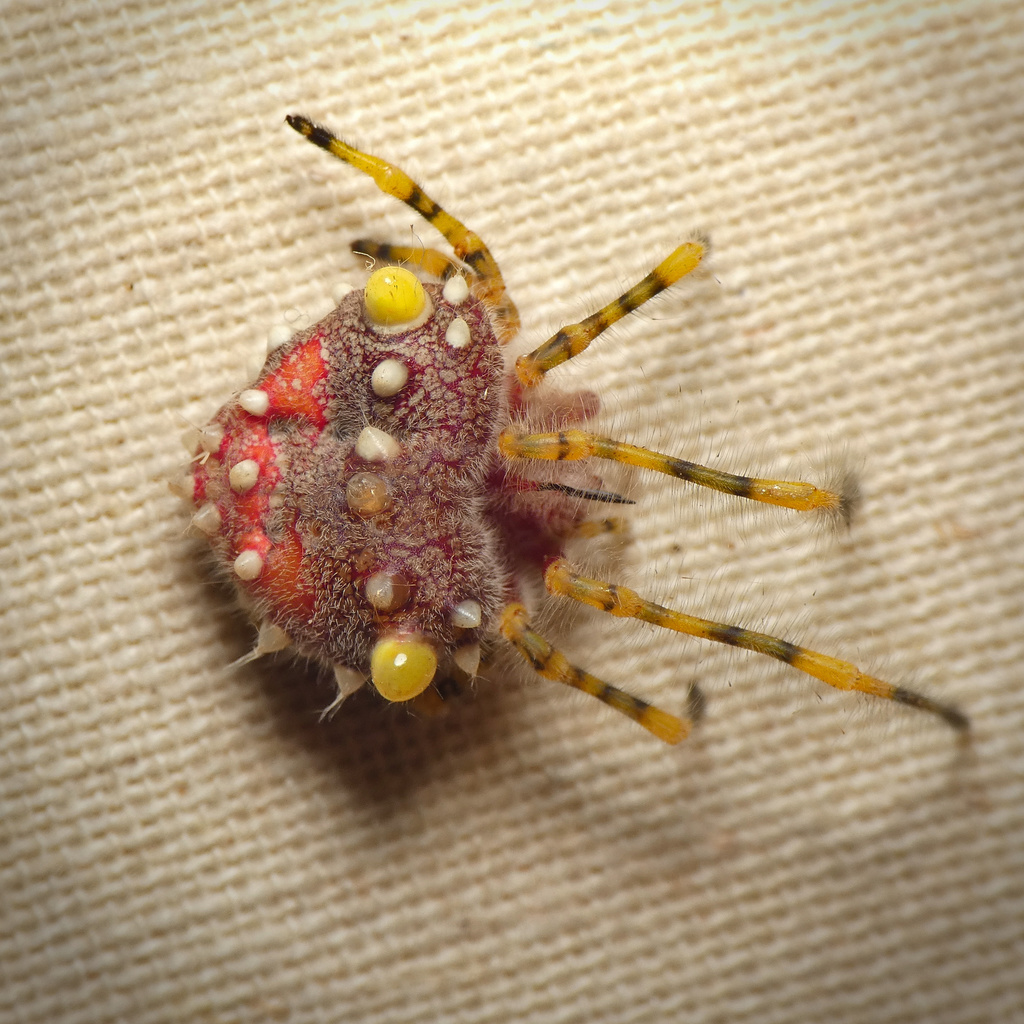
Longleg Bolas Spider
Cladomelea longipes
Cladomelea longipes is a species of spider in the family Araneidae. It is endemic to Africa and is commonly known as the pink bolas spider.
From the article Cladomelea longipes on Wikipedia (CC BY-SA), quoted section by section
Range & habitat
Cladomelea longipes is known from Cameroon, Democratic Republic of the Congo, Zimbabwe, and South Africa. The type locality was given as the banks of the river Coanza in Angola, possibly referring to the Quanza River. In South Africa, the species has been recorded from Limpopo Province.
Wikipedia: “Distribution”
What it does
The spider constructs a reduced orb web consisting of a bolas line used to catch moths at night. The egg cocoon constructed by C. longipes differs from that of other known Cladomelea species. Females construct four egg sacs that are suspended 0.5 to 1.9 m above the ground. The incubation period is about 40 days. The spiderlings emerge in groups of more than 100 and stay together for up to 36 hours after hatching. During breezier days they leave the hatching site quicker, with ballooning observed when some lift off with the breeze, attached to a length of silk. An interesting observation was made when a small male was observed sitting on the epigyne of the female, with the white spot on the abdomen of the male clearly visible, indicating that he sits with his venter pressed against her epigyne. He stayed there for a few days, even while she was feeding.
Wikipedia: “Habitat and ecology”
Where it lives
Recorded sightings
—
geo-referenced records in GBIF, from museums, herbaria and field observers.
Drag the globe to turn it. Dots are where records exist, not a range map; darker means more records.
In the stacks
Searching the stacks…
Every page naming Cladomelea longipes in the Biodiversity Heritage Library →
This page is assembled live from iNaturalist, GBIF, Wikipedia, the Source Library and the Internet Archive. It is not yet part of the hand-edited codex. iNaturalist taxon 843738.