- Animals
- ›Echinoderms
- ›sea urchins and sea cucumbers
- ›Sea Cucumbers
- ›Actinopoda
- ›Synallactida
- ›Stichopodidae
- ›Thelenota
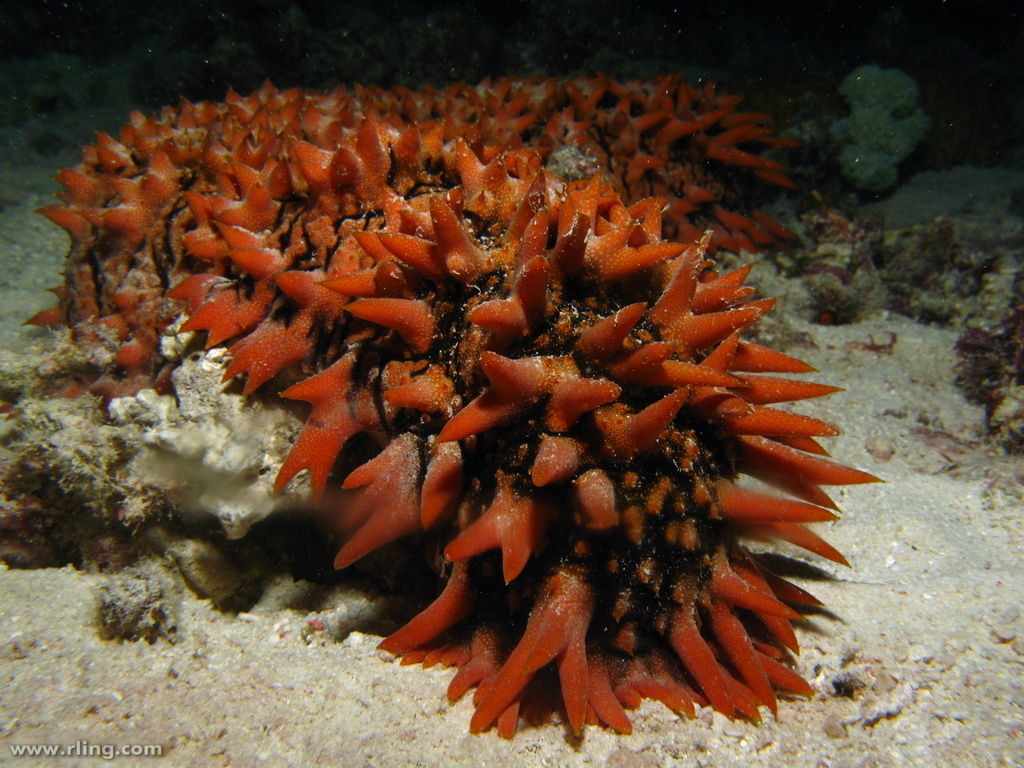
Pineapple Sea Cucumber
Thelenota ananas
Thelenota ananas, also known as pineapple sea cucumber, oloturia ananas, tripang, prickly skin cucumber, pointed teat sea cucumber, armoured sea cucumber, giant sea cucumber, sand fish or prickly redfish, is a species of sea cucumber found in tropical Indo-Pacific waters from the Red Sea and East Africa to Hawaii and Polynesia. Its reddish-brown body with large and mostly branched papillae can reach up to 70 centimetres (28 in) in length. This species can be found on clean...
From the article Thelenota ananas on Wikipedia (CC BY-SA), quoted section by section
Description
Thelenota ananas (pineapple sea cucumber) is a species of sea cucumber characterized by its large size, warm colors, and pointed, star-shaped, spotted teats covering the entire body, grouped in rows of 2 or 3, as seen in Figure 1. Their body is reddish-orange in color, with the teats slightly darker. They are able to reach up to 70 cm (28 in) in length, with a weight of between 3–6 kg (6.6–13.2 lb), and have numerous large tube feet on the flat ventral side of their body. T. ananas is a slow growing organism.
What it does
T. ananas are widely distributed, but tracking these organisms in a non-invasive and accurate way is somewhat difficult. Mark and recapture methods can be difficult because their bodies are extendable, so measuring their body has proven difficult to scientists since the numbers are ever-changing. The body wall of T. ananas cannot be tagged because it affects the growth of the organism, and are later shed off altogether. Scratching marks into the body wall induces short-term trauma and does not last long enough for mark and recapture efforts. These methods all harm T. ananas in some form, so the best non-invasive way to track their growth and traveling is through photographs.
While generally considered sedentary, they have large tube feet hidden underneath their body which allow them to be highly mobile creatures and widely distributed. They are slow growing, but also longer lived and have lower mortality rates. T. ananas is diurnally active, meaning they're active during the day. T. ananas plays an important role in coral reef ecosystems by recycling nutrients, bioturbating sediments, buffering sea water from ocean acidification to local scales, prey to a range of predators, and acting as a host for symbiotic biota.
Wikipedia: “Behavior”
At the table
T. ananas is one of the most popular edible sea cucumber species consumed in China, and some other Southeast Asian countries. Consumption of T. ananas provides health benefits such as antioxidants, anti-inflammatory, anti-tumor, anti-proliferative, anti-coagulant, and anti-viral effects. Furthermore, sea cucumbers contain saponins, which can help regulate cholesterol metabolism, alleviate the development of obesity, hyperlipidemia, and diabetes.
Wikipedia: “As a food source”
Where it lives
Recorded sightings
—
geo-referenced records in GBIF, from museums, herbaria and field observers.
Drag the globe to turn it. Dots are where records exist, not a range map; darker means more records.
In the stacks
Searching the stacks…
Every page naming Thelenota ananas in the Biodiversity Heritage Library →
This page is assembled live from iNaturalist, GBIF, Wikipedia, the Source Library and the Internet Archive. It is not yet part of the hand-edited codex. iNaturalist taxon 83882.