- Animals
- ›Arthropods
- ›Crustaceans
- ›Typical Crustaceans
- ›Malacostracans
- ›Decapods, Isopods, and allies
- ›Decapods and Krill
- ›Decapods
- ›Crabs, Lobsters, Shrimps, and Allies
- ›Caridean Shrimps
- ›Crangonoidea
- ›Crangonidae
- ›Crangon
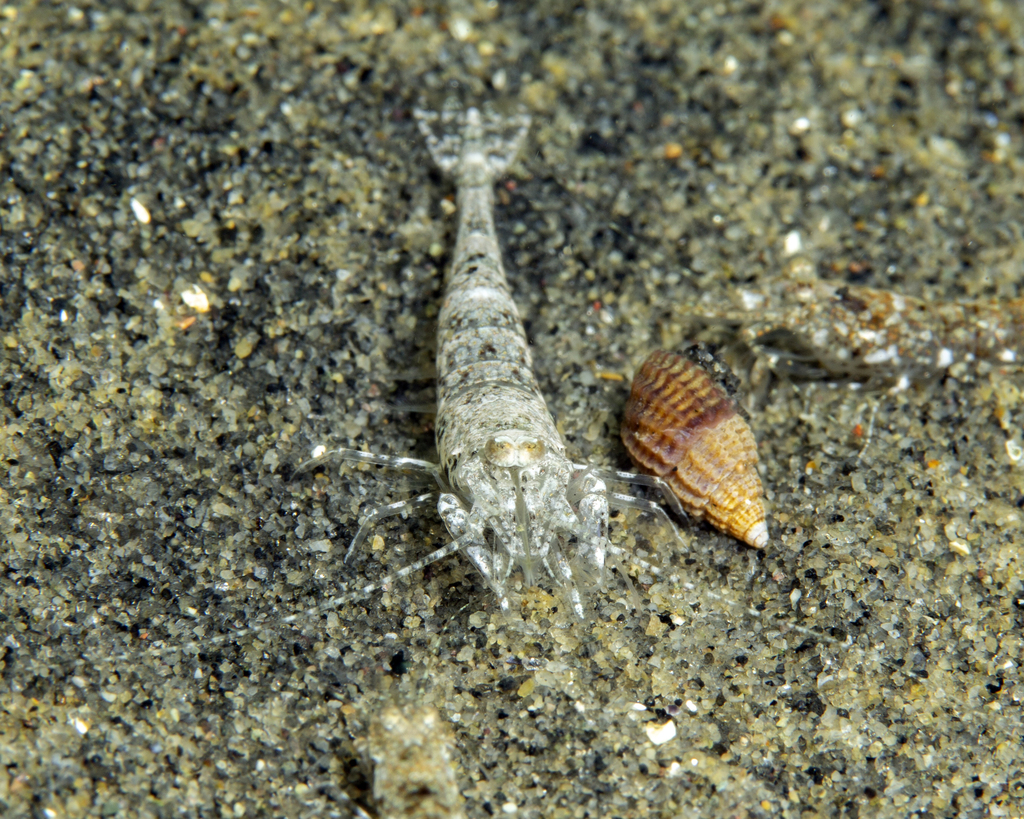
Sand Shrimp
Crangon septemspinosa
Crangon septemspinosa (sand shrimp), also known as seven-spined bay shrimp, is a species of shrimp commonly found along the Atlantic coast of North America, with a wide range spanning from Newfoundland to eastern Florida. Sand shrimp is often found in eelgrass beds, salt marshes, and estuaries and can be found at depths to 450 m (1,480 ft). At maturity, they can reach about 7 to 7.5 cm in length. Its name derives from the sand-like coloration that helps camouflage the species with its environment.
From the article Crangon septemspinosa on Wikipedia (CC BY-SA), quoted section by section
Description
Sand shrimp is a nocturnal species, which means that it is much more active in dark environments rather than light ones. This increased rate of activity is also more prominent in high temperature environments, as indicated by an increase in respiration rate. At 20°C, the species is observed to adopt a bimodal pattern rather than a uni-modal one. As a prey resource to many predators, the sand shrimp has a limited prey availability. Fortunately, the species is an unspecialized feeder with an incredibly diverse diet. As such, in the case of a more active lifestyle, the sand shrimp may compensate by altering its diet into a more carnivorous feeding and selectively consume animal tissues, which provide higher energy content.
What it does
Sand shrimp appears to have two major reproductive periods. According to an observation of the populations in Mystic River estuary, this is categorized into one in early spring and one in late autumn. Another observation on the species, which was based on the populations of in the Southern Gulf of St. Lawrence estuary, however, categorizes this into spring and late summer instead, followed by smaller portion of reproductive rates in around summer and early fall. It also shows a more continuous reproductive period throughout spring and summer rather than having two separate spawning events in spring and autumn, suggesting a reproduction cycle more distinct than its northerly populations. Hence, the species' mating seasons may vary depending on the species' habitats and locations. In early spring, mature sand shrimps that are two or three year old immigrate from its regular habitat offshore and into shallow shorelines, where they will then mate and reproduce. This immigration pattern works as a recruitment mechanism within the life history of mature sand shrimps. Autumn reproduction period averages up to about 1,600 eggs. However, eggs found in spring reproductive period are noted to be most abundant, with about twice as many eggs produced.
Wikipedia: “Reproduction”
Where it lives
Recorded sightings
—
geo-referenced records in GBIF, from museums, herbaria and field observers.
Drag the globe to turn it. Dots are where records exist, not a range map; darker means more records.
In the stacks
Searching the stacks…
Every page naming Crangon septemspinosa in the Biodiversity Heritage Library →
This page is assembled live from iNaturalist, GBIF, Wikipedia, the Source Library and the Internet Archive. It is not yet part of the hand-edited codex. iNaturalist taxon 83099.