- Animals
- ›Arthropods
- ›Chelicerates
- ›Arachnids
- ›Spiders
- ›Typical Spiders
- ›Entelegyne Spiders
- ›Salticoid Spiders
- ›Jumping Spiders
- ›Typical Jumping Spiders
- ›Chrysillini
- ›Menemerus
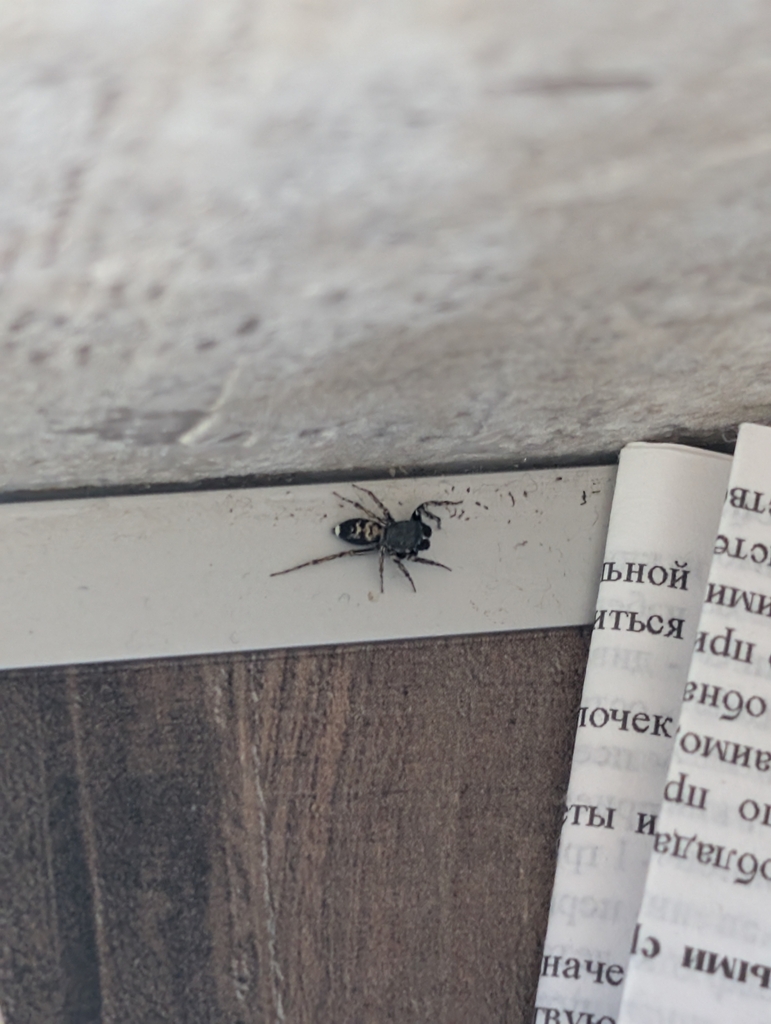
Menemerus guttatus
Menemerus guttatus is a species of jumping spider in the genus Menemerus that lives in Morocco. The spider has been found in the High Atlas mountains in gravel rivers. It displays complex courtship patterns. The species was first described in 1999 by Wanda Wesołowska, one of over 500 descriptions she has made during her lifetime. The spider is small, with a dark brown, nearly black carapace that is between 2.8 and 3.5 millimetres (0.11 and 0.14 in) long and a dark brown abdomen between 2.5 and 5.6 millimetres (0.098 and 0.220 in) long. The female is larger than the male. It can be distinguished from other species in the genus by the pattern on its abdomen, which consists of two lines of white patches that converge to the back of the spider. Otherwise, it is the copulatory organs that most identify the species. The male has a distinctive relatively wide and short embolus and lamella and two similar appendages at the base of the palpal bulb, or apophyses. The female has a complex internal structure of the epigyne including crescent-shaped chambers and circular spermathecae.
From the article Menemerus guttatus on Wikipedia (CC BY-SA), quoted section by section
Description
Menemerus guttatus is a small spider. The male has a carapace that is between 2.8 and 3.1 millimetres (0.11 and 0.12 in) long and an abdomen is between 2.5 and 3.1 millimetres (0.098 and 0.122 in) long. The carapace is dark brown, nearly black, and has a patch formed of white hairs in the middle and two streaks on the sides. The eye field is covered with brown hairs, which are shorter further from the eyes. The spider has a very low brown clypeus and dark brown chelicerae, labium and maxilae. It has a light brown sternum. The spider's abdomen is dark brown on top with an indistinct pattern of light patches that is covered in brownish hairs. The pattern consists of a series of dissimilar patches, some bean-shaped, that form two lines converging to the rear of the spider as a series of stripes becoming chevrons. The underside is yellowish or grey. It has brownish spinnerets and brown legs. The spider's copulatory organs are distinctive. The pedipalps are dark brown. The embolus is relatively wide and short with a lamella that is of a similar length. The palpal bulb has a distinctive arrangement of tibial appendages, or apophyses. They are short and stumpy, with a blunted spike, and face downwards. The female is larger than the male. …
Range & habitat
Menemerus spiders are found throughout Africa and Asia, and have been identified as far as Latin America. Menemerus guttatus is endemic to Morocco. The male holotype was found near Asni in the High Atlas mountains, at an altitude of 1,300 m (4,300 ft) above sea level in 1977. Other examples, both male and female, have been found nearby. The spider thrives in gravel rivers.
Wikipedia: “Distribution and habitat”
What it does
Due to their good eyesight, Menemerus spiders are mostly diurnal hunters. They attack using a complex approach to their prey and are generally more proactive in comparison to web-spinning spiders. They will eat a wide range of prey and is likely to eat nectar. They undertake complex displays and dances during courtship. The males also undertake aggressive displays between themselves.
Wikipedia: “Behaviour”
Where it lives
Recorded sightings
—
geo-referenced records in GBIF, from museums, herbaria and field observers.
Drag the globe to turn it. Dots are where records exist, not a range map; darker means more records.
In the stacks
Searching the stacks…
Every page naming Menemerus guttatus in the Biodiversity Heritage Library →
This page is assembled live from iNaturalist, GBIF, Wikipedia, the Source Library and the Internet Archive. It is not yet part of the hand-edited codex. iNaturalist taxon 826414.