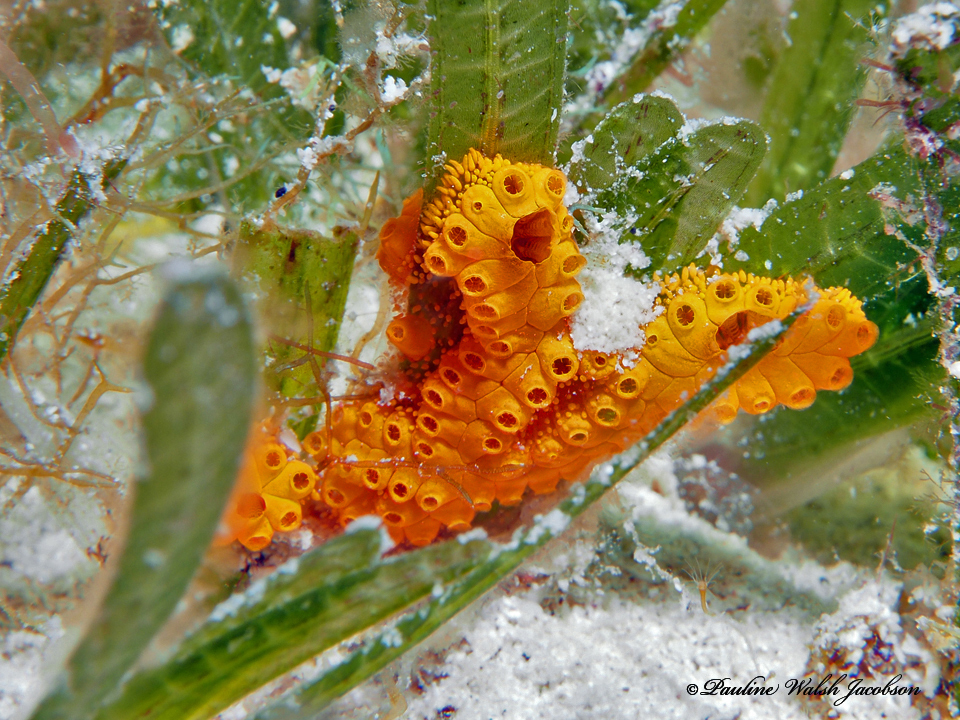
Chain Tunicate
Botrylloides violaceus
Botrylloides violaceus is a colonial ascidian. It is commonly known as the chain tunicate, but has also been called several other common names, including: lined colonial tunicate, orange sheath tunicate, orange tunicate, and violet tunicate.
Its native range is in the northwest Pacific from southern China to Japan and Siberia. Colonies grow on solid substrates and consist of individuals arranged in twisting rows. Outside its native range, it is considered an invasive species and is becoming more common in coastal waters of North America and other waters around the world, likely being spread by shipping activity.
From the article Botrylloides violaceus on Wikipedia (CC BY-SA), quoted section by section
Description
Zooids are embedded in a transparent tunic and connected by a network of blood vessels that terminate in ampullae (small sac-like structures) at the periphery of the colony. Colony color varies from bright orange to reddish or dull purple. These tunicates usually have 8 branchial tentacles and 11 rows of stigmata.
Wikipedia: “Morphology”
Where it lives
Recorded sightings
—
geo-referenced records in GBIF, from museums, herbaria and field observers.
Drag the globe to turn it. Dots are where records exist, not a range map; darker means more records.
In the stacks
Searching the stacks…
Every page naming Botrylloides violaceus in the Biodiversity Heritage Library →
This page is assembled live from iNaturalist, GBIF, Wikipedia, the Source Library and the Internet Archive. It is not yet part of the hand-edited codex. iNaturalist taxon 81776.