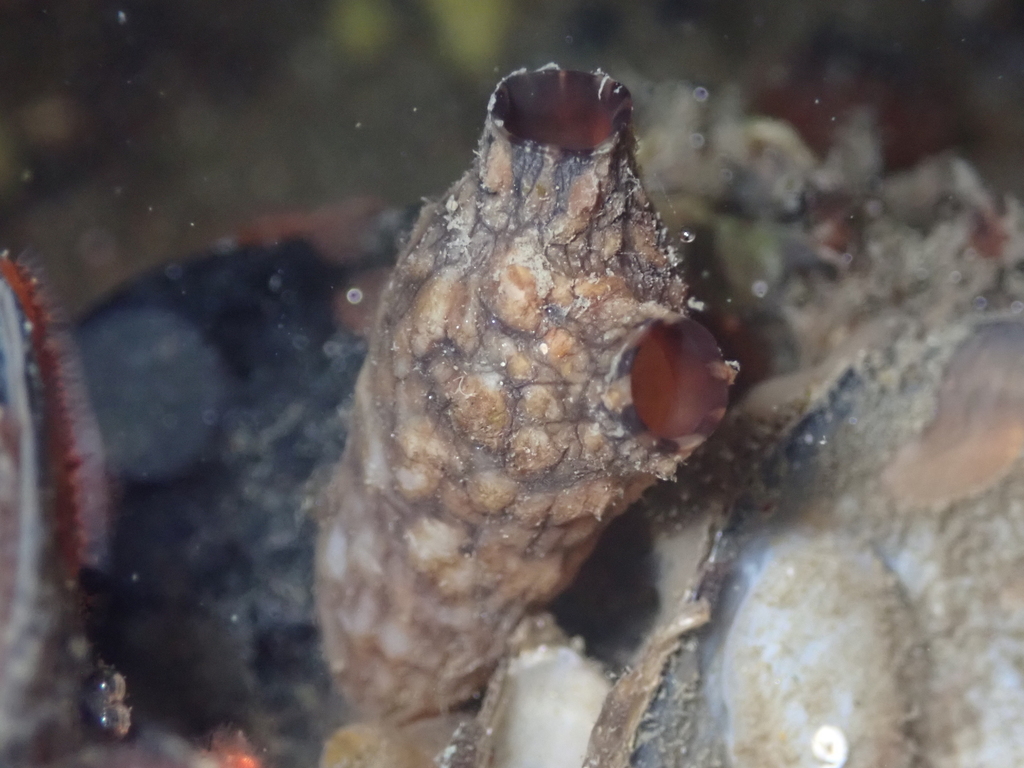
Stalked Sea Squirt
Styela clava
Styela clava is a solitary, subtidal ascidian tunicate. It has a variety of common names such as the stalked sea squirt, clubbed tunicate, Asian tunicate, leathery sea squirt, or rough sea squirt. As its common names suggest, S. clava is club-shaped with an elongated oval body and a long peduncle for attaching to a substrate. Although native to the northwestern waters of the Pacific Ocean, S. clava has become an increasingly successful invasive species outside of its native range since the 1900s. It is edible.
From the article Styela clava on Wikipedia (CC BY-SA), quoted section by section
Description
S. clava is a solitary tunicate. Including both the club-shaped body and peduncle, larger specimens of S. clava can have a maximum length of around 130 mm (5.1 in) while smaller specimens only reach 30 mm (1.2 in) in length. Smaller specimens tend to lack a distinct peduncle. As described by some of its common names, S. clava has a tough, wrinkled or irregularly grooved skin and comes in two variations of color dependent on size. Larger specimens have a light brown body and a darker brown peduncle while smaller specimen are yellow-brown.
Wikipedia: “Morphology”
Range & habitat
S. clava is a marine invertebrate animal. Adults are entirely sessile, growing attached to hard subtidal substrata as deep as 25 meters (82 ft). They can be found on virtually any hard surface such as rocks, buoys, pilings and shells of mussels. S. clava is predominant in the littoral zone, preferring sheltered localities free of strong wave action and floating objects, making artificial surfaces in harbors and marinas exceptional habitats. It is a hardy species that can live in a wide range of temperatures from -2 °C to 27 °C and can tolerate high salinity waters (26% - 28% salinity) that would be lethal to other tunicate species.
Wikipedia: “Habitat”
What it does
Like most tunicates, S. clava is hermaphroditic and produces short-lived pelagic lecithotrophic larvae. They reproduce externally via broadcast spawning, and the reproductive period is highly dependent on sea surface temperatures reaching a critical temperature threshold, between 16 °C and 20°C. The reproductive period can vary from 4 to 10 months depending on location. Along the Californian coast in the United States, the reproduction period occurs for 4 months from June to September, while in Denmark and England, the reproduction period is also 4 months but occurs from July to October.
Wikipedia: “Reproduction”
Where it lives
Recorded sightings
—
geo-referenced records in GBIF, from museums, herbaria and field observers.
Drag the globe to turn it. Dots are where records exist, not a range map; darker means more records.
In the stacks
Searching the stacks…
Every page naming Styela clava in the Biodiversity Heritage Library →
This page is assembled live from iNaturalist, GBIF, Wikipedia, the Source Library and the Internet Archive. It is not yet part of the hand-edited codex. iNaturalist taxon 81615.