- Animals
- ›Arthropods
- ›Crustaceans
- ›Typical Crustaceans
- ›Barnacles and Copepods
- ›Barnacles and Allies
- ›Barnacles
- ›Normal Barnacles
- ›Thoracican Barnacles
- ›Symmetrical Sessile Barnacles
- ›Coronuloidea
- ›Whale Barnacles
- ›Platylepas
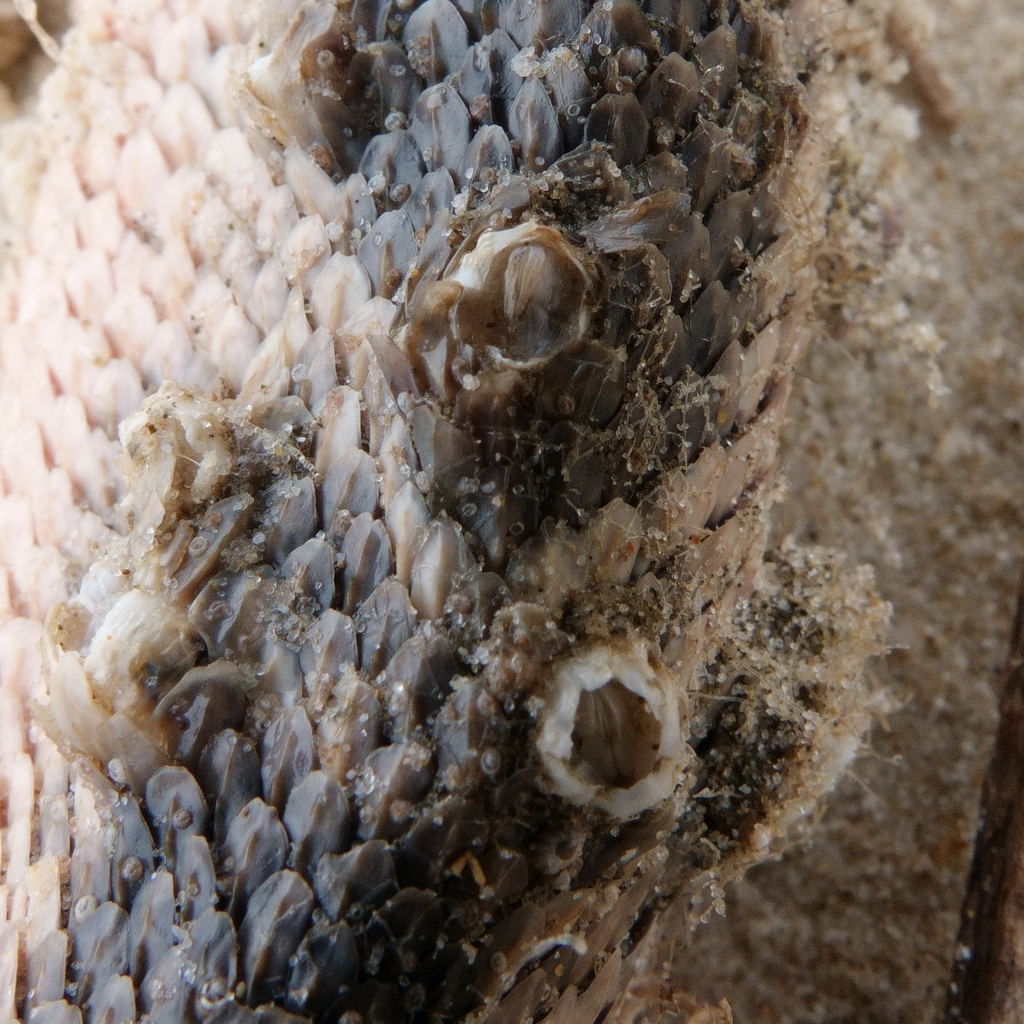
Platylepas ophiophila
Platylepas ophiophila, commonly known as the sea snake barnacle, is a species of barnacle in the family Platylepadidae. It is native to the Indo-Pacific Ocean where it lives as a symbiont of a sea snake.
From the article Platylepas ophiophila on Wikipedia (CC BY-SA), quoted section by section
What it does
Platylepas ophiophila is found living in association with several species of sea snake as an ectosymbiont. The barnacle adheres to the snake's skin, and has ribs that penetrate the snake's skin to make the attachment more secure. Nevertheless, the barnacle usually becomes detached when the snake sheds its skin. Barnacles breed by internal fertilisation, so individuals of this species have to be located adjacent to another individual in order to reproduce. Despite the fact that sea snakes are mobile and generally solitary, about half the sea snakes support barnacles. The barnacle may have adopted this lifestyle as a result of intense competition for space on coral reefs, rocks and other hard substrates; the advantages for the barnacle are freedom from predators, freedom from competitors, mobility, a feeding current, and possibly food fragments discarded by its host. There is no discernible benefit to this relationship for the sea snake and the barnacles increase drag in the water, impeding swimming. Snakes may engage in behaviors intended to dislodge the barnacles, such as rubbing against rocks for coastal species or knotting for open water species, [1] This species of barnacle is short-lived because it dies when the sea snake sheds its skin; as the skin is sloughed every four to six weeks, it is presumed that the barnacle completes its life cycle within this period. …
Wikipedia: “Ecology”
Where it lives
Recorded sightings
—
geo-referenced records in GBIF, from museums, herbaria and field observers.
Drag the globe to turn it. Dots are where records exist, not a range map; darker means more records.
In the stacks
Searching the stacks…
Every page naming Platylepas ophiophila in the Biodiversity Heritage Library →
This page is assembled live from iNaturalist, GBIF, Wikipedia, the Source Library and the Internet Archive. It is not yet part of the hand-edited codex. iNaturalist taxon 795457.