- Animals
- ›Arthropods
- ›Crustaceans
- ›Typical Crustaceans
- ›Malacostracans
- ›Decapods, Isopods, and allies
- ›Amphipods, Isopods, and Allies
- ›Isopods
- ›Woodlice, Pillbugs, and Rock Slaters
- ›Rock Slaters
- ›Rock Lice, Sea Slaters, and Allies
- ›Ligia
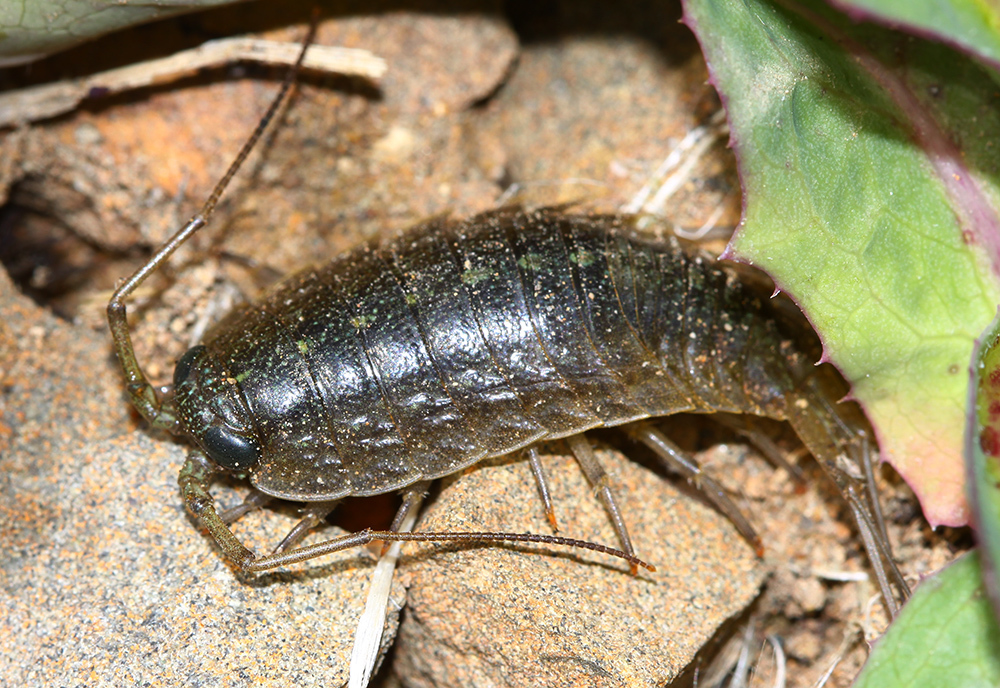
Cinereous Seaslater
Ligia cinerascens
Ligia cinerascens is a woodlouse in the family Ligiidae.
From the article Ligia cinerascens on Wikipedia (CC BY-SA), quoted section by section
Description
L. cinerascens is very similar to L. occidentalis with more antenna segments, but shorter overall antennal length. It can be distinguished from L. exotica by its shorter antennae and uropods, as well as its uniformly gray color and granular texture. The species name cinerascens comes from the Latin for "ashy," referring to the gray color of this species.
Range & habitat
G. H. A. Budde-Lund found samples of L. cinerascens on a long ocean exploration, and when he returned, he could not remember if they had come from Japan, Manila, or Chile, limiting current knowledge of the full range of the species. It has also been found on Kuril Islands (specifically Kunashir Island) and Peter the Great Gulf in far western Russia. It is one of four Ligia species to be found on Japanese coasts. Specifically, it is found mainly on Hokkaido, with a separate population in Tokyo Bay.
Wikipedia: “Distribution”
What it does
In the wild, L. cinerascens usually lives about a year (overwintering once), but occasionally lives up to 2.5 years (overwintering twice). Females breed in their first year for five months, then die before the second winter, typically producing one brood or two at the most. Reared in the lab, L. cinerascens has a longer lifespan and may produce three or more broods in a lifetime. L. cinerascens is parasitized by Thinoseius setifer, a mite attaching to the woodlouse's pleopods.
Wikipedia: “Life cycle”
Where it lives
Recorded sightings
—
geo-referenced records in GBIF, from museums, herbaria and field observers.
Drag the globe to turn it. Dots are where records exist, not a range map; darker means more records.
In the stacks
Searching the stacks…
Every page naming Ligia cinerascens in the Biodiversity Heritage Library →
This page is assembled live from iNaturalist, GBIF, Wikipedia, the Source Library and the Internet Archive. It is not yet part of the hand-edited codex. iNaturalist taxon 780882.