- Animals
- ›Arthropods
- ›Crustaceans
- ›Typical Crustaceans
- ›Malacostracans
- ›Decapods, Isopods, and allies
- ›Decapods and Krill
- ›Decapods
- ›Crabs, Lobsters, Shrimps, and Allies
- ›Crayfishes and Lobsters
- ›Northern Hemisphere Crayfishes
- ›Cambarid Crayfishes
- ›Faxonius
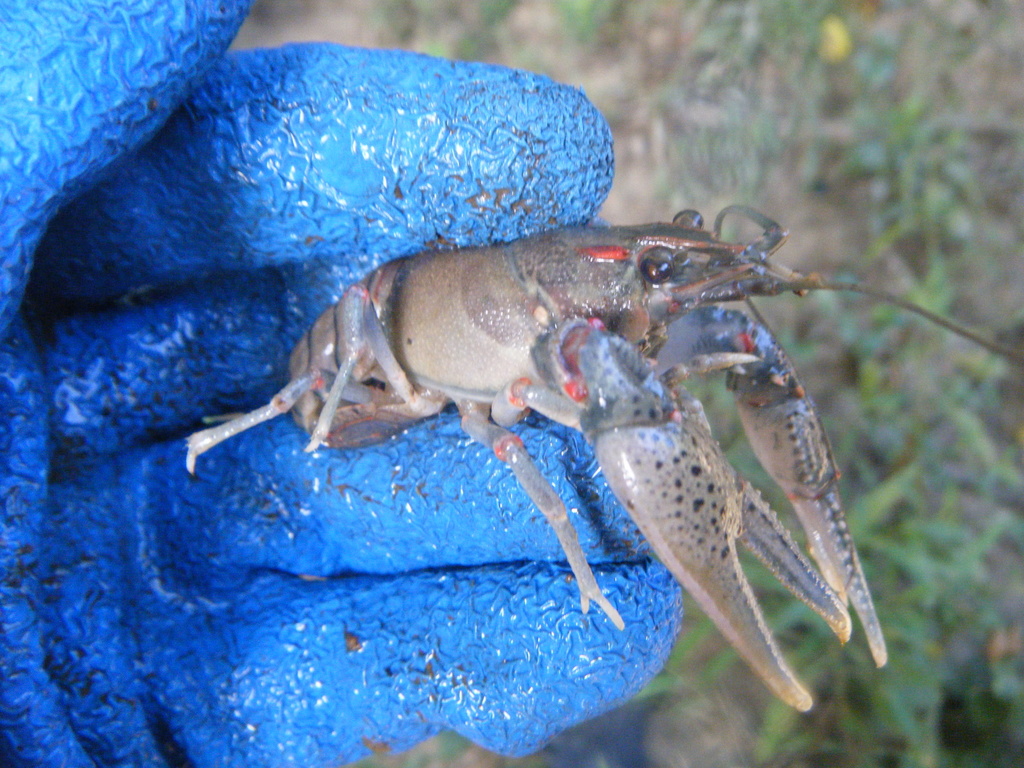
Kisatchie Painted Crayfish
Faxonius maletae
Faxonius maletae, sometimes called the Kisatchie painted crayfish or Kisatchie painted crawfish, is a species of crawdad in the Cambaridae family. The specific epithet maletae is in honor of the discoverer's wife, author Maleta M. Walls, who helped collect many of the original specimens. It was originally described as a subspecies of Faxonius difficilis, but later elevated to full species status. The common name refers to the Kisatchie National Forest, near where the original specimens were found in Bayou Santabarb.
From the article Faxonius maletae on Wikipedia (CC BY-SA), quoted section by section
Description
Kisatchie painted crawfish are brown or olive with red, blue, and white to yellow markings. The red is mainly on the central joints of the pereiopods, the postorbital ridges, and a little on the posterior margins of the uropods (tail fins) and abdominal segments. The fingers of the long, stout chelae (claws) are in order from tip to base, red, yellow/cream, blue, and greenish brown/brown. Its cephalothorax is about 40 millimetres (1.6 in) long, to a maximum of 4.4 centimetres (1.7 in). The rostrum (beak) is acuminate and has lateral spines. It has a closed areola (the hourglass shaped lines on the back). It is very similar to Faxonius difficilis but has a central projection that is longer and more curved, with a more smoothly curved expanded mesial process. It can be distinguished from F. palmeri by its shorter gonopods (which may reach the third coxa) and a shorter and stouter central projection. It is fairly indistinguishable from F. hathawayi blacki except that form I (breeding) males have an apex of their first pleopod (swimming leg) that is slender, long, and curved. They only have simple copulatory hooks on their third legs. It is also unique among members of its clade for having a structure like a sulcus caused by a single cephalomedian (anterior) prominence.
Range & habitat
F. maletae prefers clear flowing streams with sandy bottoms and plenty of plant litter and rocks. Occasionally it found in reed beds. It eats carrion and plants.
Wikipedia: “Habitat and ecology”
What it does
Form I males are found in low-water conditions between June and October, peaking in September–October. Males have mating plugs in October. Kisatchie painted crawfish reproduce with the male depositing sperm into an external receptacle under the female's abdomen. She then fertilizes her eggs as she excretes them. Both eggs and hatchlings remain with the mother, held under her body by her pleopods until they are big enough to swim and crawl without assistance. June and July are when juveniles are most commonly found.
Wikipedia: “Behaviour”
Where it lives
Recorded sightings
—
geo-referenced records in GBIF, from museums, herbaria and field observers.
Drag the globe to turn it. Dots are where records exist, not a range map; darker means more records.
In the stacks
Searching the stacks…
Every page naming Faxonius maletae in the Biodiversity Heritage Library →
This page is assembled live from iNaturalist, GBIF, Wikipedia, the Source Library and the Internet Archive. It is not yet part of the hand-edited codex. iNaturalist taxon 776130.