- Animals
- ›Arthropods
- ›Crustaceans
- ›Typical Crustaceans
- ›Malacostracans
- ›Decapods, Isopods, and allies
- ›Decapods and Krill
- ›Decapods
- ›Crabs, Lobsters, Shrimps, and Allies
- ›Crayfishes and Lobsters
- ›Northern Hemisphere Crayfishes
- ›Cambarid Crayfishes
- ›Faxonius
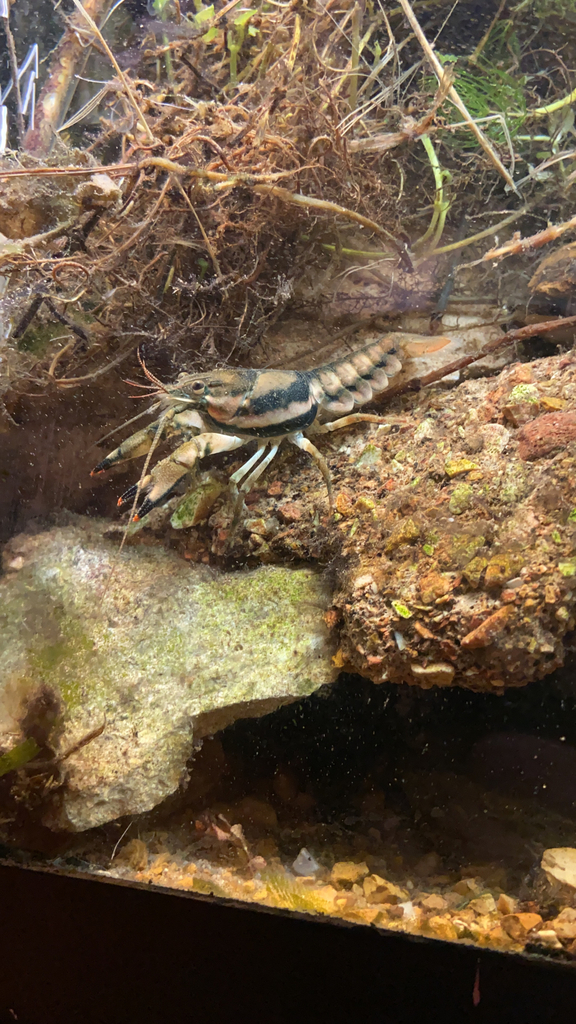
Ringed Crayfish
Faxonius neglectus
Faxonius neglectus, a species of freshwater crayfish also known as the ringed crayfish, is native to Central North America, with two major disjunct areas of distribution in the Ozarks and around Nebraska. The species name, Faxonius neglectus, was previously Orconectes neglectus (before this, Faxonius was a subgenus of Orconectes). Faxonius was declared its own genus in 2017 by Crandall & De Grave, as many previously thought Orconectes species were found to not reside in caves (a quality of Orconectes).
From the article Faxonius neglectus on Wikipedia (CC BY-SA), quoted section by section
Description
There are two subspecies of F. neglectus: F. neglectus chaenodactylus (also known as the gapped ringed crayfish or the gap-ringed crayfish) and F. neglectus neglectus. F. neglectus has a uniquely marked decapod anatomy, which includes a wide ring on the rostrum in combination with a dark brown wide ring on the dactyl and propodus of the crayfish's chelipeds, ending in bright red/orange. The third maxilliped ends in a scalloped appearance. The color of the carapace can range from a light brown or yellow color, just rear of the cephalic groove, being banded by a dark brown ring.
Evidence of sexual dimorphism has not been observed to be present for this species. Adult carapace length is an average of 32 mm (1.3 in) for males and females. During F. n. chaenodactylus's initial year of life, the average number of molts performed is 8, followed by 4, 3, 4, 4, and 4 molts for each year after. Mating is polygonous, resulting in size based dominance. Like many other decapods, F. neglectus consumes algae and detritus within the environments that they occupy.
Males. In F. neglectus males, there is the presence of the pleopods (swimmerets) being curved towards the tail. Males have been documented to reach maturity within 8 months, but the growth of immature F. n. chaenodactylus is dependent upon temperature fluctuations during this time. The average maximum age for F. n. …
Wikipedia: “Description and ecology”
Range & habitat
F. neglectus has been documented as an invasive species in the Hudson River's Croton River drainage of southeastern New York, and the Housatonic River drainage of Connecticut. F. neglectus is an invasive species in the Spring River (Arkansas) drainage of the Ozarks. Where F. neglectus colonizes, the native species, Faxonius eupunctus and Cambarus hubbsi, are no longer present, despite having been previously observed in those areas.
Wikipedia: “Invasive range”
Where it lives
Recorded sightings
—
geo-referenced records in GBIF, from museums, herbaria and field observers.
Drag the globe to turn it. Dots are where records exist, not a range map; darker means more records.
In the stacks
Searching the stacks…
Every page naming Faxonius neglectus in the Biodiversity Heritage Library →
This page is assembled live from iNaturalist, GBIF, Wikipedia, the Source Library and the Internet Archive. It is not yet part of the hand-edited codex. iNaturalist taxon 776066.