- Animals
- ›Arthropods
- ›Chelicerates
- ›Arachnids
- ›Spiders
- ›Typical Spiders
- ›Entelegyne Spiders
- ›Salticoid Spiders
- ›Jumping Spiders
- ›Typical Jumping Spiders
- ›Chrysillini
- ›Phintella
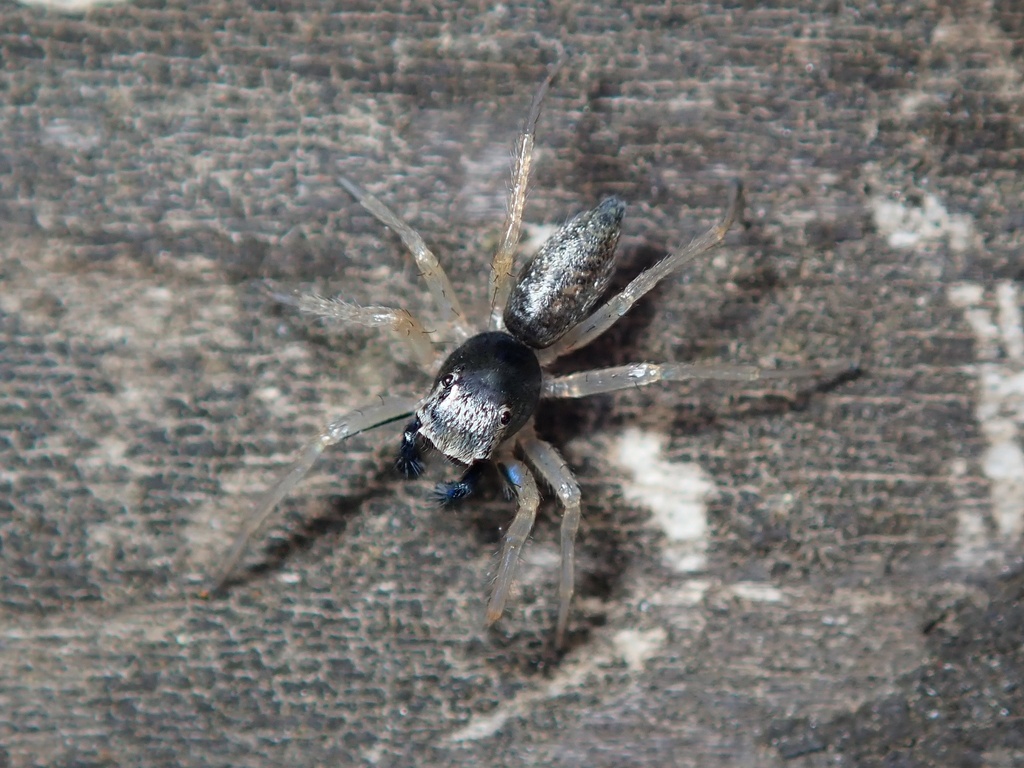
Phintella parva
Phintella parva is a species of jumping spider in the genus Phintella that lives in China, Japan, Korea and Russia. The spider is yellow in colour and small, measuring between 3.5 and 4 mm (0.14 and 0.16 in) in body length. It exhibits sexual dimorphism, with the female being slightly larger than the male. The abdomen has a striped pattern and the carapace has circular markings, but the most significant difference to other members of the genus are its copulatory organs, particularly the short curved embolus in the male and the long straight insemination ducts in the female. The species was first described by Wanda Wesołowska in 1981 based on a specimen collected in North Korea. The spider was originally classified within the genus Icius under the name Icius parvus, but was transferred to its current genus by Jerzy Prószyński in 1983. It was also recognised that other examples of the spider had been previously collected, including, at one time, a description of one found in the Soviet Union published in 1979 without a species name.
From the article Phintella parva on Wikipedia (CC BY-SA), quoted section by section
Description
Phintella parva is a small spider with some sexual dimorphism. The female is larger than the male, with a total length of between 4 and 5 mm (0.16 and 0.20 in). The body is divided into two main parts: a cephalothorax and an abdomen. The cephalothorax is between 1.78 and 2.05 mm (0.070 and 0.081 in) in length and between 1.28 and 1.55 mm (0.050 and 0.061 in) in width. The carapace, the hard upper shell of the cephalothorax, is longer than wide and quadrangle-shaped. It is yellow with circular markings to towards the back. The spider's eye field is black. The underside of the carapace, or sternum, has brown sides and a yellow middle. The mouthparts are distinctive. They are generally yellow but the chelicerae have brown lines on the front and the labium has a brown lower part. The abdomen measures between 2.98 and 3.08 mm (0.117 and 0.121 in) in length and 1.8 and 2.18 mm (0.071 and 0.086 in) in width. It is also yellow and has two broad stripes running along the sides. Some spiders have an additional stripe running down the middle of the abdomen. Four or five chevrons can often be seen at the very back. There is another black stripe on the underside that runs from the epigastric furrow at the back to the spiracle. The spinnerets are yellow, as are the legs. It has unusual copulatory organs. The epigyne, the external female copulatory organ, is small with little sclerotization. …
Range & habitat
Phintella parva lives in China, Japan, Korea and Russia. The holotype of the species, a female, was discovered in the valleys around Mount Myohyang, North Korea, by Bohdan Pisarski and Prószyński in 1959. Other female specimens were also seen near the city of Pyongyang and in South Hamgyong Province. They were not described and named until 1981. Subsequently, examples have been found throughout the country. The spider was recorded in Haeju in 1987, followed by Chongjin, Hongwon County, Kaesong and Kyongsong County in 1990. The spider was also found around Mount Kumgang at the same time. South Korea was later added to the species distribution, with examples being identified in Sobaeksan and area around Palgongsan in the North Gyeongsang Province, the first to be found dating from 1964. The spider has also been observed outside the Korean peninsula. Wesołowska noted that it had been found in Primorsky Krai, in what was then the Russian Soviet Federative Socialist Republic of the Soviet Union, and described in 1979, but had not been given a species name. Later, specimens from Furugelm Island were also referred to the species. The first example in China was identified in Shanxi. The species was subsequently found in many other areas of the country, including Beijing, Gansu, Hebei and Henan. Hebei is a particularly rich area for the species. …
Wikipedia: “Distribution and habitat”
In human culture
In 1981, the Polish arachnologist Wanda Wesołowska described a new species of jumping spider, a member of the family Salticidae, which she named Icius parvus. It was one of over 500 species that she identified in her career. Originally ascribed to the genus Icius, first circumscribed by Eugène Simon in 1876, the species was later transferred to Phintella in 1983 by Jerzy Prószyński. At the same time, the gender of the species name was changed, from parvus to parva. The genus Phintella was first circumscribed in 1906 by Embrik Strand and W. Bösenberg. There are similarities between Phintella and the genera Chira, Chrysilla, Euophrys, Icius, Jotus and Telamonia. Genetic analysis confirms that Phintella is related to the genera Helvetia and Menemerus. In 2015, Wayne Maddison classified it in the tribe Chrysillini, named after the genus Chrysilla. In 2017, Prószyński grouped the genus with 32 other genera of jumping spiders under the name Chrysillines in the supergroup Chrysilloida. Phintella parva is known under the common name Myohyangkkangchunggeomi (Korean: 묘향깡충거미) in Korea. The spider's specific name is Latin for "small". Its generic name derives from the genus Phintia due to the similarities between the two genera. Phintia was itself renamed Phintodes and was subsequently absorbed into the genus Tylogonus.
Wikipedia: “Taxonomy and etymology”
Where it lives
Recorded sightings
—
geo-referenced records in GBIF, from museums, herbaria and field observers.
Drag the globe to turn it. Dots are where records exist, not a range map; darker means more records.
In the stacks
Searching the stacks…
Every page naming Phintella parva in the Biodiversity Heritage Library →
This page is assembled live from iNaturalist, GBIF, Wikipedia, the Source Library and the Internet Archive. It is not yet part of the hand-edited codex. iNaturalist taxon 773472.