- Animals
- ›Arthropods
- ›Chelicerates
- ›Arachnids
- ›Spiders
- ›Typical Spiders
- ›Entelegyne Spiders
- ›Salticoid Spiders
- ›Jumping Spiders
- ›Typical Jumping Spiders
- ›Aelurillini
- ›Aelurillina
- ›Stenaelurillus
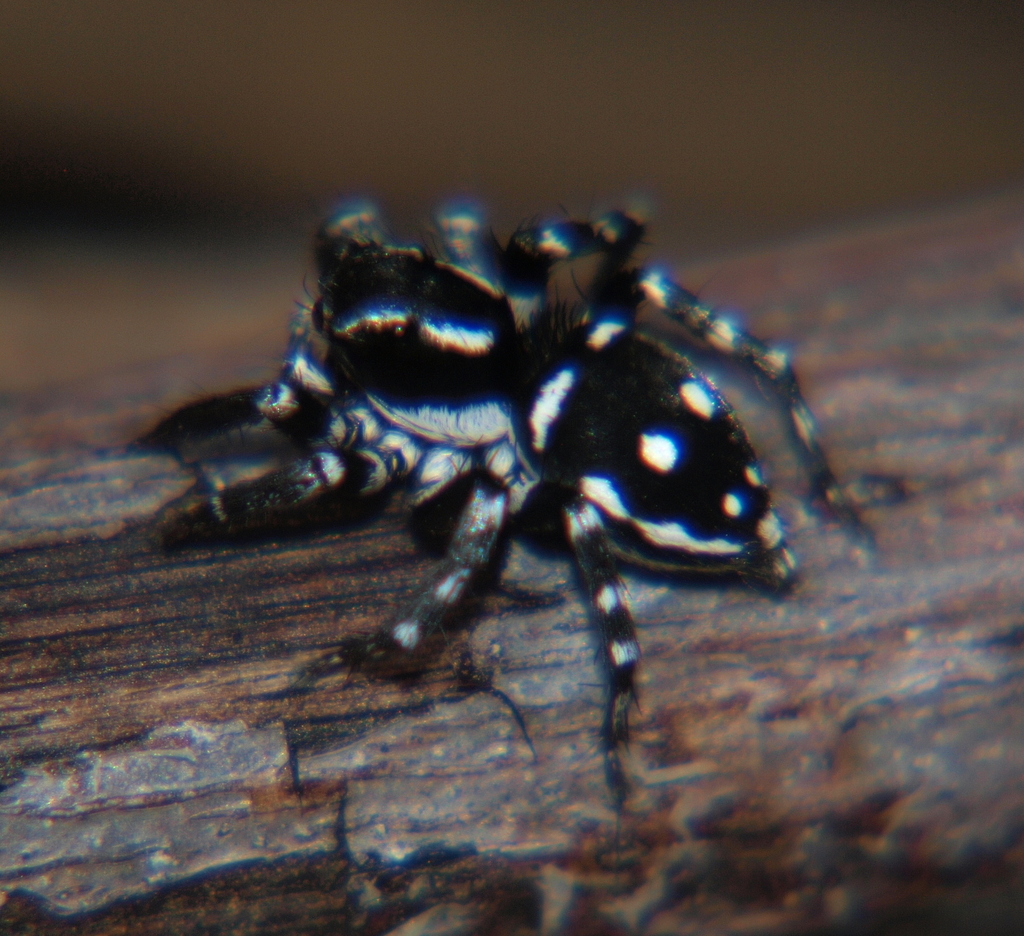
Stenaelurillus guttatus
Stenaelurillus guttatus, synonym Mashonarus guttatus, is a species of jumping spider in the genus Stenaelurillus that lives in Botswana, Zambia and Zimbabwe. It was first described in 2002 by Wanda Wesołowska and Meg S. Cumming. It was initially the type species for the genus Mashonarus but was moved to its current genus in 2018. The spider is medium-sized, with a cephalothorax that is between 2.1 and 2.7 mm (0.083 and 0.106 in) long and 2.0 mm (0.079 in) and an abdomen that is between 2.3 and 3.8 mm (0.091 and 0.150 in) long. It is very dark in colour, either dark brown or black, and has a distinctive pattern on its back consisting of two white stripes on the thorax and three sets of two white patches on the abdomen. This pattern gives the species its name, which is based on a Latin word that can be translated spotted. It lives in a wide range of environments, from dry to wet climates, and at altitudes between 500 and 1,500 m (1,600 and 4,900 ft) above sea level. First observed in a garden, the spider has been found under logs, stones and rocks, in leaf litter, and, after rains, on grass, shrubs and garden walls. It feeds on termites, particularly Odontotermes transvaalensis, and other prey including fruit flies and leafhoppers.
From the article Stenaelurillus guttatus on Wikipedia (CC BY-SA), quoted section by section
Description
The spider is medium-sized and has an overall shape that is typical for the genus. The cephalothorax is typically 2.7 mm (0.11 in) long and 2.0 mm (0.079 in) wide, while the abdomen is 2.5 mm (0.098 in) long and 1.9 mm (0.075 in) wide. The spider has a pear-shaped dark brown or black carapace and oval or shield-shaped abdomen have a distinctive colouration and pattern. The carapace has two slightly curved stripes formed of white hairs that cross the thorax while the abdomen has a pattern of three sets of two white patches made up of small scales. There is another small patch at the end of the abdomen, near the spinnerets. The spinnerets are brownish or grey, legs brown or yellow and the chelicerae dark brown. The eye field is black. As well as the colouration, it is distinguished from other members of the genus by the design of the sexual organs, including its stilleto-shaped embolus. The female is similar to the male but with a larger abdomen. It has a cephalothorax that measures between 2.1 and 2.6 mm (0.083 and 0.102 in) in length and between 1.6 and 2.0 mm (0.063 and 0.079 in) in width. The abdomen measures between 2.3 and 3.8 mm (0.091 and 0.150 in) in length and between 1.6 and 2.6 mm (0.063 and 0.102 in) in width. The colours are very similar and the patterns are often richer with additional white patches on the sides of the spider. …
Range & habitat
The species was first identified in Harare, Zimbabwe, based on specimens collected in a garden in 1992. Both a holotype male and paratype female were collected. The species was also identified in Botswana, near Francistown, and Harry Mwanga Nkumbula International Airport in Zambia. An example initially identified as the species from Namibia was found to be misnamed. The spider lives in diverse habitats. It has been identified under logs, stones and rocks. It lives in leaf litter and, after rain has fallen, can be found on grass, shrubs and garden walls. It thrives in both dry and wet climates, at altitudes between 500 and 1,500 m (1,600 and 4,900 ft) above sea level.
Wikipedia: “Distribution and habitat”
What it does
The spider is a specialised hunter of Odontotermes termites, particularly Odontotermes transvaalensis, seeking out prey in the leaf litter that lays on top of termite mounds. The spider has been observed particularly seeking out new areas of termite construction, and grabbing termite workers even when they attempt to defend themselves. The spider shows a tendency to avoid members of the soldier caste. The species also feeds on other prey, including fruit flies and leafhoppers. Stenaelurillus guttatus has been found to nest and produce juveniles between September and November. Between December and March, they remain hidden until the mating season, at the end of the wet season in April. Although some of the adults from the previous season survived until the juveniles hatched, there was no overlap between the adult generations.
Wikipedia: “Behaviour”
Where it lives
Recorded sightings
—
geo-referenced records in GBIF, from museums, herbaria and field observers.
Drag the globe to turn it. Dots are where records exist, not a range map; darker means more records.
In the stacks
Searching the stacks…
Every page naming Stenaelurillus guttatus in the Biodiversity Heritage Library →
This page is assembled live from iNaturalist, GBIF, Wikipedia, the Source Library and the Internet Archive. It is not yet part of the hand-edited codex. iNaturalist taxon 764914.