- Animals
- ›Arthropods
- ›Crustaceans
- ›Typical Crustaceans
- ›Malacostracans
- ›Decapods, Isopods, and allies
- ›Amphipods, Isopods, and Allies
- ›Amphipods
- ›Senticaudata
- ›Gammarida
- ›Gammaridira
- ›Gammaroidea
- ›Gammaridae
- ›Gammarus
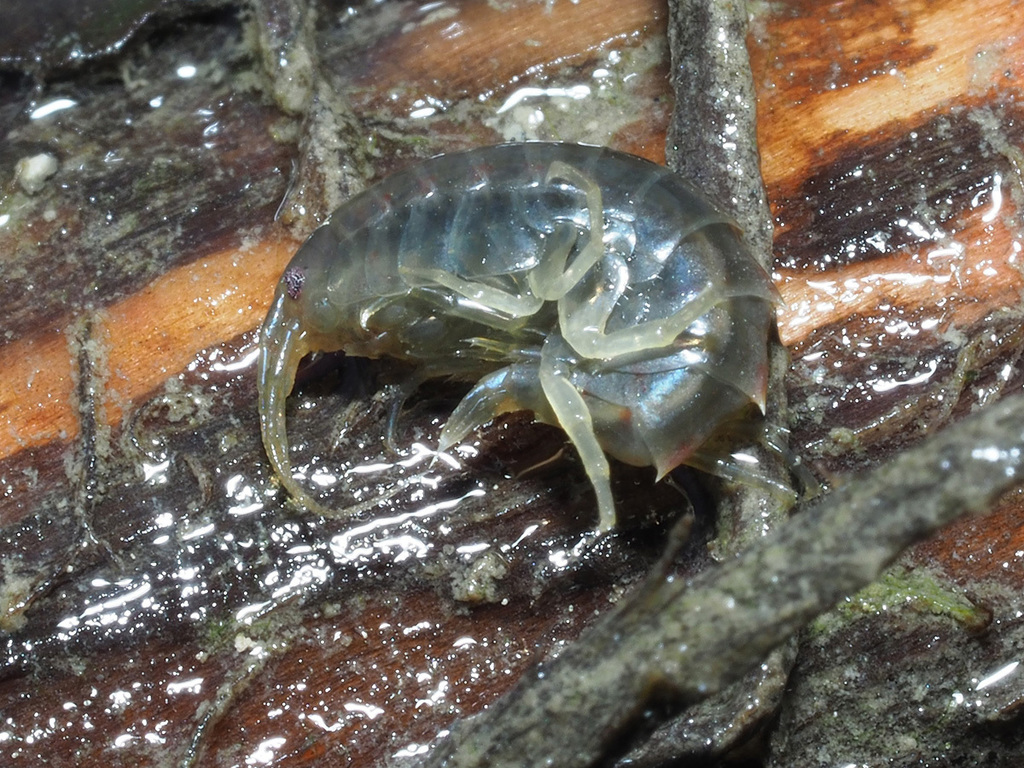
Roeseli's Scud
Gammarus roeselii
Gammarus roeseli is a species of freshwater amphipod found across Europe from the Benelux countries to European Turkey. It spread from the Balkans northwards, via the Danube system to establish itself as an alien species in Poland, although it is not an invasive species.
From the article Gammarus roeseli on Wikipedia (CC BY-SA), quoted section by section
Description
Gammarus roeselii adult males reach a length of up to 22 mm; females are smaller than males. The species is distinct from many other common amphipods due to the spines on its fifth through seventh pereiopods. The color of G. roeselii individuals can vary from green to brown, gray, or yellow, and some have reddish markings on parts of their carapaces.
Range & habitat
Gammarus roeselii originated in the Balkan area of Europe, and appears to have populated the Pannonian Basin as a glacial refuge before expanding into central and western Europe 10,000 years ago. It is now widespread across continental Europe. Having been in France since at least the mid-1800s it is considered to be a well-established non-native species in central, northern, and western Europe. However, it continues to expand its distribution range, including into new river basins in Italy in the 2010s. Even within the same geographic area – for example in France – some refer to the species as being invasive while others refer to it as being naturalized.
Wikipedia: “Distribution”
What it does
Gammarus roeselii are omnivores. Although they feed on animal prey, their mouthparts are morphologically better suited for ingesting detritus and suspended particles, as well as for scraping algae and fungi off detritus and other surfaces. Studies across the cryptic species complex indicate that distinct genetic lineages occupy comparable trophic positions, suggesting functional equivalence among allopatric lineages despite deep genetic divergence. Gammarus roeselii are predated on by fish. The distinctive spines of G. roeselii were found in a laboratory experiment to be associated with defense against predation by brown trout. Like other gammaridean amphipods, G. roeselii serve as hosts for microsporidian parasites. The parasites have a variety of effects on infected G. roeselii. Physiologically, infection can increase salinity tolerance. Infection by some microsporidians can feminize male embryos and lead to female-biased sex ratios. Infection status also alters predator-avoidance behavior in G. roeselii.
Wikipedia: “Trophic interactions”
In human culture
Males and females form precopulatory mating pairs; after mating, females carry eggs in a brood pouch and then release juveniles. Clutch size is variable, reaching up to 80 or more eggs for some females; clutch sizes are smaller, but eggs are larger, in the winter than during warmer months. Development in the brood pouch can take anywhere from 10 to over 200 days depending on water temperature, and survival of embryos is highest between 10 and 16 °C. Females can produce up to eight broods over their lifetimes. Juveniles moult nine or ten times before reaching sexual maturity. A study investigating potential life-history differences among the cryptic lineages of the species complex found no significant variation; traits such as clutch size are similar across lineages.
Wikipedia: “Life history”
Where it lives
Recorded sightings
—
geo-referenced records in GBIF, from museums, herbaria and field observers.
Drag the globe to turn it. Dots are where records exist, not a range map; darker means more records.
In the stacks
Searching the stacks…
Every page naming Gammarus roeselii in the Biodiversity Heritage Library →
This page is assembled live from iNaturalist, GBIF, Wikipedia, the Source Library and the Internet Archive. It is not yet part of the hand-edited codex. iNaturalist taxon 714591.