- Animals
- ›Molluscs
- ›Cephalopods
- ›Octopuses, Squids, and Cuttlefishes
- ›Octopuses and Vampire Squids
- ›Octopuses
- ›Incirrate Octopuses
- ›Typical Octopuses, Giant Octopuses, and Allies
- ›Megaleledonids
- ›Velodona
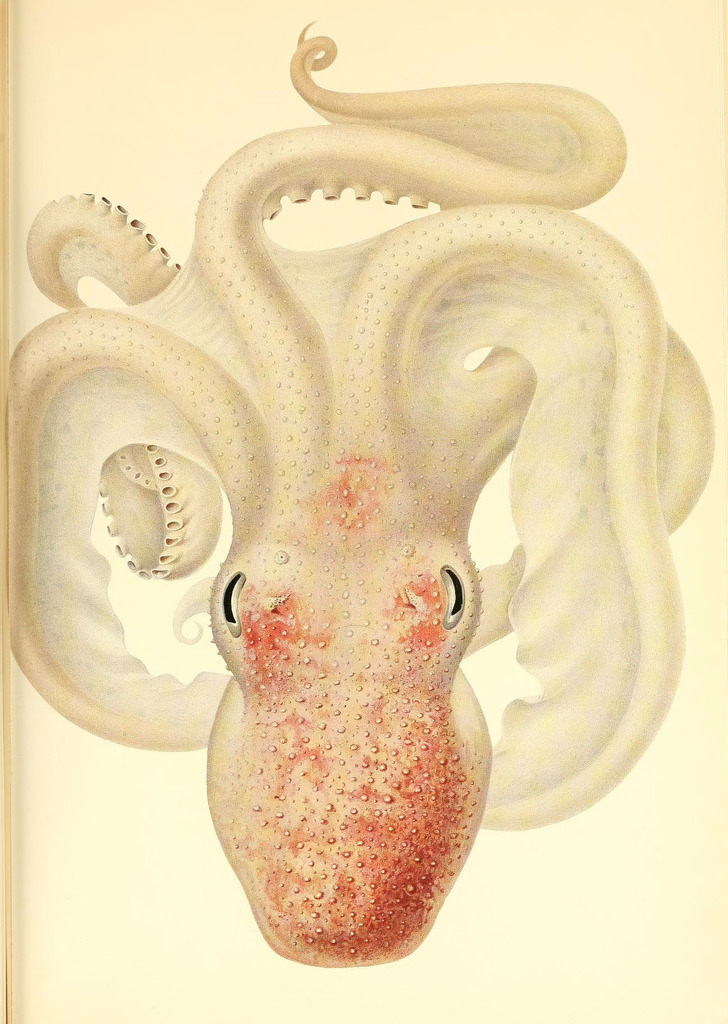
Angel Octopus
Velodona togata
Velodona togata is a species of octopus in the monotypic genus Velodona. First described by Carl Chun in 1915, with a second subspecies discovered by Guy Coburn Robson in 1924, it was named for the distinctive membranes on its arms.
Described as being similar to members of the genera Pareledone, Eledone, and Enteroctopus, V. togata has a large body with large eyes and extensive membranes that link the octopus' arms together. The species has a single line of suckers on each arm, and its head, mantle, and part of its arms are covered in warts. Although the reproductive habits of V. togata have not been extensively studied, the species is believed to be one of the most fecund among octopuses in its region and depth level, despite the species possessing large eggs and extremely large spermatophores.
From the article Velodona on Wikipedia (CC BY-SA), quoted section by section
Description
Chun described the first specimen he caught, a male, as looking similar to the genus Eledone, but with larger membranes, a differently shaped hectocotylus, and a differently shaped funnel organ (siphon). The specimen had "a sac-shaped body and very large eyes", with arms that "are folded back and have very large membranes which enclose the whole animal", and had a "characteristic pale coloration". Reiterating Chun, Guy Robson summarized the differences between Eledone and V. togata as "the possession of (a) a funnel organ composed of two separate pieces, (b) a sigmoid bend in the hectocotylized arm, and (c) the development of extensive lateral membranes on the arms". Robson, however, was not fully convinced that the shape of the hectocotylized arm was of value in identifying the species, positing that the curve could have been caused by a shrinkage of the membrane. In comparing the distinctive features of V. togata with other known octopus species, Robson found similarities between V. togata and species in the genera Moschites (now considered a synonym for Pareledone and Eledone, the former now considered to be in the family Megaleledonidae and the latter in the family Eledonidae), and Polypus (now considered a synonym for Enteroctopus, in the family Enteroctopodidae). He found V. togata closest to the southern species of Moschites, such as M. …
Range & habitat
The first specimen of Velodona togata (Velodona togata togata) was captured off the east coast of Africa at a depth of 749 meters below sea level. The four specimens described by Guy Robson as being members of a separate subspecies (Velodona togata capensis) were caught off the "Natal coast" (modern KwaZulu-Natal coast, South Africa) at depths of between 220 fathoms (402.3 meters) and 250 fathoms (460 meters). According to the Integrated Taxonomic Information System (ITIS) database, Velodona togata togata is possibly located in the waters north of Zanzibar, Tanzania, while Velodona togata capensis is located off of the "Natal coast, South Africa". In 2009, a Spanish research vessel conducted a study of the cephalopod population off the coast of Mozambique. The study found populations of V. togata across the entire study area, which ran most of the coast of Mozambique, with especially high concentrations at the very southern end of the Mozambiquan coast, in the waters near the city of Maputo. The study performed trawls in four depth groups, 200–400, 400–500, 500–600, and 600–700 meters below sea level. While V. togata was found in all four depth ranges, they were most abundant between 400 and 600 meters below sea level. The study also noted that males were most common in the shallower two groups, while females were more common in the deeper two groups.
Wikipedia: “Habitat and distribution”
What it does
Little is known about the reproductive habits of V. togata. A 2009 study, the first to focus on V. togata, conjectured that "The high proportion of immature females obtained in the survey (76%) and the low proportion of mature females (10%) could indicate that the spawning season is finishing at the beginning of the autumn. Moreover, the wide size range of the sampled population, with a considerable number of small individuals (possibly only a few days old), suggests the existence of an extended reproduction period.". Analyzing the spermatophores and eggs of the captured specimens, the 2009 study found that V. togata had a low fecundity value, with females having large eggs and males producing a low number of large spermatophores (the largest reported of any deep-sea member of the suborder Incirrina). Despite this, the species was still one of the most fecund among "deep-sea octopods that inhabit the Southern Ocean".
Wikipedia: “Reproduction”
Where it lives
Recorded sightings
—
geo-referenced records in GBIF, from museums, herbaria and field observers.
Drag the globe to turn it. Dots are where records exist, not a range map; darker means more records.
In the stacks
Searching the stacks…
Every page naming Velodona togata in the Biodiversity Heritage Library →
This page is assembled live from iNaturalist, GBIF, Wikipedia, the Source Library and the Internet Archive. It is not yet part of the hand-edited codex. iNaturalist taxon 695054.