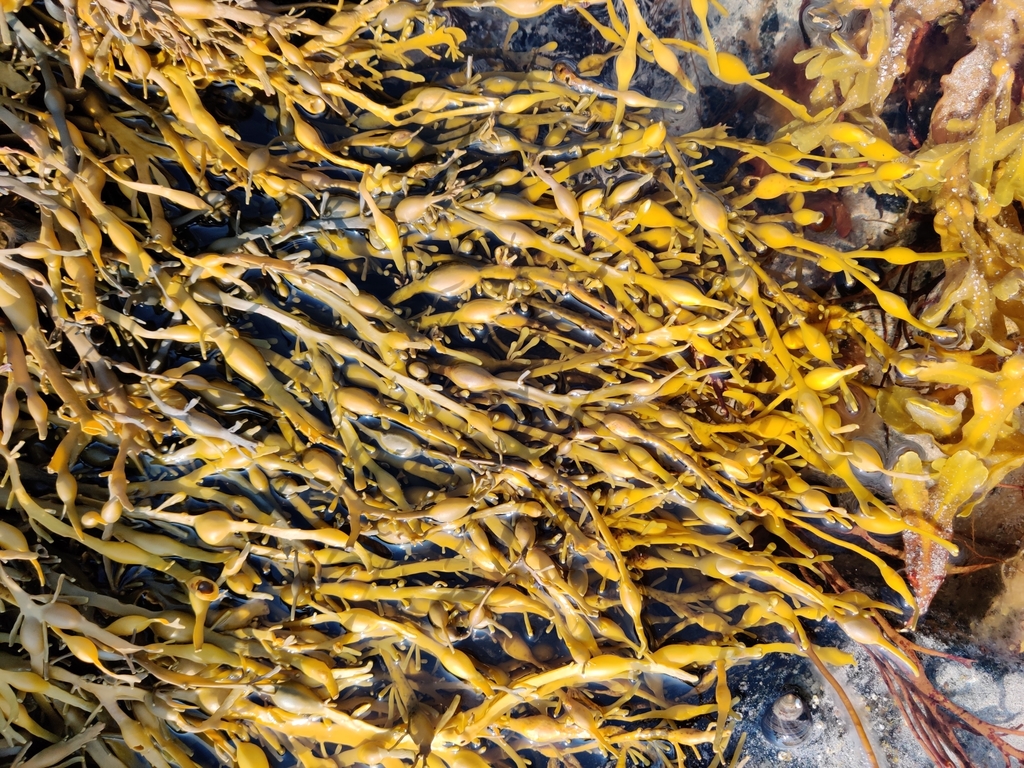
Knotted Wrack
Ascophyllum nodosum
Ascophyllum nodosum is a large, common cold water seaweed or brown alga (Phaeophyceae) in the family Fucaceae. Its common names include knotted wrack, egg wrack, feamainn bhuí, rockweed, knotted kelp and Norwegian kelp. It grows only in the northern Atlantic Ocean, along the north-western coast of Europe (from the White Sea to Portugal) including east Greenland and the north-eastern coast of North America. Its range further south of these latitudes is limited by warmer ocean waters. It dominates the intertidal zone. Ascophyllum nodosum has been used numerous times in scientific research and has even been found to benefit humans through consumption.
From the article Ascophyllum on Wikipedia (CC BY-SA), quoted section by section
Description
Ascophyllum nodosum has long tough and leathery fronds, irregularly dichotomously branched fronds with large, egg-shaped air bladders set in series at regular intervals along the fronds and not stalked. The air bladders create a way for fronds broken by wave exposure or other causes to be dispersed and regrow in other areas. While the fronds can reach up to 2 m, the length depends on wave exposure: the length increases with water velocity until a certain point, then decreases as waves become more intense. The fronds can reach 2 m in length and are attached by a holdfast to rocks and boulders. In rare cases, the fronds can reach 6m long. The fronds are olive-green, olive-brown in color and somewhat compressed, but without a midrib. Young shoots are yellow, however darken with age.
Range & habitat
This species has been recorded in Europe from Ireland, the White Sea, the Faroe Islands, Norway, Britain and Isle of Man, Netherlands, and North America from the Bay of Fundy, Nova Scotia, Baffin Island, Hudson Strait, Labrador, and Newfoundland. The southern boundary of A. nodosum ends around Long Island, NY, on account of higher water temperatures when traveling farther south. It has been recorded as an accidental introduction near San Francisco, California, and eradicated as a potential invasive species.
Wikipedia: “Distribution”
What it does
Each individual is dioecious, either male or female. The gametes are produced in the spring in conceptacles embedded in yellowish receptacles on short branches. A year after the gamete is fertilized and forms a zygote, the first frond grows, and at the beginning of year 2, an air bladder forms, which creates a way to age individuals.
Varieties and forms. Several different varieties and forms of this species have been described, including the two below.
Ascophyllum nodosum var. minor has been described from Larne Lough in Northern Ireland. Free-floating forms of this species are found in, for example, A. n. mackaii Cotton, which is found at very sheltered locations, such as at the heads of sea lochs in Scotland and Ireland.
Wikipedia: “Reproduction”
At the table
The consumption of Ascophyllum nodosum has been proven to have dental benefits in humans, dogs and cats. In addition to dental benefits, A. nodosum can reduce inflammation and speed up healing, especially after a serious injury. Brown algae contains fucoidans, which are sulfated, fucose-rich polymers. Fucoidans block selectins, which are receptors on white blood cells that allow those cells to enter a tissue, causing inflammation. Since the fucoidans block inflammation, A. nodosum can be considered an anti-inflammatory. Ascophyllum nodosum extracts can be used to control body weight in obese mice. There is potential for these extracts to be efficient in humans, but most studies focus on the effects in small rodents, so more testing needs to be done. Ascophyllum nodosum is harvested for use in alginates, fertilisers, and the manufacture of seaweed meal for animal and human consumption. Due to the high level of vitamins and minerals that bioaccumulate in A. nodosum, it has been used in Greenland as a dietary supplement. It has also been used for certain herbal teas, particularly kelp teas. It has long been used as an organic and mainstream fertilizer for many varieties of crops due to its combination of both macronutrients, (N, P, and K) and micronutrients (Ca, Mg, S, Mn, Cu, Fe, Zn, etc.). …
Wikipedia: “Uses”
In human culture
Ascophyllum nodosum is the only species in the genus Ascophyllum. The original name (basionym) was Fucus nodosus Linnaeus 1753. The species was transferred to the genus Ascophyllum (as Ascophylla) by Stackhouse (Papenfuss 1950), under the name Ascophyllum laevigata (Guiry and Guiry 2020). The combination Ascophyllum nodosum was made by Le Jolis (1863).
Wikipedia: “Scientific name history”
Where it lives
Recorded sightings
—
geo-referenced records in GBIF, from museums, herbaria and field observers.
Drag the globe to turn it. Dots are where records exist, not a range map; darker means more records.
In the stacks
Searching the stacks…
Every page naming Ascophyllum nodosum in the Biodiversity Heritage Library →
This page is assembled live from iNaturalist, GBIF, Wikipedia, the Source Library and the Internet Archive. It is not yet part of the hand-edited codex. iNaturalist taxon 68770.