- Animals
- ›Arthropods
- ›Chelicerates
- ›Arachnids
- ›Spiders
- ›Typical Spiders
- ›Entelegyne Spiders
- ›Salticoid Spiders
- ›Jumping Spiders
- ›Typical Jumping Spiders
- ›Chrysillini
- ›Pseudicius
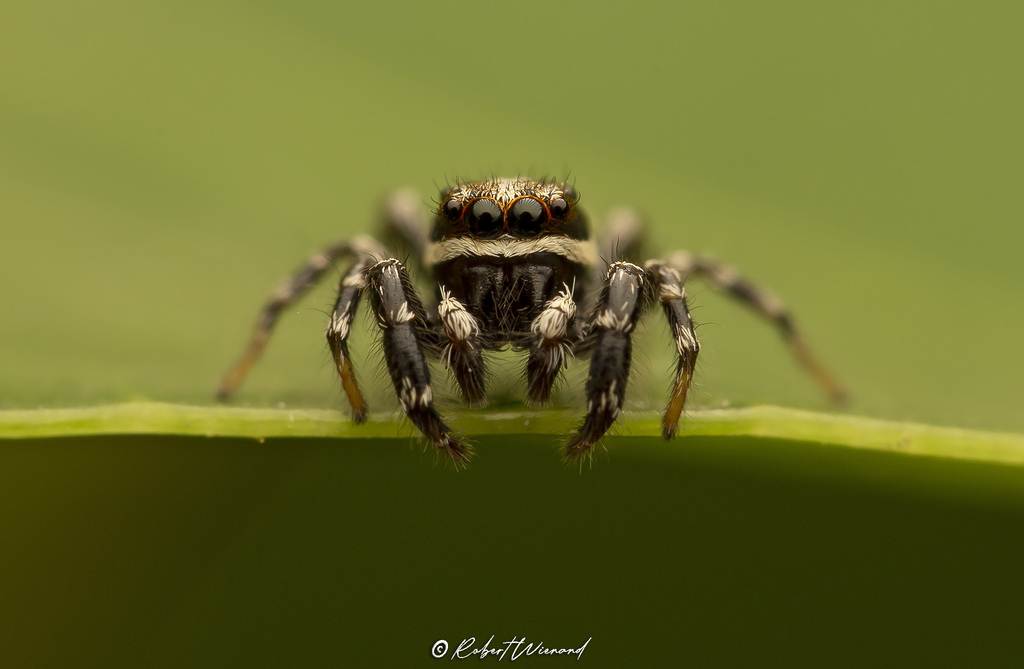
Pseudicius femineus
Pseudicius femineus is a species of jumping spider in the genus Pseudicius that is endemic to South Africa. The spider was first defined in 2013 by Wanda Wesołowska and Charles Haddad. It has a genus name that is derived from two Greek words meaning false and honest and a species name that is a Latin word for womanly. The spider is small, with a cephalothorax typically 2.1 mm (0.083 in) long and an abdomen typically 3.4 mm (0.13 in) long. The female has a pattern of eight patches on its abdomen. It is most easily distinguished from other species in the genus by its epigyne, which has a deep depression to the rear and has gonopores to the side of a pocket in the middle. Internally, the single chambered spermathecae is reached by short insemination ducts. The male has not been described.
From the article Pseudicius femineus on Wikipedia (CC BY-SA), quoted section by section
Description
Pseudicius femineus is a small spider. The female has a cephalothorax that is typically 2.1 mm (0.083 in) long and typically 1.6 mm (0.063 in) wide. The carapace is oval, flat and brown with a dense covering of grey hairs. It has a black eye field with long, brown bristles near the eyes. The rearmost end of the carapace has fine white lines. clypeus has white hairs. The sternum and mouthparts are dark brown. The abdomen is typically 3.4 mm (0.13 in) long and typically 2.2 mm (0.087 in) wide. It is elongated and dark grey with a pattern of eight patches in pairs. The underside is pale. The spinnerets are grey and the legs are yellow with dark hairs. The epigyne is very broad with a deep depression to the rear, a deep pocket towards the middle lined with gonopores. The insemination ducts are short leading to single chambered spermathecae. The species is similar to others in the genus and is most easily identified by the shape of the epigyne. For example, it is similar to the related Pseudicius maculatus but the depression is positioned to the rear of the epigyne. The male has not been described.
Range & habitat
Pseudicius spiders can be found across Afro-Eurasia and the Eastern hemisphere. Pseudicius femineus is endemic to South Africa. The holotype was found in Lovemore Park in Gqeberha during 2010. It thrives near human habitations. The holotype was found in a suburban garden, hanging from a tree.
Wikipedia: “Distribution and habitat”
Where it lives
Recorded sightings
—
geo-referenced records in GBIF, from museums, herbaria and field observers.
Drag the globe to turn it. Dots are where records exist, not a range map; darker means more records.
In the stacks
Searching the stacks…
Every page naming Pseudicius femineus in the Biodiversity Heritage Library →
This page is assembled live from iNaturalist, GBIF, Wikipedia, the Source Library and the Internet Archive. It is not yet part of the hand-edited codex. iNaturalist taxon 685996.