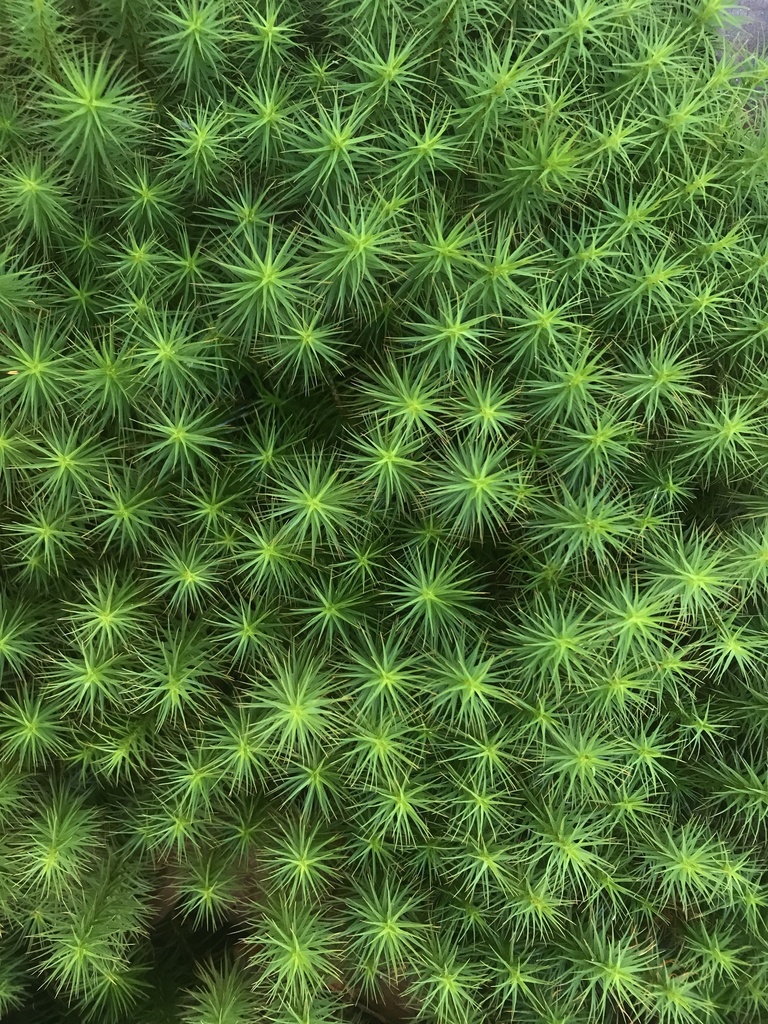
Common Haircap Moss
Polytrichum commune
Polytrichum commune (also known as common haircap, great golden maidenhair, great goldilocks, common haircap moss, or common hair moss) is a species of moss found in many regions with high humidity and rainfall. The species can be exceptionally tall for a moss with stems often exceeding 30 cm (12 in) and rarely reaching 70 cm (27.5 in), but it is most commonly found at shorter lengths of 5 to 10 cm (2 to 4 in). It is widely distributed throughout temperate and boreal latitudes in the Northern Hemisphere and also found in Mexico, several Pacific Islands including New Zealand, and also in Australia. It typically grows in bogs, wet heathland and along forest streams. Additionally, class Polytrichopsida has been shown to thrive in partially open habitats that have been recently disturbed by human activities or even livestock.
From the article Polytrichum commune on Wikipedia (CC BY-SA), quoted section by section
Description
Polytrichum commune is a medium to large moss. It is dark green in colour, but becomes brownish with age. The stems can occur in either loose or quite dense tufts, often forming extensive colonies. The stems are most typically found at lengths of 5 to 10 cm (2.0 to 3.9 in), but can be as short as 2 cm (0.79 in) or as long as 70 cm (28 in). They range in stiffness from erect to decumbent (i.e. reclining) and are usually unbranched, though in rare cases they may be forked. The leaves occur densely to rather distantly, and bracts are present proximally. The leaves typically measure 6 to 8 mm (0.24 to 0.31 in) in length, but may be up to 12 mm (0.47 in) long. When dry they are erect, but when moist they are sinuous with recurved tips and are generally spreading to broadly recurved, or sharply recurved from the base. The leaf sheath is oblong to elliptic in outline, forming an involute (i.e. with inward rolling margins) tube and clasping the stem. This sheath is typically golden yellow and shiny, and it is abruptly contracted to the narrowly lanceolate blade. Using a microscope, the marginal lamina can be seen to be level or erect, narrow, and typically 2 to 3 cells wide, though sometimes as many as 7 cells wide. It is toothed from the base of the blade up to the apex, with the teeth being unicellular and embedded in the margin. …
Where it lives
Recorded sightings
—
geo-referenced records in GBIF, from museums, herbaria and field observers.
Drag the globe to turn it. Dots are where records exist, not a range map; darker means more records.
In the stacks
Searching the stacks…
Every page naming Polytrichum commune in the Biodiversity Heritage Library →
This page is assembled live from iNaturalist, GBIF, Wikipedia, the Source Library and the Internet Archive. It is not yet part of the hand-edited codex. iNaturalist taxon 68293.