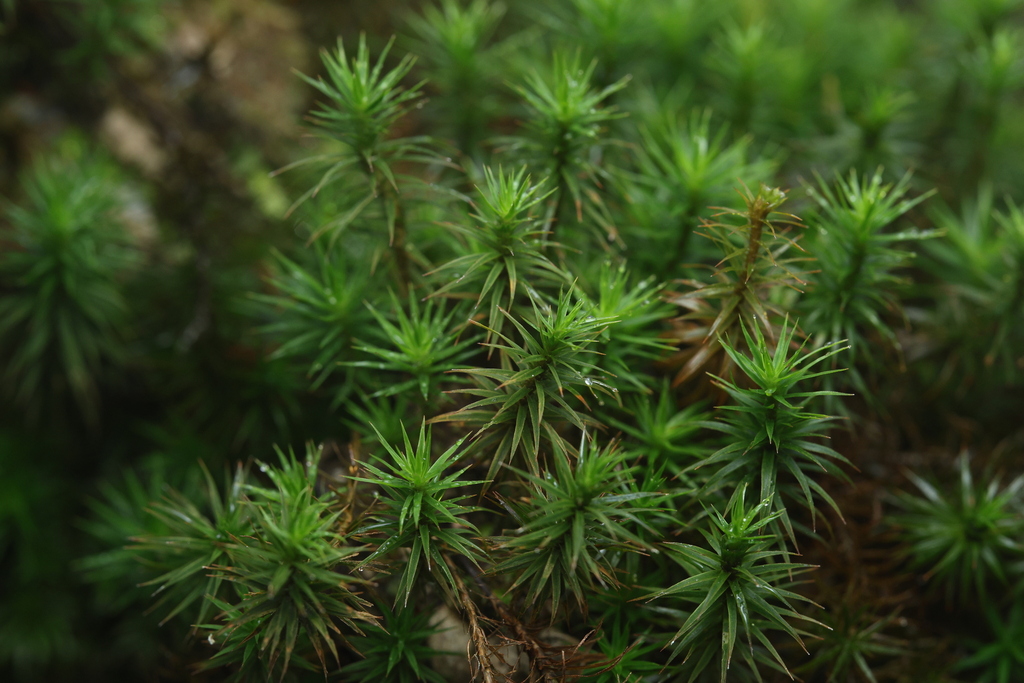
Bank Haircap Moss
Polytrichum formosum
Polytrichastrum formosum, commonly known as the bank haircap moss, is a species of moss belonging to the family Polytrichaceae.
It has a cosmopolitan distribution, found mostly in temperate latitudes in the Northern Hemisphere and especially dominant in Europe and North America. However, it has also been identified in India, China, Nepal, Japan, Algeria, Australia, New Zealand, Russia, Turkey, Syria, and the Atlantic islands (i.e. Iceland).
From the article Polytrichastrum formosum on Wikipedia (CC BY-SA), quoted section by section
Range & habitat
Polytrichastrum formosum generally inhabits shaded, poor soils and humus in damp coniferous forests and cool temperate rainforests. This species is most common in Europe and grows in grasslands, lowland heaths, acidic moorlands, rocky slopes, and old buildings.
Wikipedia: “Habitat”
What it does
Polytrichastrum formosum is sexually dioicous, meaning the male and female reproductive structures are on separate plants. P. formosum, like all members of the Polytrichaceae family, is an acrocarpous or cushion moss with reproductive structures borne at the terminus of the gametophyte stem. The perichaetial leaves surrounding the archegonia (female reproductive structure) resembles the other stem leaves besides being longer. The antheridia (male reproductive structure) are at the apex of the male gametophyte in a cup-like structure formed by perigonial leaves which are modified stem leaves. Sperm is produced in the antheridia via mitosis, and when mature they are released from the antheridia by raindrops splashing onto the cup. Sperm can be dispersed up to one meter from the male, and if they successfully reach an archegonia, the egg will be fertilized and grow into a diploid sporophyte.
Wikipedia: “Sexual reproduction”
Where it lives
Recorded sightings
—
geo-referenced records in GBIF, from museums, herbaria and field observers.
Drag the globe to turn it. Dots are where records exist, not a range map; darker means more records.
In the stacks
Searching the stacks…
Every page naming Polytrichum formosum in the Biodiversity Heritage Library →
This page is assembled live from iNaturalist, GBIF, Wikipedia, the Source Library and the Internet Archive. It is not yet part of the hand-edited codex. iNaturalist taxon 68290.