- Animals
- ›Arthropods
- ›Chelicerates
- ›Arachnids
- ›Spiders
- ›Typical Spiders
- ›Entelegyne Spiders
- ›Salticoid Spiders
- ›Jumping Spiders
- ›Typical Jumping Spiders
- ›Plexippini
- ›Plexippina
- ›Parajotus
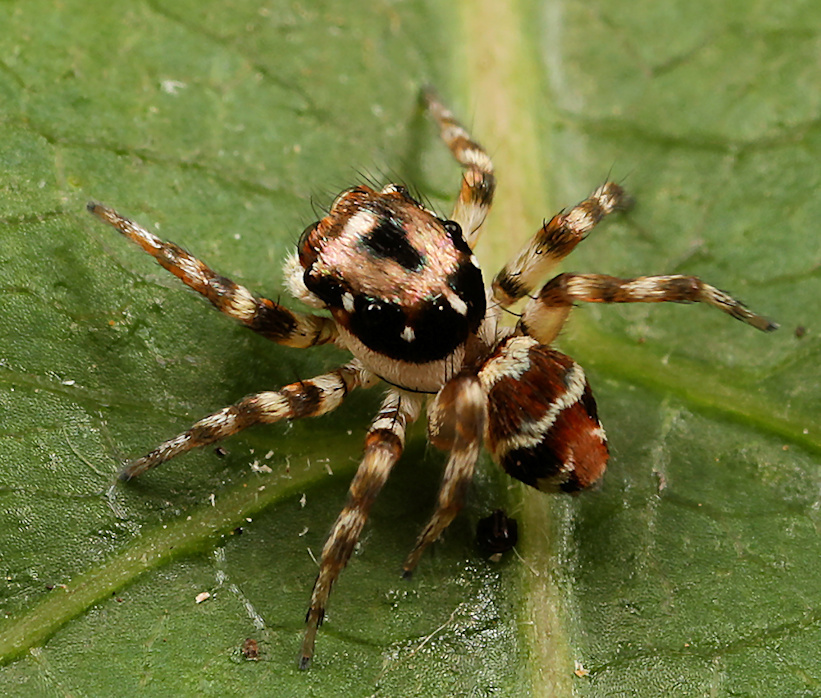
Parajotus refulgens
Parajotus refulgens is a species of jumping spider that lives in Africa. A member of the genus Parajotus, the species was first described based on a holotype from Zimbabwe and paratypes from Democratic Republic of Congo, but has been also seen in Botswana, Ivory Coast and Nigeria, and is likely to be more widespread across the continent. The spider has a dark brown round forward section or cephalothorax that is between 1.6 and 2.1 mm (0.06 and 0.08 in) long and, behind that, a greyish or reddish-brown more ovoid abdomen that is between 1.5 and 2.7 mm (0.06 and 0.11 in) long, the female being smaller than the male. This distinctive coloration help distinguish the species from its relatives. The male also has characteristic long black scale-like hairs near the rearmost set of its large central eyes. The male has long light brown or yellow legs, the female's being yellowish-white with dark grey and greyish sections.
From the article Parajotus refulgens on Wikipedia (CC BY-SA), quoted section by section
Description
Parajotus refulgens is a small spider with distinctive physical features. The spider's body is divided into two main parts: a dark round forward section or cephalothorax and, to the rear of that, a lighter more ovoid abdomen. Males of this species have a cephalothorax measuring between 1.6 and 2.1 mm (0.06 and 0.08 in) in length and between 1.2 and 1.8 mm (0.05 and 0.07 in) in width. Its carapace, the hard upper part of the cephalothorax, is high mainly dark brown with a large eye field and a nearly black area around spider's eyes. A pattern of rounded spots, three larger ones towards the front, two smaller ones towards the rear and a larger patch on the eye field, are formed of white hairs. There are wide streaks formed of white hairs on the sides of the carapace. The spider has large main eyes, twice the diameter of those at the edges, with long brown bristles along the first row of eyes, small reddish scales near the front eyes and characteristic long black scale-like hairs near the rearmost central ones. The underside of its cephalothorax, or sternum, is yellow. The part of the spider's face known as the clypeus is moderately high and has a mat of white hairs. The male has long, light-brown chelicerae with two teeth at the front and one at the back. The remainder of its mouthparts, its labium and maxillae, are orange. …
Range & habitat
Parajotus spiders are only found in Africa. Parajotus refulgens has been found in Botswana, Democratic Republic of Congo, Ivory Coast,Nigeria and Zimbabwe. It is likely that it is even more widespread across the continent. The male holotype was found at Nyamepi in Zimbabwe in 1984. Previously, in 1981, both male and female specimens had been collected near Kolwezi in what was then Zaire and later became the Democratic Republic of Congo. Other paratypes have been found near Lake Chivero in Zimbabwe and in the Okavango Delta in Botswana. The first example to be discovered in Nigeria was seen in Borgu Game Reserve, Kwara State. In Ivory Coast, it has been seen in many sites across the Lamto in the Bandama Forest. It is one of the most abundant species of jumping spider in Lamto. The spider lives in a wide range of environments. It has mainly been seen living on branches of trees and on bushes in forests. A minority were found amongst the base of grasses and in savanna. It had also been found in debris by the side of rivers and occasionally living on granite boulders.
Wikipedia: “Distribution and habitat”
In human culture
Parajotus refulgens is a species of jumping spider, a member of the family Salticidae, that was first described by the arachnologist Wanda Wesołowska in 2000. It was one of over 500 species described by Wesołowska during her career, making her one of the most prolific in the field. The holotype is stored at the Natural History Museum of Zimbabwe in Bulawayo. It has a name derived from the Latin word refulgens, which can be translated as 'dazzling'. Wesołowska allocated the spider to the genus Parajotus, first circumscribed in 1903 by George and Elizabeth Peckham. The genus only contains a few species. Spiders in the genus resemble those in the genus Jotus. In 2015, Wayne Maddison listed the genus in the subtribe Plexippina, which is part of the tribe Plexippini. He considered this provisional as it is based on the shape of the spider's body and the presence of tufts near its eyes. He allocated the tribe to the subclade Simonida in the clade Saltafresia in the clade Salticoida. In 2017, Jerzy Prószyński allocated the genus to a group of genera that he called Hyllines.
Wikipedia: “Taxonomy and etymology”
Where it lives
Recorded sightings
—
geo-referenced records in GBIF, from museums, herbaria and field observers.
Drag the globe to turn it. Dots are where records exist, not a range map; darker means more records.
In the stacks
Searching the stacks…
Every page naming Parajotus refulgens in the Biodiversity Heritage Library →
This page is assembled live from iNaturalist, GBIF, Wikipedia, the Source Library and the Internet Archive. It is not yet part of the hand-edited codex. iNaturalist taxon 681428.